Cut Resistant Gloves A1-A9: The Complete Buyer’s Guide to ANSI/ISEA 105 Levels
Cut resistance is the single most requested glove spec in North American industrial procurement — and the ANSI/ISEA 105 scale, running from A1 to A9, is how that spec gets written into purchase orders. Yet walk into any distributor’s office and you will still find spec sheets where "cut resistant" means nothing more than a knit glove with a coating. A1 and A8 are both "cut resistant." They are separated by roughly a twelve-fold difference in measured force, and handing an A1 glove to a worker handling sheet metal is not a purchasing mistake — it is a liability event.
This guide is written for importers, distributors and brand owners who buy cut resistant gloves from OEM/ODM manufacturers like IAN Safety Gloves. It explains exactly what each ANSI level means, how the TDM-100 test behind it works, how abrasion and puncture ratings sit alongside the cut score, how the scale converts against EN 388 for mixed-market customers, and how to build a sellable A1–A9 range instead of guessing. For the category overview, start at our ANSI cut level A1–A9 glove collection.
What ANSI/ISEA 105 Actually Measures
ANSI/ISEA 105 is the North American standard for hand protection performance, maintained by the International Safety Equipment Association. The current edition is ANSI/ISEA 105-2024, which refined the labeling but kept the same cut scale introduced in the landmark 2016 revision.
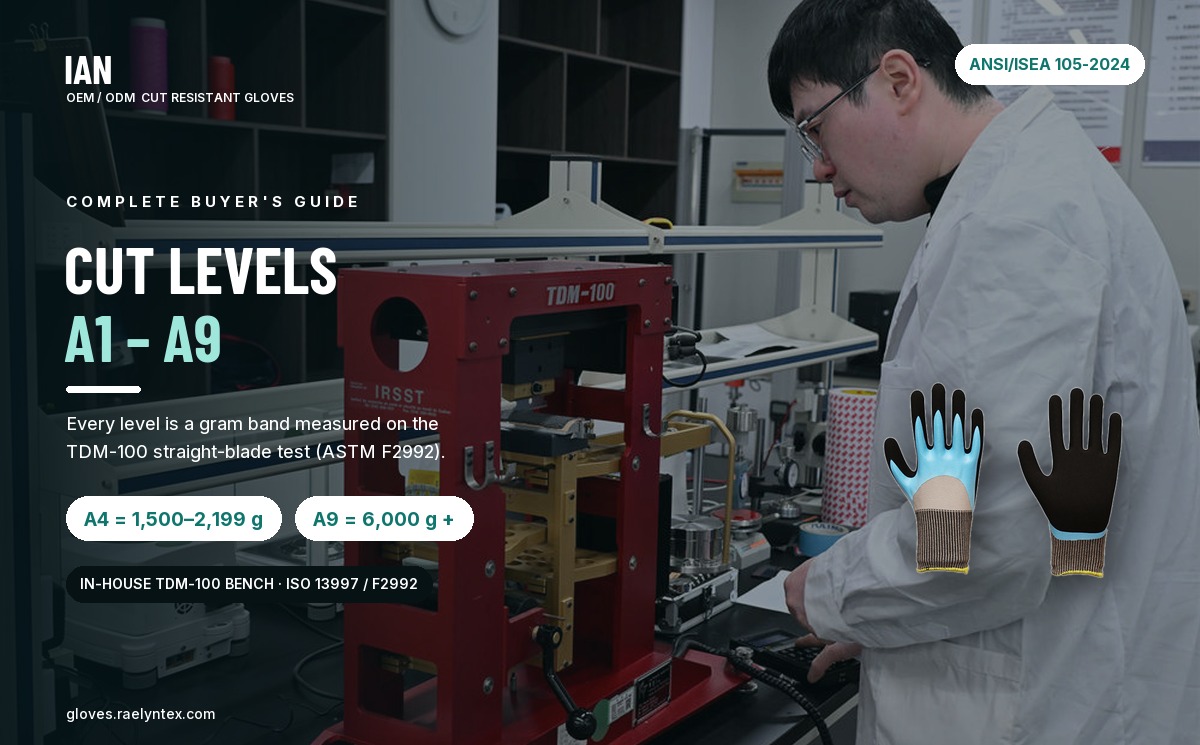
The important change of 2016 — retained in 2024 — is that cut resistance is no longer scored by a rotating blade. It is measured on a TDM-100 machine under ASTM F2992: a straight blade is drawn across the glove material under a controlled load, and the machine records the force, in grams, at which the blade cuts through within a 20 mm travel. Each cut uses a fresh blade, which is what makes the result repeatable even on high-performance fibers that would quickly dull a rotating blade.
That gram-force figure is what the A1–A9 scale bins. One level does not describe "a bit more protection" in vague marketing terms — it describes a specific, lab-measured gram band that any accredited test report can verify. When you source from an OEM factory, this is the number that must appear on the test report, not just the marketing copy: a claim of "ANSI A4" is meaningless unless the underlying ASTM F2992 result falls between 1,500 and 2,199 grams.
The 2024 edition also standardized the marking. Cut, abrasion and puncture now appear on a pentagon pictogram — the cut level printed large at the top, abrasion on the left, puncture on the right, and an "X" for any rating that was not tested. If you private-label gloves for the US market, this pentagon (not the older shield) is what your artwork should carry.
The A1–A9 Cut Ladder, Level by Level
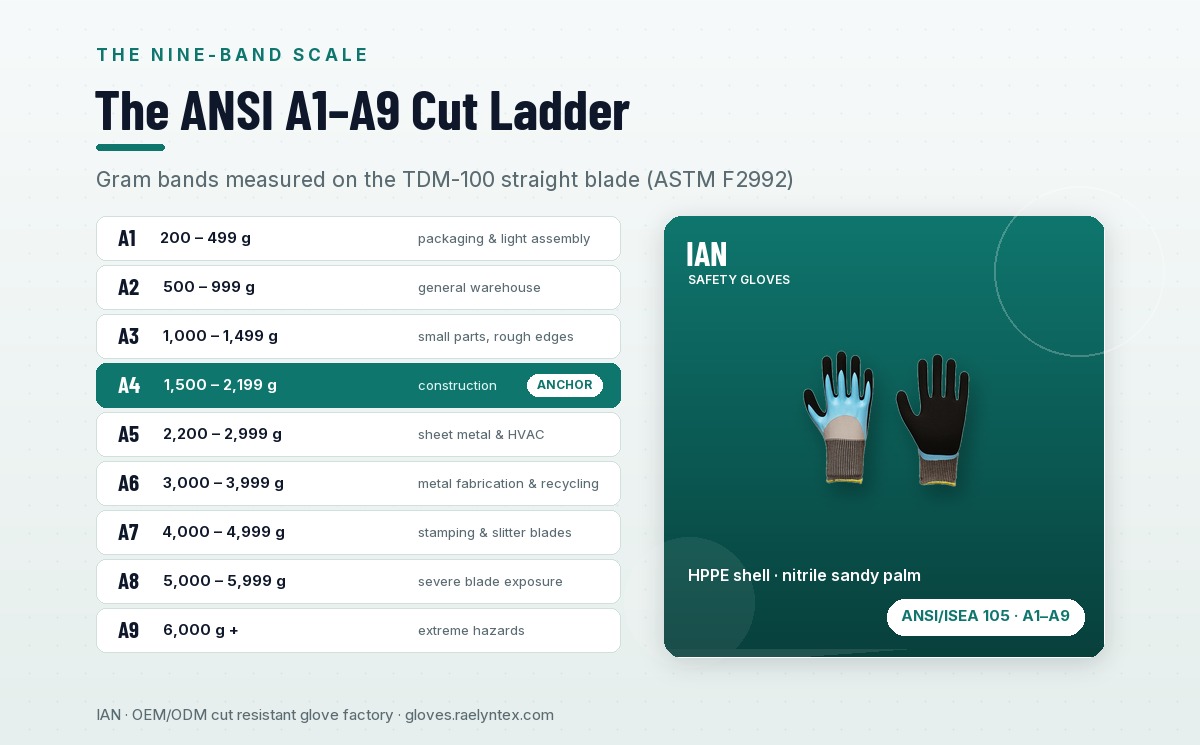
Here is the complete scale as it appears under ANSI/ISEA 105, with the gram bands measured on the TDM-100:
| Level | Grams to cut (ASTM F2992) | Typical tasks |
|---|---|---|
| A1 | 200 – 499 g | Packaging, cardboard handling, light assembly, general warehouse |
| A2 | 500 – 999 g | General warehouse, light automotive, small parts with occasional edges |
| A3 | 1,000 – 1,499 g | Small parts with rough edges, appliance assembly, carton slitting |
| A4 | 1,500 – 2,199 g | Construction, light metal handling, HVAC, drywall, glass handling (light) |
| A5 | 2,200 – 2,999 g | Sheet metal, HVAC ducting, sharper stampings, blade-handling tasks |
| A6 | 3,000 – 3,999 g | Metal fabrication, stamping, recycling, glass manufacturing, blade changes |
| A7 | 4,000 – 4,999 g | Heavy metal stamping, slitter blade changes, pulp and paper |
| A8 | 5,000 – 5,999 g | Severe blade exposure, heavy recycling and metal conversion |
| A9 | 6,000 g and above | Extreme cut hazards; the highest rating under the standard |
Three readings of this table are worth making explicit.
First, the levels are not evenly spaced. A4 begins 50% above A3’s floor and A5 sits 46% above A4’s ceiling — the top of the scale compresses far more protective performance into each band. This is why serious buyers treat the gram numbers, not just the letter, as the real spec: two "A4" gloves from different factories can land at 1,510 g and 2,180 g, and the second is a meaningfully better glove even though both are labeled A4.
Second, the distribution of real demand is a pyramid. The majority of industrial volume lives between A2 and A5 — warehouse, automotive assembly, HVAC, construction. A6 and above is real but specialized: metal fabrication, stamping, recycling and glass. When we plan a private-label cut program for a distributor, we typically weight the assortment roughly: 20% at A2–A3, 45% at A4–A5, 25% at A6, and a 10% halo of A7+ for credibility. An A4 nitrile-coated cut resistant glove is usually the anchor SKU of that program.
Third, "higher is better" is wrong. An A9 glove for carton handling wastes money and, more importantly, dexterity — workers quietly remove over-specced gloves, and removed gloves protect no one. The correct sell is matching the level to the hazard assessment, which is also exactly what OSHA 29 CFR 1910.138 expects employers to document: a PPE selection based on the actual hazard, not the biggest number on the shelf.
Cut Is One Digit: Abrasion and Puncture Complete the Spec
The A-level is only one of three performance ratings ANSI/ISEA 105 reports. A complete spec sheet for a cut resistant glove should carry all of them.
Abrasion resistance (0–6). Measured by rotating abrasion cycles — ASTM D3389 for coated gloves, ASTM D3884 for uncoated — under a defined load. Level 1 requires at least 100 cycles at 500 g, level 3 at least 1,000 cycles, level 4 at least 3,000 cycles at 1,000 g, level 5 at least 10,000 cycles and level 6 at least 20,000 cycles. For distributors, abrasion is the "returns killer" rating: a glove can carry a respectable cut score and still die in three days if the coating wears through at the fingertips. A durable A6 sandy nitrile glove earns repeat orders precisely because the sandy coating holds its grip texture as it abrades.
Puncture resistance (0–5). A sharp steel probe is pushed through the palm material; level 1 requires at least 10 N, level 2 at least 20 N, level 3 at least 60 N, level 4 at least 100 N and level 5 at least 150 N. Note the physics: puncture and cut are different failure modes. A thick nitrile coating resists a blunt probe far better than an HPPE knit does, while the knit may out-cut the coating. Nail guns, scrap metal and construction debris are puncture problems, not cut problems.
Needlestick puncture (ASTM F2878, separate 0–5 scale). Hypodermic needles get their own classification because a knit fabric that stops a blunt probe will let a 25-gauge needle straight through. Waste handling, sanitation and public-safety buyers must ask for this rating explicitly — it appears on the test report, not on the main pictogram.
Impact protection lives outside this standard entirely. Back-of-hand impact is scored under ANSI/ISEA 138, and a cut glove that also needs TPR armor — such as our A5 TPR sandy nitrile impact glove — carries the two ratings on separate documentation. Never let a spec sheet imply that a cut score covers impact.
ANSI A1–A9 vs EN 388: Converting for Mixed-Market Customers
If you sell into both North America and Europe, you will be asked to convert between the two scales. The honest answer is that they are different tests and cannot be legally relabeled — but they are technically comparable, and we publish the mapping in detail in our EN 388 vs ANSI/ISEA 105 comparison guide.
The short version:
-
Units differ. ANSI reports grams of force; EN 388’s TDM result (letters A–F) reports newtons under ISO 13997. One newton ≈ 102 grams-force, so an EN 388 level C (10 N) lands near ANSI A3 territory, and level F (30 N, about 3,059 g) maps somewhere in the A6–A9 band — but "somewhere" is exactly the problem: EN 388 stops reporting at F, while ANSI keeps climbing to 6,000 g and beyond.
-
A glove must be tested under each method to carry each mark. A CE-marked EN 388 "4X43F" glove cannot be stamped "ANSI A8" without a fresh ASTM F2992 report. When IAN builds a program for a customer selling into both markets, we run both test protocols on the same shell so the artwork for each market is genuine.
-
The other four EN 388 digits do not translate to the pentagon. Abrasion and puncture exist in both standards on different scales; tear and coup cut exist only in EN 388. If your customers read the European code, send them to our six-digit EN 388 pictogram decoder.
For European customers, the equivalent deep-dive is our guide to EN 388 levels A–F for German procurement — the selection logic mirrors this article level-for-level, just with different paperwork.
Matching Levels to Tasks: Building the Range
A sellable cut program is a ladder, not a single SKU. Here is how we map the levels for distributors building an assortment:
A1–A2 — the volume floor. Packaging, receiving, general warehouse and light assembly. These gloves live on thin HPPE or polyester blends with light PU or nitrile palm coatings, where dexterity is the selling point. Our A2 cut resistant nitrile glove is the classic MRO starter item, and our A3 dotted-palm cut glove bridges into small-parts work where customers want visible grip texture on the shelf.
A3–A4 — the mid-market core. Appliance, HVAC, automotive tier suppliers, construction trades. This is where 13-gauge seamless liners matter: workers accept a higher-cut glove only when it still feels like a second skin. The A4 nitrile-coated glove linked above is our anchor SKU for exactly this reason — HPPE-blend shell, sandy nitrile palm, and a gram result comfortably above the A4 floor so the label claim never sits on the band edge.
A5–A6 — the specialty band. Sheet metal, ducting, stamping, recycling. Coatings get heavier (sandy nitrile dominates), liners may add fiberglass or steel, and shells often pair with impact armor. Our A5 cut resistant nitrile glove and A6 Kevlar-blend nitrile glove cover the two most common configurations buyers specify in this band.
A7–A9 — the credibility halo. Slitter blades, severe recycling, glass conversion. Volume is smaller, but a supplier who can genuinely deliver A7+ shells — with matching test reports — is taken seriously on the whole ladder. Ask to see gram values, not just letters.
For buyers who want the broader context of how the whole cut category is built — fibers, coatings, gauges and construction — we maintain a separate pillar guide on cut resistant glove levels and materials, and a vertical page for metalworking and glass manufacturing programs. The parent cut resistant gloves category ties the full assortment together.
What Actually Moves a Shell’s Cut Level
When an OEM quotation quotes the same "cut glove" at three different prices, the difference is usually one or more of the following levers:
1. High-performance fiber content. HPPE (ultra-high molecular weight polyethylene) is the workhorse — cut performance at low weight. Aramid (Kevlar-type) adds heat resistance and higher cut stability; fiberglass and steel fiber push the top of the ladder but cost dexterity and irritate some skin. The shell recipe is why an A2 shell and an A6 shell can look superficially identical.
2. Gauge and construction. A 13-gauge liner with HPPE wrap can carry A4 while staying thin enough for precision work; 18-gauge shells trade some cut performance for feel. Doubling-up fibers on the palm — rather than the whole shell — concentrates protection where the blade meets the hand and keeps the back breathable.
3. Coating choice and thickness. The coating contributes little to the cut score but a lot to grip, abrasion and oil resistance. Sandy nitrile dominates A5–A6 programs because the textured finish keeps grip on oily stampings. Foam nitrile breathes better but sacrifices some texture life. A PU coating keeps A1–A3 gloves slim and dry-feeling.
4. Batch-level testing discipline. This is the lever buyers never see and the one that most often separates a real manufacturer from a trader with a catalog. Cut levels must be verified per production lot on the same TDM-100 method the certificate is built on. At our own facility we run TDM-100 pre-testing on site before any third-party round — the same discipline we described in our 2026 factory certification update on the EN 388 side. An A4 label backed by a 1,550 g result is fragile; the same shell verified at 1,900 g survives the buyer’s own lab audit.
Sourcing Notes for Importers and Private-Label Buyers
If you are building a private-label cut range with an OEM partner, these are the points that decide whether the program runs smoothly:
-
Ask for the gram value, not just the letter. The test report behind every claimed level should show the ASTM F2992 gram result and the lab that produced it. We attach both to every private-label certification pack.
-
Plan the ladder deliberately. Two or three levels in one consistent shell family (same look, different gram bands) outsells nine disconnected SKUs. It also halves your SKU-management burden on the shelf.
-
Confirm the 2024 marking early. If your market uses the pentagon pictogram, get the artwork into the sampling round — late artwork changes are the classic cause of delayed containers. Our team handles US, EU and dual-marking artwork as part of the OEM service described in our US hand-protection compliance guide and the US distributor program.
-
Sample before the container. Cut gloves feel different at the same gram level depending on gauge and coating. A trial order across the ladder — one SKU per level — is the cheapest possible insurance on a 40-foot commitment.
-
Match coating to the actual workplace. Oily stamping: sandy nitrile. Dry parts: PU or foam nitrile. Mixed indoor/outdoor: consider the cold-flexibility lessons in our winter glove guide before locking the recipe.
Quick Reference: The Five-Spec Checklist
Before approving any cut glove spec, write these five lines into your purchase documents:
-
Cut level A1–A9 with the gram value, per ASTM F2992 (TDM-100).
-
Abrasion level 0–6 with cycles, per ASTM D3389/D3884.
-
Puncture level 0–5 in newtons; add ASTM F2878 needlestick if the task involves sharps waste.
-
Liner and coating construction (gauge, fiber, coating type) — the physical story behind the number.
-
Marking artwork: ANSI pentagon for North America, EN 388 code where CE documentation applies.
Conclusion: Buy the Band, Verify the Report, Build the Ladder
The ANSI/ISEA 105 scale rewards buyers who read it precisely. A1 through A9 is not marketing shorthand — it is a nine-band measurement with published gram thresholds, backed by a repeatable straight-blade test and a standardized pentagon marking. The winners in the cut category are importers who specify gram values, demand batch-level verification, and assemble a deliberate A2-to-A6 ladder matched to their customers’ real hazards.
IAN manufactures cut resistant gloves across the full A1–A9 range as an OEM/ODM supplier — shell engineering, coating recipes, in-house TDM-100 pre-testing and private-label certification packs are all in-house. Browse the ANSI cut level collection or the complete product catalog, then contact our export team with your target levels and markets. A short spec conversation usually shortens the sampling round by weeks.