OSHA 29 CFR 1910.138 Explained: Hand Protection Requirements for US Employers
Hand injuries are among the most common and most preventable injuries in US workplaces — and they are also one of the first things an OSHA compliance officer looks at during an inspection. The rule that governs them is short, performance-based, and often misread: 29 CFR 1910.138, the hand protection standard for general industry.
This guide explains what 1910.138 actually requires, the seven hazard categories it names, how to select and document compliant hand protection, and what records an inspector will ask to see. It is written for safety managers, plant managers, and procurement teams who buy work gloves for US operations.
What OSHA 29 CFR 1910.138 Actually Requires
The standard has two paragraphs, and both matter:
-
1910.138(a) — General requirements. Employers shall select and require employees to use appropriate hand protection when employees’ hands are exposed to hazards. Providing gloves is not enough; use must be enforced.
-
1910.138(b) — Selection. Employers shall base the selection of hand protection on an evaluation of the performance characteristics of the glove relative to the task, the conditions present, the duration of use, and the hazards and potential hazards identified.
Read together, the standard imposes three duties: identify the hazards, select gloves that perform against those specific hazards, and require their use. It applies to general industry workplaces under OSHA’s Part 1910 standards.
The Seven Hazard Categories Named in the Standard
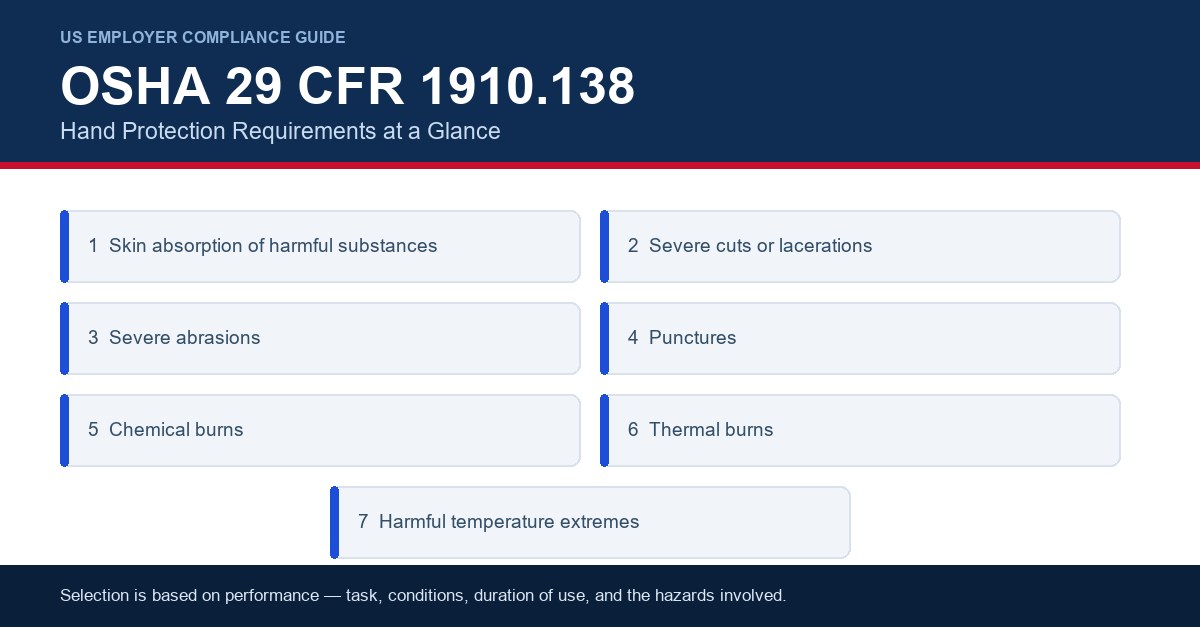
1910.138(a) lists the exposures that trigger the duty to provide hand protection:
| # | Hazard named in 1910.138(a) | Typical trigger tasks |
|---|---|---|
| 1 | Skin absorption of harmful substances | Handling solvents, pesticides, epoxy resins |
| 2 | Severe cuts or lacerations | Sheet metal, stamping, glass, blade work |
| 3 | Severe abrasions | Concrete, castings, masonry, rough stock |
| 4 | Punctures | Wire, recycling, sharps and scrap sorting |
| 5 | Chemical burns | Degreasing, plating, parts washing |
| 6 | Thermal burns | Hot surfaces, welding support, foundry work |
| 7 | Harmful temperature extremes | Freezers, cold stores, hot stamping |
If any employee’s hands face even one of these exposures, the employer must provide — and enforce — appropriate protection.
What OSHA Does Not Require — A Common Misconception
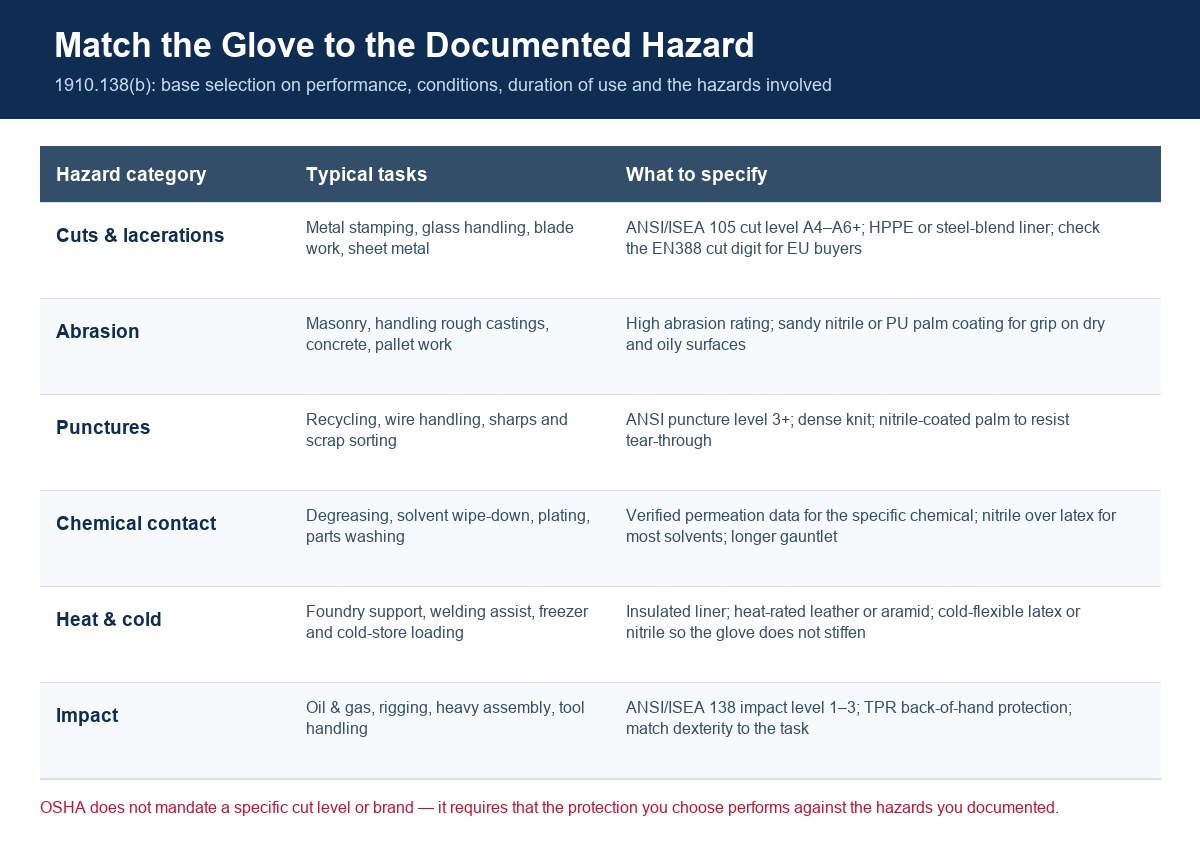
1910.138 is performance-based. It does not mandate a specific cut level, a specific brand, a specific certification mark, or a minimum rating. OSHA tells you what the glove must do, not what label it must carry.
That said, "performance characteristics" need evidence. This is where consensus standards become practical:
-
ANSI/ISEA 105-2016 rates cut resistance (A1–A9), abrasion (1–6) and puncture (1–5) using standardized lab methods. Citing a cut level on your hazard documentation is far stronger than writing "cut-resistant glove".
-
ANSI/ISEA 138-2019 rates impact protection (Levels 1–3) for the back of the hand — relevant for oil and gas, rigging and heavy assembly work.
For buyers sourcing from overseas factories, the same test methods underpin the EN388 pictogram used in Europe, so a supplier that tests to both standards can support a US program and an EU program from the same product file.
How to Build a Compliant Hand Protection Program
Step 1 — Conduct and document a hazard assessment
The umbrella PPE standard, 1910.132(d), requires a walk-through hazard assessment by task and area — and a written certification of that assessment showing the workplace evaluated, the person certifying, and the date. This certification is the single most requested record in an inspection. Review our glove range against your hazard list.
Step 2 — Select gloves by documented performance
Match each hazard to a glove with published test data: cut level A4 or higher for sharp metal and glass, nitrile chemical gloves with verified permeation data for solvents, impact-rated gloves with TPR back-of-hand protection for rigging and heavy assembly. For chemical work, never rely on a generic "chemical resistant" label — ask for the permeation breakthrough time for the specific chemicals in use.
Step 3 — Verify the glove fits the job conditions
Duration, temperature, grip surface and dexterity all affect real-world performance. A glove that passes a lab test can fail on a wet, oily line after four hours of wear. Pilot the glove on the actual job before rolling it out plant-wide.
Step 4 — Train and enforce use
Under 1910.132(f), employees must be trained on when hand protection is necessary, its limitations, and how to inspect, wear and care for it. Remember that 1910.138(a) says "select and require" — gloves sitting in a toolbox do not satisfy the standard.
Step 5 — Reassess after changes and incidents
Update the hazard assessment when processes, chemicals or machinery change, and after any hand injury. Repeated small lacerations are evidence your selection is underperforming — and inspectors notice patterns.
What Records Inspectors Ask For
-
Written certification of the PPE hazard assessment (1910.132(d))
-
Glove specification sheets with test ratings matched to each task
-
Chemical permeation data for chemical-handling areas
-
Training records with dates, content and attendee signatures
-
Proof that PPE is provided at no cost to employees (1910.132(h))
Common Violations Under 1910.138
-
No documented hazard assessment. The most frequent citation chain starts at 1910.132(d), not 1910.138 itself.
-
Gloves available but not required or enforced.
-
Wrong glove for the chemical. Latex or leather used against solvents that demand nitrile or a laminated barrier film.
-
One size for everyone. Poorly fitting gloves are removed by workers — an enforcement and injury problem at once. Size programs correctly from the start: see our work glove size guide.
-
No training records.
FAQ
Does OSHA require ANSI-rated gloves?
No. 1910.138 is performance-based and names no specific rating. However, citing ANSI/ISEA 105 or 138 levels in your hazard documentation is the clearest way to demonstrate that selection was performance-based.
What cut level do I need?
It depends on your documented hazard — there is no universal minimum. As a market practice, general handling sits around A2–A3, sharp metal and glass typically justify A4–A6, and extreme blade hazards go higher. Match the level to the task, not the budget.
Who pays for the gloves?
The employer. Under 1910.132(h), PPE required by OSHA standards must be provided at no cost to employees, with limited exceptions for everyday items like non-specialty safety-toe footwear.
How does 1910.138 relate to 1910.132?
1910.132 is the umbrella PPE standard covering hazard assessment, training and payment. 1910.138 adds the hand-specific duty: select appropriate protection for the listed hazards. Inspectors typically cite both together when hand protection is missing or inadequate.
Do chemical-resistant gloves need a certificate?
OSHA does not certify gloves, but your selection must be defensible. Request permeation test data (breakthrough time and degradation) for the specific chemicals handled, and document why the chosen glove meets the exposure.
The Bottom Line
1910.138 compliance comes down to a documented chain: hazards identified, gloves selected against them with real performance data, use enforced, and training recorded. If your current glove program cannot show that chain, it is one inspection away from a citation.
Send us your hazard list and our team will recommend gloves with matching ANSI/ISEA and EN388 test data — including sample sets for pilot testing before you commit to a plant-wide rollout.