Cut Resistant Gloves: Levels, Materials, Applications & Buyer’s Guide
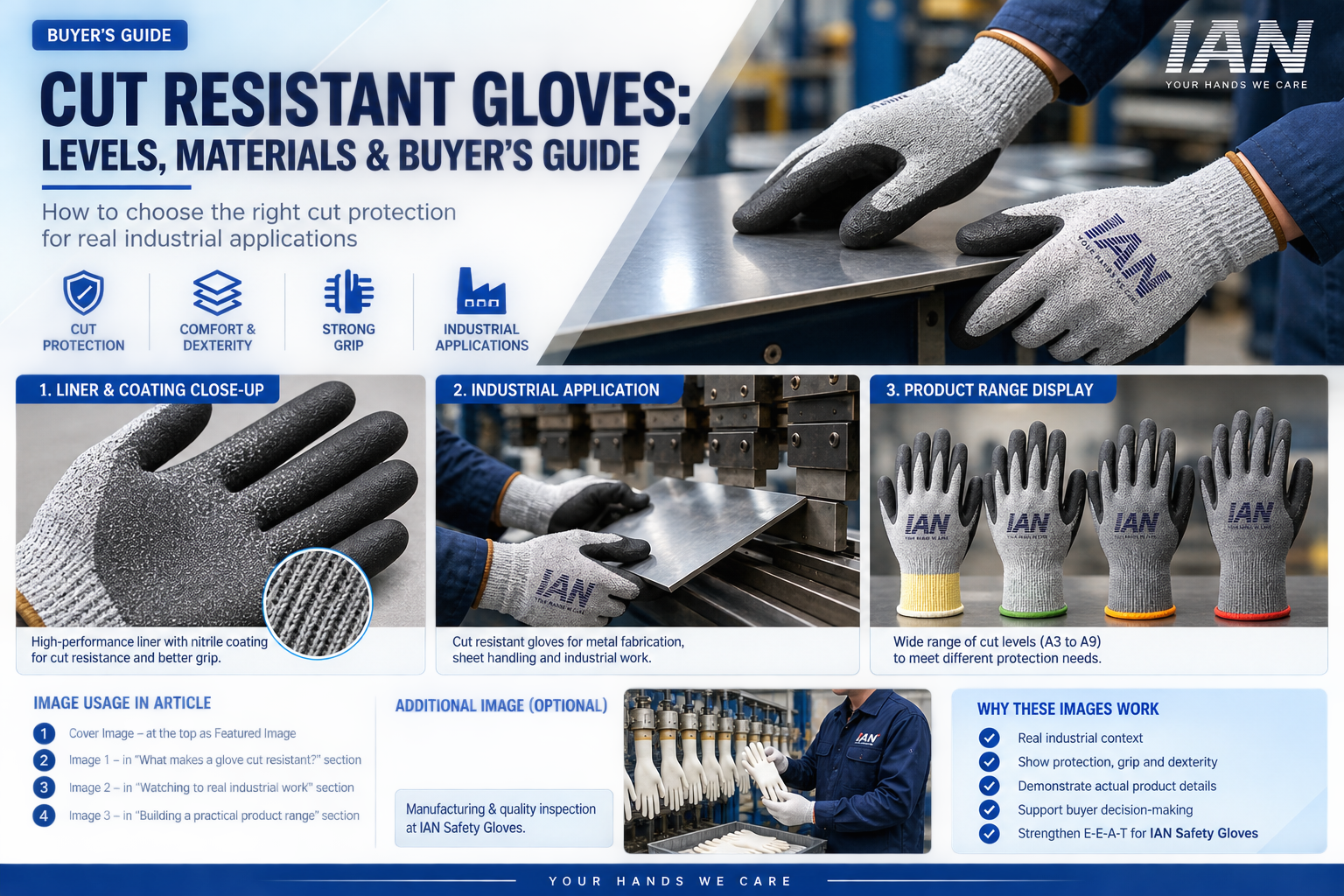
A cut rating can tell you how a glove performed in a standardized test. It cannot tell you, by itself, whether that glove is the right choice for someone handling oily sheet metal for eight hours a day.
That distinction matters when buying cut resistant gloves for industrial use.
A metal fabricator may need protection from sharp edges but also enough grip to control large components. An automotive supplier may be more concerned about dexterity during repetitive assembly. A distributor building a PPE range has another problem: choosing specifications that cover meaningful differences in customer needs without stocking several gloves that perform almost the same job.
For these buyers, selecting a cut resistant glove is less about finding the highest number on a datasheet and more about understanding how cut level, liner construction, coating, grip and working conditions fit together.
Start with the hazard, not the glove
Before comparing glove specifications, look at what workers actually handle.
Is the material thin sheet metal with exposed edges? Stamped automotive parts? Glass? Rough fabricated components? Are the parts dry, slightly oily or heavily contaminated with fluids? Does the worker hold large objects or perform fine assembly?
These details change the type of glove that makes sense.
Consider two factories that both request “cut resistant work gloves.”
The first moves unfinished metal sheets between production processes. Workers need cut protection, but losing control of a sheet because of poor grip creates another hazard.
The second assembles smaller components. Here, an unnecessarily bulky glove may reduce finger control and make repetitive work more difficult.
Both need cut protection. They do not necessarily need the same glove.
What actually gives a glove cut resistance?
For knitted industrial gloves, much of the cut performance comes from the liner and yarn construction.
Modern cut-resistant liners can use high-performance fibers and engineered yarn combinations to increase resistance to cutting while keeping the glove practical enough for industrial work.
HPPE is commonly associated with cut-resistant glove construction, but a material name alone does not define the finished glove.
Yarn composition, liner structure, glove gauge and reinforcement can all influence the final result. The palm coating then adds another layer of performance by affecting grip, abrasion behavior and handling characteristics.
This is why purchasing solely from a description such as “HPPE cut resistant glove” leaves important questions unanswered.
For a B2B quotation, more useful information includes the required cut level, liner construction, coating type, gauge, sizes and intended application.
Understanding ANSI cut levels
For buyers serving the North American market, ANSI/ISEA 105 is one of the important references for hand-protection performance.
The current ANSI/ISEA 105-2024 standard classifies cut resistance across nine levels, A1 through A9. Higher classifications represent resistance to greater cutting force under the specified test method.
That scale is useful for comparing performance, but it should not become a shortcut for glove selection.
A higher cut level is not automatically the best specification for every workplace.
Increasing protection can involve trade-offs in areas that matter to the person wearing the glove: dexterity, tactile sensitivity, weight, flexibility and cost.
For procurement teams, the better question is therefore not:
“What is your highest cut level?”
It is:
“What level and construction are appropriate for the hazard and task we are supplying?”
We will cover the ANSI A1–A9 levels and their test thresholds separately in a dedicated guide, rather than turning this buyer’s guide into a table of numbers.
ANSI and EN 388 should not be treated as the same rating
International buyers may also encounter EN 388, particularly when sourcing gloves for European and other markets.
ANSI/ISEA 105 and EN 388 are different standards and use different classification systems. A buyer should therefore avoid comparing an ANSI designation and an EN 388 marking as though the letters or numbers were directly interchangeable.
This becomes especially important when comparing quotations from several suppliers.
Ask which standard was used, which test method supports the stated performance and what documentation is available for the product being quoted.
A vague claim such as “high cut protection” provides far less purchasing value than a clearly identified performance rating backed by the appropriate test information.
The liner is only half of the selection
Cut protection receives most of the attention, but the worker usually interacts with the object through the coated palm and fingers.
That makes coating selection important.
Nitrile-coated cut resistant gloves
Nitrile coatings are widely used in industrial work gloves where buyers are looking for a combination of grip, wear resistance and practical handling performance.
But “nitrile coated” still does not describe one single surface.
Smooth and textured finishes can behave differently, particularly when handling components under different working conditions.
If grip is important to the application, ask about the actual coating finish rather than specifying nitrile alone.
PU-coated cut resistant gloves
PU coatings are often selected when a relatively thin coating and dexterity are important.
For applications involving smaller components or more precise finger movement, that can make a meaningful difference to the wearer.
Again, the decision should follow the task.
A coating that works well for dry precision handling is not automatically the preferred solution for every metalworking environment.
Gauge and dexterity deserve attention
Glove gauge is sometimes treated as a secondary specification, but buyers should not ignore it.
A finer knitted construction can contribute to a closer-fitting glove and better finger movement, although gauge by itself does not determine protection or comfort.
The finished glove needs to be evaluated as a complete system:
liner + yarn construction + gauge + coating + fit.
This matters particularly for workers who wear gloves continuously rather than only for occasional hazardous handling.
A glove can meet a protection requirement on paper and still be a poor operational choice if workers repeatedly remove it to perform ordinary tasks.
Matching cut resistant gloves to real industrial work
Rather than choosing from a generic list of industries, it is more useful to look at the handling problem inside the industry.
Sheet metal and fabrication
Sharp or unfinished edges make cut protection an obvious requirement.
At the same time, workers need enough grip to maintain control of the workpiece. The size, weight, surface condition and presence of oil should all be considered when choosing the coating and protection level.
Automotive and component manufacturing
The hazard can vary substantially between stamping, component handling, assembly and maintenance.
Some operations prioritize higher protection around sharp components, while repetitive assembly may place greater emphasis on dexterity and long-wear comfort.
Glass handling
Cut protection is important, but so is secure handling.
The correct specification depends on the glass product, edge condition, handling process and other hazards present in the workplace.
Machinery and industrial maintenance
Maintenance workers can encounter sheet metal, machined components, sharp edges and a wide variety of surfaces during the same shift.
For distributors serving these customers, versatility can be more valuable than optimizing a glove for one narrowly defined production operation.
What should an industrial buyer put in an RFQ?
A surprisingly large number of glove inquiries begin with only a product name and quantity.
For standard commodity products that may be enough to start a conversation. For cut resistant gloves, it often isn’t.
Providing several pieces of application information can make supplier recommendations much more useful:
-
intended application;
-
material or component being handled;
-
required cut standard and protection level, if already specified;
-
dry, oily or other handling conditions;
-
preferred palm coating;
-
glove sizes;
-
estimated order quantity;
-
packaging requirements;
-
private-label or logo requirements;
-
destination market.
If the buyer does not yet know the required cut level, describing the application is still worthwhile.
“Cut gloves for handling stamped steel components with light oil” gives a supplier much more to work with than “send price for cut resistant gloves.”
Samples matter more than specifications suggest
Two gloves can look remarkably similar in photographs.
They can even share several headline specifications.
That does not mean they will feel the same during work.
Fit, coating feel, flexibility, finger movement and grip are difficult to judge from a spreadsheet. For distributors, importers and PPE brands evaluating a new construction, samples provide an opportunity to compare those characteristics before committing to bulk production.
Where possible, evaluate the sample in conditions that resemble the intended application rather than judging it only by appearance.
For an OEM program, the approved sample also helps establish a clearer reference for the construction expected in production.
Building a practical product range
A distributor does not necessarily benefit from carrying five cut resistant gloves that differ only slightly.
A more useful range gives customers clear reasons to move from one model to another.
For example, one glove may focus on dexterity for lighter handling. Another may combine stronger cut protection with a coating suited to demanding industrial handling. A third may address applications where substantially higher cut resistance is required.
The exact range depends on the customers being served, but the principle is useful:
each SKU should solve a recognizable purchasing problem.
This also makes product pages, sales discussions and inventory decisions easier to manage.
Questions to ask before approving a supplier
When comparing manufacturers, price should be evaluated alongside the specification behind the quotation.
Ask what liner and coating construction is being offered.
Confirm the cut-performance standard being referenced and the documentation available for the quoted product.
For private-label programs, confirm sizes, colors, branding, packaging, MOQ and sample arrangements before approving production.
It is also worth clarifying whether the bulk product will follow the construction of the approved sample.
For a distributor putting its own name on a safety product, consistency is not a minor purchasing detail.
Choosing the right cut resistant glove
There is no single cut resistant glove that is ideal for every sharp-object hazard.
The strongest purchasing decisions start with the work: what is being handled, how sharp it is, whether grip is difficult, how much finger movement is required and how long the glove will be worn.
The cut rating then becomes what it should be — an important piece of performance information rather than the entire buying decision.
For distributors, importers and industrial buyers comparing cut resistant gloves, IAN Safety Gloves can discuss available liner constructions, coatings, protection levels, sizing and OEM/private-label requirements according to the intended application.
When requesting a recommendation or sample, include the application and target market along with the required specification. That gives both sides a much better starting point than selecting a glove from the cut level alone.
Related reading: A4 foam nitrile cut resistant gloves · A5 cut resistant TPR impact gloves · A6 sandy nitrile cut resistant gloves