How to Read the EN388 Pictogram: All 6 Digits Explained
If you buy or specify safety gloves for industrial use, you have probably seen the EN 388 shield-shaped pictogram stamped on the back of a glove. It looks simple — a few numbers under a small icon — but those digits pack a lot of information. Reading them correctly is the fastest way to match a glove to a real hazard.
In this guide, we break down every digit of the EN 388:2016 pictogram, explain what each test measures, and show you how to use the code when sourcing cut-resistant, impact-resistant, or general protective gloves.
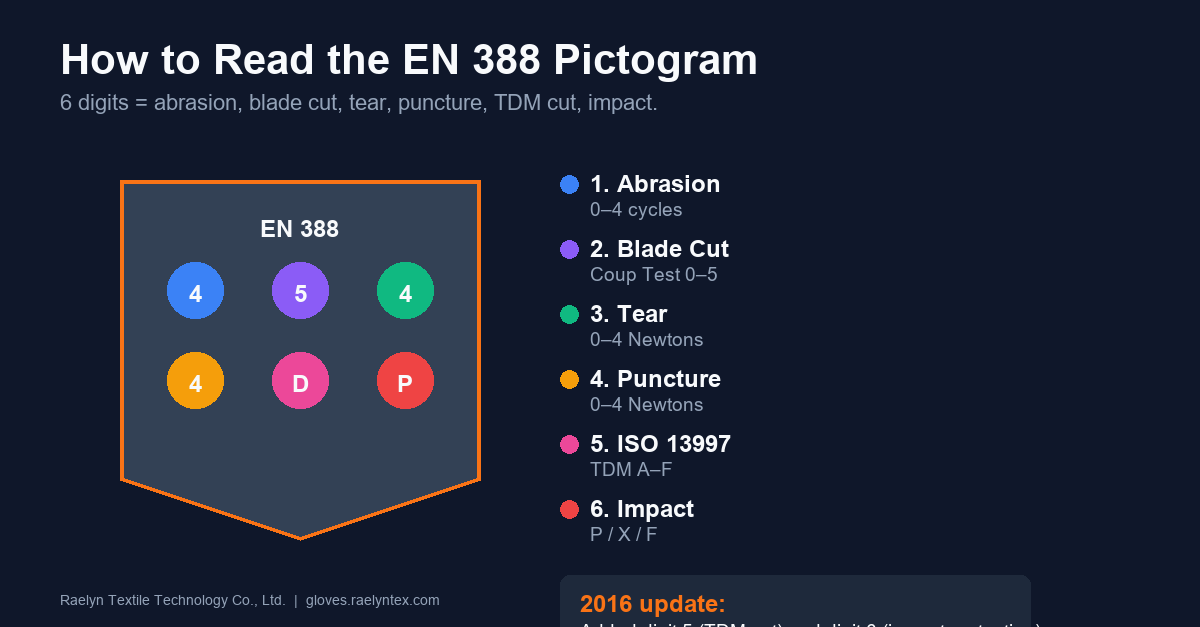
What Is EN 388 and Why Does It Matter?
EN 388 is the European standard for protective gloves against mechanical risks. It is part of the EN 420 / ISO 21420 family and is referenced directly by the EU PPE Regulation (EU) 2016/425. For any glove sold into the European market as protection against abrasion, blade cuts, tears, punctures, or impacts, the EN 388 pictogram is the first thing a safety manager or procurement buyer should check.
Unlike a marketing claim, each digit is backed by a standardized laboratory test. That makes the pictogram useful for comparing gloves from different suppliers — as long as you know what the numbers actually mean.
Old Pictogram vs New Pictogram: 4 Digits vs 6 Digits
Before 2016, the EN 388 pictogram showed only 4 digits:
-
1st digit: Abrasion resistance
-
2nd digit: Blade cut resistance
-
3rd digit: Tear resistance
-
4th digit: Puncture resistance
After EN 388:2016 took effect, two extra digits were added to solve two problems:
-
5th digit: ISO 13997 (TDM) cut resistance, rated A–F. This was added because the old blade-cut machine (Coup Test) became less reliable at higher cut levels, so a more accurate test was needed.
-
6th digit: Impact protection, shown as P (pass), X (not tested), or F (fail).
So a modern EN 388 rating might read 4 5 4 4 F P. Below we explain each position in order.
EN 388 Digit 1: Abrasion Resistance (0–4)
The first digit tells you how well the glove material resists surface wear. The test rubs a sample against abrasive paper under controlled pressure and counts the cycles until the material fails.
| Rating | Cycles to Failure | Typical Use |
|---|---|---|
| 0 | < 100 | Minimal protection |
| 1 | ≥ 100 | Light handling |
| 2 | ≥ 500 | Warehouse, assembly |
| 3 | ≥ 2,000 | Construction, logistics |
| 4 | ≥ 8,000 | Heavy abrasion, rough materials |
For most industrial jobs, a rating of 2 or 3 is sufficient. Rating 4 is reserved for the harshest abrasive environments.
EN 388 Digit 2: Blade Cut Resistance — Coup Test (0–5)
The second digit comes from the Coup Test, where a rotating circular blade moves back and forth across the glove sample until it cuts through. The result is an index number comparing the glove sample to a reference material.
| Rating | Cut Index | Typical Use |
|---|---|---|
| 0 | < 1.2 | Minimal cut risk |
| 1 | ≥ 1.2 | Light assembly |
| 2 | ≥ 2.5 | General handling |
| 3 | ≥ 5.0 | Sheet metal edges |
| 4 | ≥ 10.0 | Glass, sharp metal |
| 5 | ≥ 20.0 | Heavy cut hazards |
At higher cut levels, the Coup Test can become less reliable because the blade dulls against strong fibers. That is exactly why the 5th digit (ISO 13997 TDM) was added.
EN 388 Digit 3: Tear Resistance (0–4)
The third digit measures how much force it takes to tear the glove material once a small cut has been started.
| Rating | Force (Newtons) | Typical Use |
|---|---|---|
| 0 | < 10 N | Very low tear risk |
| 1 | ≥ 10 N | Light duty |
| 2 | ≥ 25 N | General industrial |
| 3 | ≥ 50 N | Heavy handling |
| 4 | ≥ 75 N | Rough environments |
Tear resistance matters when a glove might get snagged on equipment, sharp corners, or protruding parts. A low score here can turn a small cut into a large rip.
EN 388 Digit 4: Puncture Resistance (0–4)
The fourth digit shows resistance to puncture from a standard probe. This is different from cut resistance — a glove can resist slicing but still be vulnerable to a sharp point.
| Rating | Force (Newtons) | Typical Use |
|---|---|---|
| 0 | < 20 N | Minimal puncture risk |
| 1 | ≥ 20 N | Light assembly |
| 2 | ≥ 60 N | General handling |
| 3 | ≥ 100 N | Wood, wire, nails |
| 4 | ≥ 150 N | Heavy puncture hazards |
For waste handling, recycling, forestry, or any job with nails and splinters, look for a puncture rating of 3 or 4.
EN 388 Digit 5: ISO 13997 Cut Resistance — TDM Test (A–F)
The fifth digit is one of the most important changes in EN 388:2016. It shows the result of the ISO 13997 "TDM" (Tomodynamometer) test, which measures the force needed to cut through the material with a straight blade.
Why add another cut test? The older Coup Test (digit 2) can dull against high-performance fibers like glass, basalt, or HPPE. The TDM test gives a more stable rating for high-cut gloves.
| Rating | Cut Force | ANSI Equivalent | Typical Use |
|---|---|---|---|
| A | ≥ 2 N | A1–A2 | Light cut protection |
| B | ≥ 5 N | A2–A3 | General handling |
| C | ≥ 10 N | A4 | Sheet metal, glass |
| D | ≥ 15 N | A5 | Metal fabrication |
| E | ≥ 22 N | A6–A7 | Heavy cutting |
| F | ≥ 30 N | A8–A9 | Extreme cut hazards |
When you compare a glove to the US ANSI/ISEA 105 system, use this 5th digit, not the 2nd digit. For example, a glove rated 4 5 4 4 D in Europe is roughly equivalent to ANSI A5.
EN 388 Digit 6: Impact Protection (P / X / F)
The sixth digit tells you whether the glove was tested for back-of-hand impact protection according to EN 13594. This is especially important for TPR impact gloves used in oil and gas, mining, and heavy construction.
| Symbol | Meaning |
|---|---|
| P | Pass — the glove met the impact protection requirements. |
| X | Not tested — impact protection was not evaluated. |
| F | Fail — the glove was tested but did not meet the requirements. |
Do not confuse EN 388 impact testing with ANSI/ISEA 138. They use different test methods and different performance levels. If your buyer specifies ANSI/ISEA 138 Level 2 or 3, you need a glove tested to that standard specifically, not just an EN 388 P rating.
How to Read a Full EN 388 Code at a Glance
Let us take a real-world example: 4 5 4 4 D P.
-
4 = Abrasion: very high resistance to surface wear
-
5 = Blade cut (Coup): maximum rating on the older test
-
4 = Tear: very high tear resistance
-
4 = Puncture: very high puncture resistance
-
D = ISO 13997 TDM cut: ≥ 15 N, comparable to ANSI A5
-
P = Impact protection: passed the impact test
This glove is suitable for heavy metal handling, demolition, mining support work, or any environment where cuts, tears, and impacts are all present.
Common Mistakes When Reading the EN 388 Pictogram
-
Mixing up digit 2 and digit 5. A high Coup Test score (digit 2) does not automatically mean a high ISO 13997 score (digit 5). Always check both, and use digit 5 for ANSI conversion.
-
Ignoring digit 6. Many buyers assume all "impact gloves" are tested the same way. The EN 388 P rating is different from ANSI/ISEA 138. Match the standard to the buyer’s spec.
-
Forgetting the application. A glove with 4 5 4 4 but no TDM rating or impact rating might look impressive but could be the wrong choice for the actual hazard.
How to Choose the Right Glove from the Pictogram
Start with the hazard, not the glove. For each task, rank the mechanical risks:
-
Cut risk dominant: Focus on digit 5 (TDM). Look for C/D/E/F depending on sharpness and force.
-
Abrasion dominant: Focus on digit 1. Rating 3–4 is ideal for rough handling.
-
Puncture risk dominant: Focus on digit 4. Recycling, waste, and forestry need 3 or 4.
-
Impact risk dominant: Check digit 6 for P, and confirm the buyer needs EN 388 impact or ANSI/ISEA 138.
-
Mixed hazards: Use our cut-resistant glove range and compare multiple EN 388 ratings side by side.
EN 388 vs ANSI/ISEA 105: Which Standard Should You Use?
For the European market, EN 388 is mandatory for PPE claims. For the US market, ANSI/ISEA 105 is more common. If you sell globally, you often need both.
The fastest conversion is between EN 388 digit 5 (TDM) and ANSI/ISEA 105 cut levels:
-
EN 388 B ≈ ANSI A2–A3
-
EN 388 C ≈ ANSI A4
-
EN 388 D ≈ ANSI A5
-
EN 388 E ≈ ANSI A6–A7
-
EN 388 F ≈ ANSI A8–A9
We cover the full conversion in our earlier guide: EN 388 vs ANSI/ISEA 105 Cut Level Standards Compared.
Conclusion
The EN 388 pictogram is more than a label — it is a quick hazard-matching tool. The six digits tell you how the glove performs against abrasion, blade cuts, tears, punctures, high-force cuts, and impacts. Buyers who understand the difference between the Coup Test (digit 2) and the TDM test (digit 5) make better sourcing decisions, and suppliers who can explain the pictogram build more trust.
At Raelyn Textile Technology, we test and label our cut-resistant gloves, TPR impact gloves, and nitrile-coated gloves to EN 388 and ANSI standards. If you need help matching a glove rating to your end customer’s hazard assessment, send us your requirements and we will recommend the right specification.