ANSI Cut Resistance Levels Explained: How to Choose the Right Cut Resistant Gloves
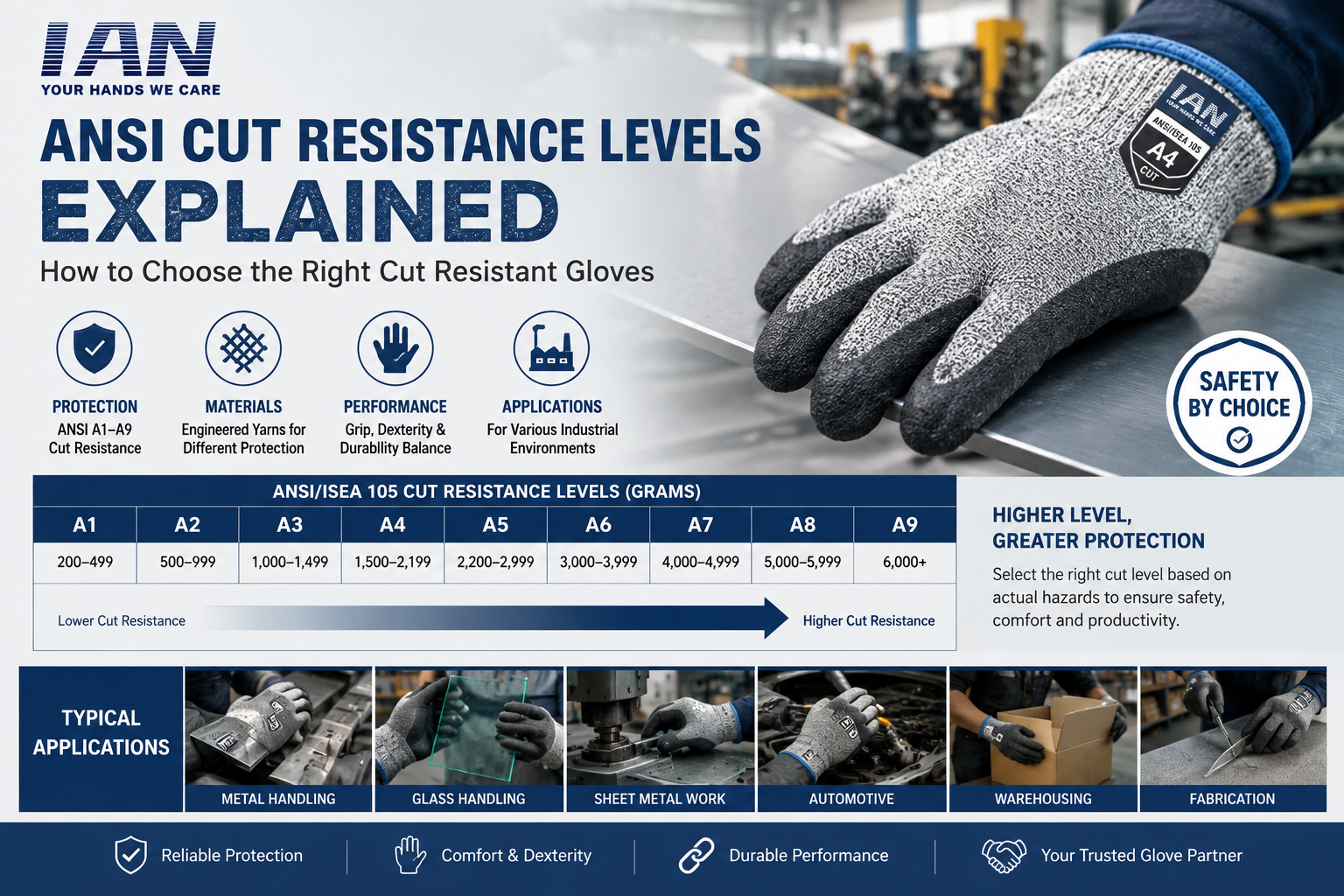
ANSI Cut Resistance Levels Explained: How to Choose the Right Cut Resistant Gloves
A glove marked ANSI A2 and a glove marked ANSI A6 may look surprisingly similar on a product page. Both can have a knitted liner, a coated palm and a familiar industrial work-glove shape. Put them into the same job, however, and they are intended to address very different levels of cut exposure.
That distinction matters to PPE buyers.
Selecting a higher cut level is not simply a matter of buying “more protection.” The goal is to match the glove to the hazard while keeping enough grip, dexterity and comfort for the work being performed.
For distributors, importers, safety managers and private-label buyers comparing cut resistant gloves, understanding the ANSI scale is a useful starting point.
What Are ANSI Cut Levels?
ANSI cut levels are part of the ANSI/ISEA 105 classification system used to communicate the cut resistance of hand protection.
The current scale runs from A1 through A9.
In general:
-
A1 represents the lower end of the cut-resistance scale.
-
The protection requirement increases as the number rises.
-
A9 represents the highest level within the ANSI scale.
The rating comes from standardized laboratory testing. It gives buyers a consistent way to compare cut performance, but it should not be treated as a complete description of how a glove will perform in every workplace.
A cut level answers one important question:
How much cut resistance did the glove demonstrate under the specified test method?
It does not answer every other question about grip, dexterity, abrasion, oil exposure, durability or suitability for a particular task.
ANSI A1–A9 Cut Resistance Levels
ANSI/ISEA 105 divides cut resistance into nine levels based on the amount of force required to cut through the glove material during standardized testing.
| ANSI Cut Level | Cut Resistance Range |
|---|---|
| A1 | 200–499 grams |
| A2 | 500–999 grams |
| A3 | 1,000–1,499 grams |
| A4 | 1,500–2,199 grams |
| A5 | 2,200–2,999 grams |
| A6 | 3,000–3,999 grams |
| A7 | 4,000–4,999 grams |
| A8 | 5,000–5,999 grams |
| A9 | 6,000+ grams |
The table makes the progression easy to see, but purchasing decisions should not be made from the numbers alone.
Moving from A2 to A4, for example, is not simply moving two positions higher on a label. It represents a substantial increase in tested cut resistance and may also require a different liner construction.
Lower Cut Levels: When Dexterity Matters
Lower cut ratings can be appropriate where workers encounter relatively limited cut hazards but still need protection from incidental contact with edges or components.
An ANSI A2 glove, for example, may fit tasks involving light assembly, component handling, warehousing, maintenance, automotive work and general industrial handling.
These applications often put a premium on finger movement and tactile control.
For that reason, buyers should not automatically eliminate lower cut levels simply because higher-rated products are available. If the hazard assessment supports a lower level, a lighter glove can sometimes provide a better balance between protection and usability.
A 15-gauge A2 cut resistant nitrile coated glove, for instance, can combine a relatively fine liner with a nitrile gripping surface for industrial handling where very high cut resistance is not the primary requirement.
A3 and A4: A Common Middle Ground for Industrial Work
As exposure to sharp edges becomes more significant, buyers often move toward intermediate ratings such as A3 and A4.
This range can be relevant when handling fabricated components, metal parts, machinery components, building materials, moderately sharp sheet materials and parts with unfinished edges.
A4 is particularly useful to examine because it can offer substantially more cut resistance than lighter-duty options without automatically moving into the heaviest glove constructions.
But two A4 gloves can still feel and perform differently.
One may use a thinner engineered liner with nitrile coating. Another may use a different fiber blend, gauge or coating system. Both may carry the same ANSI cut classification while offering different levels of flexibility, grip and wear resistance.
For buyers, the rating should therefore be treated as a minimum performance reference, not as the entire product specification.
A5 and A6: Higher Cut Exposure Changes the Priorities
When workers routinely handle sharper sheet metal, glass, fabricated edges or other materials with a greater potential for laceration, higher ANSI ratings become more relevant.
A5 and A6 gloves are commonly considered for demanding industrial environments where cut protection carries more weight in the purchasing decision.
Possible applications include sheet-metal handling, metal fabrication, glass handling, stamping operations, machinery work, construction, recycling and heavy material handling.
At these levels, liner design becomes especially important.
Higher cut resistance can be achieved with engineered fibers, composite yarns, aramid materials such as Kevlar, or other cut-resistant constructions. The exact solution affects not only the rating but also glove thickness, flexibility, heat characteristics and long-term comfort.
An A6 cut resistant glove with a Kevlar liner, for example, represents a different construction choice from a lighter graphene or engineered-fiber liner. The ANSI level tells you about tested cut resistance; it does not make those material differences disappear.
What About A7, A8 and A9?
A7 through A9 occupy the upper end of the ANSI scale.
These ratings are intended for severe cut hazards where very high resistance is required by the application and hazard assessment.
That does not mean every metalworking, glass or industrial operation should automatically specify A7, A8 or A9.
Higher protection can introduce trade-offs depending on the glove construction, including increased thickness, reduced tactile sensitivity, lower finger flexibility, greater weight, higher cost and potentially more worker fatigue.
Modern materials continue to improve the protection-to-dexterity balance, but the basic purchasing principle remains the same:
Choose the level the hazard requires, not simply the highest number available.
Why ANSI Level Alone Is Not Enough
Imagine two gloves carrying the same A4 cut rating.
Glove A uses a relatively fine liner and a PU palm coating.
Glove B uses a different liner construction with a nitrile coating.
Their cut classification may be the same, but their behavior during work can be noticeably different.
The PU-coated option may be attractive where precision handling and tactile control matter. A nitrile-coated construction may be preferred where grip, abrasion resistance or contact with oily components becomes more important.
This is why a useful glove specification normally considers several variables together:
cut level + liner + gauge + coating + grip requirement + working environment
Ignoring the rest of the construction can lead to a glove that meets the required rating but performs poorly in the actual task.
Coating Choice Still Matters at Higher Cut Levels
The coating is the working surface of many industrial gloves. It affects how the wearer interacts with parts, tools and materials throughout a shift.
Nitrile
Nitrile coatings are widely used where buyers need a combination of grip, abrasion resistance and industrial durability.
Sandy or foam nitrile surfaces can provide different grip characteristics depending on the working environment.
For metal fabrication, machinery work and automotive handling, this can be just as important as the cut rating itself.
PU
PU coatings are typically thin and flexible, making them useful when precision and dexterity are priorities.
A 13-gauge A4 cut resistant PU coated glove, for example, can be considered where the required cut protection needs to be balanced with controlled handling of components.
Again, neither coating is universally “better.” The application determines which construction makes more sense.
Do Not Convert ANSI and EN 388 Ratings Directly
International buyers often receive specifications containing both ANSI and EN 388 information.
The two systems should not be treated as interchangeable labels.
They use different classification structures and test requirements. A buyer should therefore avoid assuming that an ANSI A4 rating automatically equals a particular EN 388 cut classification.
When sourcing for multiple markets, request the actual test information and applicable certification documentation required for the destination market rather than relying on a simple conversion chart.
This becomes particularly important for distributors and private-label brands that may sell the same glove family into different regions.
Start With the Hazard, Then Select the Level
A practical sourcing process begins with the work, not the product catalog.
Before deciding whether A2, A4 or A6 is appropriate, define what the worker actually handles.
Useful questions include:
What is causing the cut risk?
A stamped component, sheet-metal edge, broken glass and utility blade do not present identical hazards.
How often does exposure occur?
Occasional contact and continuous handling can justify different glove strategies.
How much dexterity is required?
A glove suitable for carrying sheet material may be frustrating for someone manipulating small fasteners.
Are surfaces dry, oily or wet?
Grip loss can create a secondary safety problem even when the glove has adequate cut resistance.
What other hazards are present?
Abrasion, puncture, impact, heat and chemical exposure may affect the final specification.
Once these questions are answered, the ANSI level becomes much more useful.
A Practical Example: Building an A2–A6 Product Range
For distributors, one cut-resistant glove rarely covers every customer.
A more practical product family might include:
A2 — lighter industrial handling
A dexterous option for assembly, warehousing, automotive components and general maintenance.
A4 — medium-to-higher cut protection
A balanced option for customers handling metal components, fabricated parts and sharper industrial materials.
A6 — demanding cut applications
A higher-protection option for glass, sheet metal, fabrication, machinery and other environments with greater cut exposure.
This type of range gives a distributor several protection points without forcing every customer into the same glove.
It also makes product positioning easier: instead of selling only “a cut resistant glove,” the supplier can offer different constructions around actual risk and work requirements.
What Industrial Buyers Should Request From a Supplier
An ANSI rating should be supported by a complete technical specification.
When comparing suppliers, an RFQ for cut-resistant gloves should normally identify or request:
-
target ANSI cut level,
-
liner material,
-
glove gauge,
-
coating material,
-
coating coverage,
-
coating finish,
-
reinforcement requirements,
-
available sizes,
-
application or end-use,
-
test information,
-
packaging requirements,
-
and OEM or private-label requirements.
If you are replacing an existing glove, providing the current specification or sample can make comparison much more useful.
For a new project, describing the actual work environment is often better than simply asking a manufacturer for “A5 gloves.”
Test Samples in the Actual Application
Laboratory classifications are important, but a sample trial can reveal issues that a specification sheet cannot.
During a trial, pay attention to grip after repeated handling, finger mobility, liner comfort, coating wear, glove fit, worker acceptance and whether the selected protection level is practical for the task.
A technically impressive glove that workers constantly remove because it interferes with the job is not an effective solution.
For volume purchasing, testing several constructions before final approval can prevent much larger problems after production.
Choosing the Right ANSI Cut Level
ANSI A1–A9 gives industrial buyers a valuable framework for comparing cut resistance. The higher the level, the greater the tested cut resistance—but higher is not automatically better for every job.
A sound glove selection starts by identifying the hazard and then balancing protection with grip, coating, dexterity, liner construction and working conditions.
If you are still defining the broader specification, our Cut Resistant Gloves Buyer’s Guide explains how materials, coatings and applications fit together beyond the ANSI rating itself.
IAN Safety Gloves works with distributors, importers and PPE brands to develop cut-resistant glove specifications for different industrial applications. If you are comparing A2, A4, A5 or A6 constructions, send us the required protection level, application, coating preference, target market and packaging requirements when requesting a recommendation or sample.