EN 388 CUT D/E Certification: What Changed at Our Factory in 2026
If your 2026 sourcing sheet still says "cut level 5", you are quoting a test that no longer tells the whole story. Since EN 388:2016+A1:2018 became the harmonised standard under PPE Regulation (EU) 2016/425, the letters that matter for serious cut hazards are D and E — the ISO 13997 TDM ratings behind sheet metal stamping, glass handling and recycling lines. Over the past year we have reworked how our OEM cut-resistant glove programs are built, tested and certified around exactly these two letters. Here is what changed, and what importers and brand owners should check in any CUT D/E certificate before they place an order.
First, what the TDM letter actually certifies
The old coupe test — a rotating circular blade running over the fabric at constant speed — was designed for ordinary knits. Put high-performance yarns such as HPPE, glass fibre or aramid under it and the blade dulls against the material, the cut index drifts, and the result can be misleading. That is why the current EN 388 marking adds a letter from the TDM test (EN ISO 13997): a straight blade pressed into the sample at increasing force until it cuts through. The thresholds are fixed — level D requires at least 15 N and level E at least 22 N of cutting force, with F starting at 30 N. If the coupe blade blunted during testing, the coupe digit is marked "X" and the TDM letter governs.
For buyers, the practical translation is simple: a marking like 4X43D or 4X42E is not marketing copy, it is a laboratory force measurement. Level D is roughly seven and a half times the cutting force of level A. If your application involves stamped blanks, ductwork, glass panels or shredded scrap, the TDM letter is the only figure worth negotiating on.
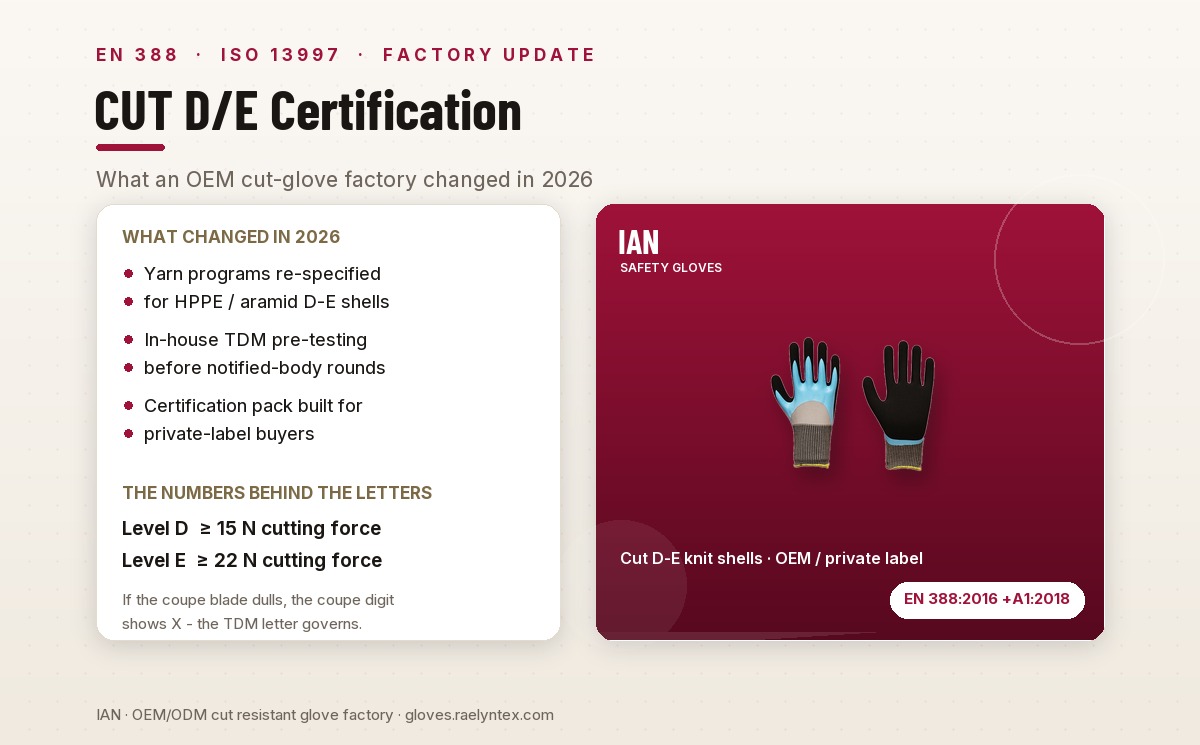
What changed on our production side in 2026
Cut level D and E gloves are not made by upgrading the coating — they are made at the knitting stage. Three changes went into our OEM lines this year:
1. Yarn programs re-specified for D/E gauges. Reaching 15–22 N in a 13-gauge or 15-gauge shell depends on the HPPE and aramid blend, the twist and the knit density. Our cut-resistant glove range now runs on re-specified yarn programs so that D and E ratings are achieved without turning the glove into a stiff, unusable board. Dexterity still sells; a level F glove that workers remove after an hour protects nobody.
2. In-house TDM pre-testing before any certificate round. The costliest failure in this category is a glove that passes coupe testing in-house, then fails or reads differently at the notified body’s TDM bench. In 2026 we moved TDM pre-testing in-house, so every OEM shell is measured against the ISO 13997 thresholds before it is submitted. For customers this shows up as fewer failed rounds, faster certification, and a development sample that already carries honest lab numbers.
3. Certification paperwork built for private label. Because we manufacture as an OEM/ODM factory, the glove on the certificate is usually not our brand — it is yours. Mechanical-risk gloves sit in Category II of Regulation (EU) 2016/425, which means an EU type-examination (Module B) performed by a notified body, followed by the manufacturer’s declaration of conformity and CE marking. This year we standardised the documentation pack we hand to importers and brand owners: the type-examination certificate, the EU declaration of conformity drafted with the customer’s brand as the manufacturer or importer, the full EN 388 test results, and print-ready marking artwork. Buyers who want to see how the letters map to real tasks can start with our German-market EN 388 guide or the level-by-level EN 388 vs ANSI/ISEA 105 comparison.
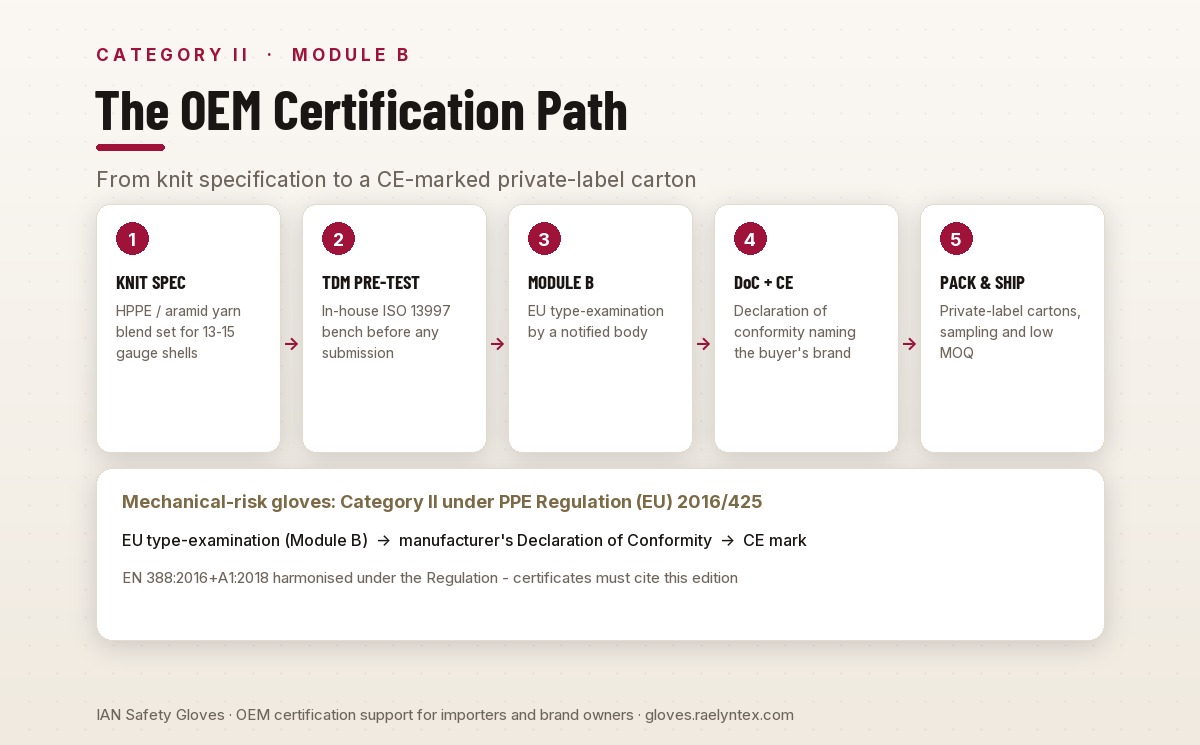
What to verify in a CUT D/E certificate
Cut D/E claims are exactly where low-cost suppliers cut corners. Before approving a private-label order, check four things:
Scope versus model. The type-examination certificate names a specific model and construction. If your order changes the gauge, the yarn or the coating, the certificate no longer covers the glove — a variant needs its own assessment. Match the certificate to the sample, not to the brochure.
Standard edition. The certificate should cite EN 388:2016+A1:2018. Older 2003-edition paperwork has no TDM letter at all, which means no defensible D or E claim.
The full marking, not one digit. A strong cut letter does not excuse weak abrasion or puncture. Read the whole code — our walkthrough of all six EN 388 digits shows how each position is earned. For structured selection by grade, the ANSI A1–A9 range on our site gives a parallel US-market ladder, and the metalworking and glass category groups the shells we build for those exact hazards.
Renewal and surveillance. Type-examination certificates carry validity periods; ask when the current certificate was issued and whether the tested model still matches current production.
Which of our shells carry D and E ratings
For buyers mapping a product line, the current cut family includes the A6 aramid knit with nitrile coating for the top of the range, the A6 sandy-finish nitrile glove for oily grip, and level A5 options such as the A5 nitrile coated glove and the A4 nitrile coated work glove for mid-range programs. All are produced as unbranded, customisable base gloves — your logo, your packaging, your certificate paperwork — with sampling and low-MOQ trial orders handled through our contact page. Company background and factory details are on the about page, and the full mechanical-risk catalogue is in the product centre.
The demand signal behind all of this is consistent across our 2026 inquiries: buyers no longer ask for "cut level 5", they ask which notified body issued the type-examination, what the TDM force was, and how fast a private-label variant can be certified. That is a better question — and it is now the question our factory is built to answer.