Nitrile Coated Gloves for US Distributors: ANSI/ISEA 105 Levels and Truckload Lead Times
A US distributor’s nitrile glove enquiry rarely starts with compliance documents the way a German enquiry does. It starts with the spec sheet: what cut level, what abrasion number, what puncture rating — and then, almost immediately, how fast you can repeat that exact program at container volume without the quality drifting. That second question is where the real buying decision lives, because in the US market a nitrile coated glove is a replenishment product. Your customer is not buying one container; they are buying a program they have to refill every month for years.
This guide is written for US distributors, importers and private-label buyers sourcing nitrile coated gloves from an OEM factory. It covers how to read and specify ANSI/ISEA 105 levels on a nitrile palm, which level combinations match the programs that actually move in American volume, and what realistic truckload lead times look like when the factory is in China — including the specification language that keeps a reorder from turning into a dispute.
1. ANSI/ISEA 105: the three numbers a US buyer actually checks
ANSI/ISEA 105 is the North American classification standard for hand protection. Unlike EN 388, which reports four-to-six digits on one pictogram, ANSI/ISEA 105 scores each property on its own scale — and since the 2016 revision, cut resistance has its own letter scale, A1 through A9. The 2021 revision added a standardized pictogram that prints the cut, abrasion and needlestick scores directly inside the marking, and the current 2024 edition keeps the same test methods and scales. On a modern nitrile glove tag you should expect to see all three scores spelled out — if a spec sheet gives you only "ANSI cut level A4" and nothing else, ask for the abrasion and puncture numbers too.
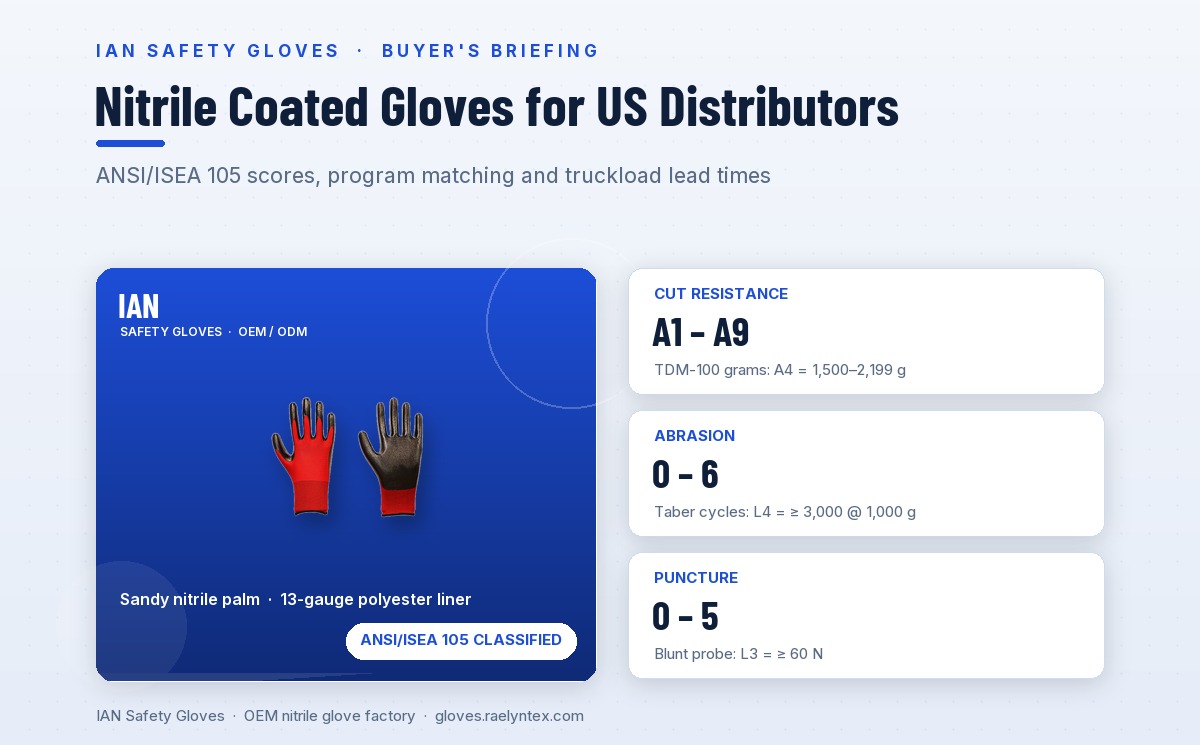
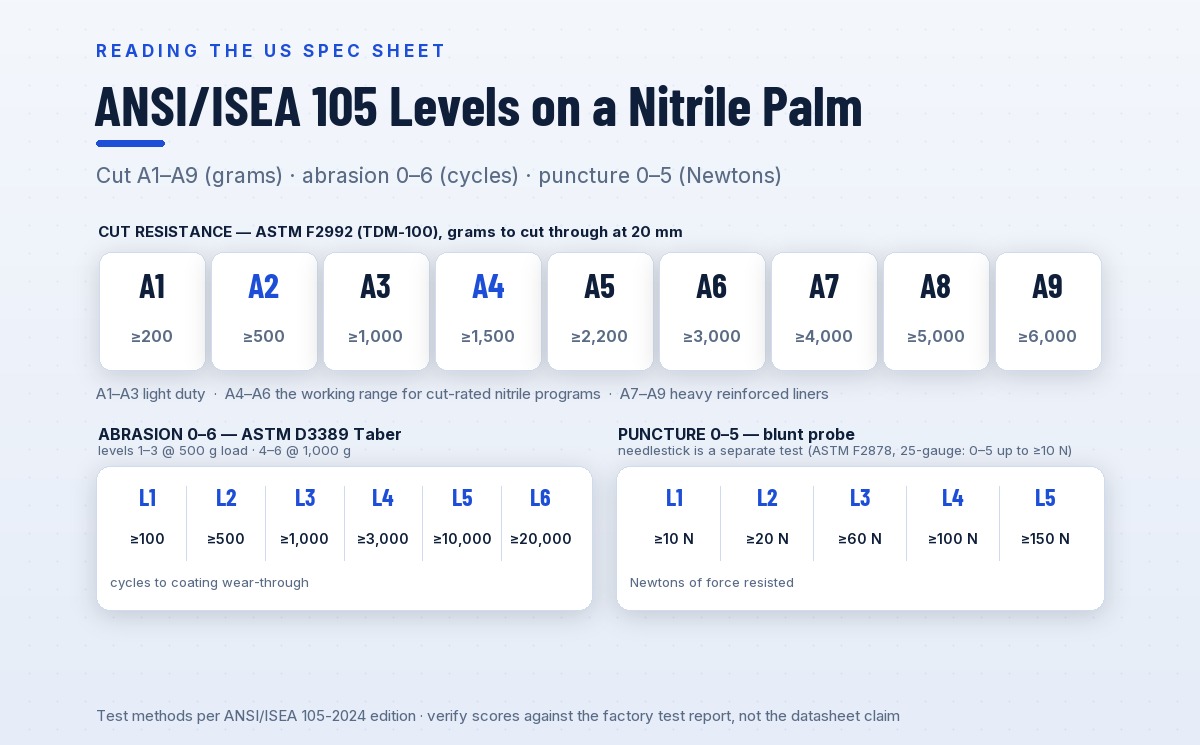
Cut resistance: A1–A9, in grams. Cut is tested with the TDM-100 machine (ASTM F2992): a straight blade travels 20 mm across the palm material under increasing load, and the gram force needed to cut through sets the level. A1 starts at 200 g, A2 at 500 g, A3 at 1,000 g, A4 at 1,500 g, A5 at 2,200 g, A6 at 3,000 g, A7 at 4,000 g, A8 at 5,000 g and A9 at 6,000 g. Most nitrile coated gloves for general handling land at A1–A2 (plain polyester or nylon liner under a nitrile palm); adding HPPE or glass fiber into the knit moves a sandy nitrile program to A4–A6. A plain nitrile palm adds essentially no cut resistance — the liner does that work — so never let a coating claim stand in for a cut claim.
Abrasion resistance: levels 0–6, in cycles. Abrasion runs on a Taber-type abrader (ASTM D3389 for coated fabrics): two H-18 wheels rub the palm under a set load until the coating wears through. Levels 1–3 are tested under a 500 g load — roughly ≥100, ≥500 and ≥1,000 cycles — while levels 4–6 jump to a 1,000 g load at ≥3,000, ≥10,000 and ≥20,000 cycles. For a nitrile palm, abrasion is the number that predicts how long the glove survives rough handling work, and it is mostly a function of nitrile compound quality and coating thickness. A well-built sandy nitrile program should be quoting abrasion level 3–4 without hesitation.
Puncture resistance: levels 0–5, in Newtons. A blunt steel probe (the same 4.5 mm probe family as EN 388) measures the force to puncture the palm: level 1 at ≥10 N, level 2 at ≥20 N, level 3 at ≥60 N, level 4 at ≥100 N and level 5 at ≥150 N. Note what this does not cover: hypodermic needles are a separate test (ASTM F2878, a 25-gauge needle, scored 0–5 up to ≥10 N). For a distributor selling into waste, recycling or public-sector channels, that distinction is worth a line on the quote — a blunt-puncture level 5 glove is not automatically needle-resistant.
2. Matching levels to the programs that move in US volume
ANSI scores only matter to a distributor because they map onto repeatable end-user programs. Four archetypes cover most of the nitrile volume moving into US wholesale channels:
-
General warehouse and material handling (A1–A2, abrasion 2–3). A 13-gauge polyester liner with a smooth nitrile palm — dexterity first, price per pair decisive, sold by the bale to 3PLs and light assembly. Smooth nitrile also carries light oil contact, which keeps it useful beyond dry goods.
-
Construction and yard work (A2–A3, abrasion 3–4). A heavier 10–13 gauge knit with a sandy nitrile coating — the open texture channels water and oil away from the grip surface, which is why sandy has become the default "glove that works wet" on US job sites.
-
Machinery and oil-exposed work (abrasion 3–4, smooth or foam). Where the spec is really "oil resistant" rather than cut, the honest keyword is nitrile itself: nitrile rubber is the reason the palm survives petroleum-based fluids. The trade-offs between sandy, foam and smooth finishes are set out in our sandy vs foam vs smooth nitrile comparison.
-
Cut-rated nitrile programs (A4–A6). HPPE-blend liners dipped in nitrile serve metal fabrication, glass and HVAC distributors. These cross into our cut resistant gloves line — see the A4 nitrile coated cut resistant gloves and A6 sandy nitrile programs for how the same coating carries very different liners.
One warning that saves distributors real money: do not build a dual-market quote by copying EN 388 numbers next to ANSI numbers as if they translated. They are different probes, different machines, different units. If your customer resells into both markets, our EN 388 vs ANSI/ISEA 105 crosswalk explains what can and cannot be compared. And since the employer — often your end customer — carries the duty to select hand protection against workplace hazards under OSHA 29 CFR 1910.138, a clean ANSI score sheet is also a sales tool: it lets your customer’s safety manager sign off without writing their own test protocol.
3. Truckload lead times: what a China OEM program actually runs on
The levels get the glove into the catalog; lead time is what keeps it there. Nitrile coated gloves are a made-to-order product at factory level — the coating compound, liner, color and cuff are set per production run — so realistic planning looks like this:
-
Pre-production samples: 7–10 days. A spec change (gauge, coating weight, cuff color, palm finish) is a compound and line change, not a warehouse pick. Budget a week and a half from confirmed spec to a sample pair in your hands, and evaluate it against the ANSI scores in writing, not by feel.
-
Bulk production: 30–40 days after sample approval and deposit. That covers dipping, curing, QC and packing for a full container. Sandy and foam finishes run marginally longer than smooth because of the extra finishing step.
-
Shipping: figure 25–35 days ocean to a US West Coast or Gulf port plus inland drayage. A distributor running monthly replenishment should hold 60–90 days of forward cover during peak season (March–June restocking and the pre-hurricane Q3 pull are the two predictable spikes).
-
Mixed-SKU containers are normal. A single 40-ft container routinely mixes sizes and programs — a split of 12-pair poly-packed general-purpose pairs, sandy programs and an A4 cut program in the same load. What the factory needs frozen is the SKU list and pack-out, not a single part number.
The same logic applies to the paperwork side of truckload planning: carton markings, a packing list that matches pallet quantity per SKU, and consistent carton labels across reorders. Distributors who private-label should treat the carton as part of the spec — a label change is a print change, and it costs lead time if it is discovered at packing instead of at PO.
4. Specification language for the purchase order
A US distributor’s PO protects them to the exact degree that it is specific. Five lines do most of the work:
-
Gauge and liner: e.g. 13-gauge polyester (or HPPE blend for cut programs), seamless knit.
-
Coating: nitrile, sandy/foam/smooth, palm-only or full dip, and target coating weight if you have a reference pair.
-
ANSI/ISEA 105 scores in full: cut A-level, abrasion level, puncture level — all three, from the same test report, not "or better".
-
Size run and pack-out: sizes S–XXL, pairs per poly bag, bags per carton, cartons per pallet.
-
Branding: your logo on the cuff print, poly bag and carton, plus any UPC or case labels the DC requires.
Fit belongs on the list too: American hands average larger than the size curves on some Asian-made gloves, and a program that runs small generates returns and lost refills. Our work glove size guide covers measuring and size curves worth confirming at the sample stage.
5. Why buy the program from the factory, not the trading sheet
Everything above — repeatable ANSI scores, stable sandy texture between batches, cartons that match the packing list — is a manufacturing-capability question. As an OEM/ODM nitrile glove factory, we control the compound and the line, which is what makes a reorder the same product rather than a close guess. That is the substance behind our OEM nitrile production expansion.
For distributors building a private-label nitrile program, the practical offer set is: custom liner and coating specification, low MOQ on first trial orders so the program can be tested with one lane, private-label packaging from cuff print to carton, pre-shipment test reports against the agreed ANSI scores, and standing samples so your customer service team can answer spec questions without emailing overseas. If you are comparing coating families for the rest of the catalog, our PU coated gloves buyer’s guide covers the precision-handling end and the latex coated gloves range covers heavy grip work — the three coating families share most of the same liner infrastructure, which is why a single factory relationship can carry the whole program.
When the next nitrile RFQ lands on your desk, send us the spec sheet and the annual volume: we will return a sample pair, the full ANSI/ISEA 105 test data and a container program price — and the reorder, six months from now, will be the same glove. Start the conversation through our contact page or browse the full nitrile coated gloves range first; seasonal buying notes for other programs are in the news archive.
Related reading: nitrile coated work gloves for industrial buyers