TPR Impact Gloves Explained: Back-of-Hand Protection, ANSI/ISEA 138 Levels and How to Choose
Cut injuries get most of the attention in hand-safety programs, but in heavy industry the injuries that actually put workers in hospital are often crush and impact injuries — a dropped wrench, a pinched hand between steel plates, a swinging load on a drilling floor. Most of that force lands on the back of the hand, where there is almost no muscle to absorb it.
That is the problem TPR impact gloves are built to solve. In this guide we explain what TPR actually is, how the two major standards grade impact protection (ANSI/ISEA 138 in North America, EN 388 in Europe), where the protective panels sit on a well-designed glove, and how to match an impact rating to your actual jobsite hazards.
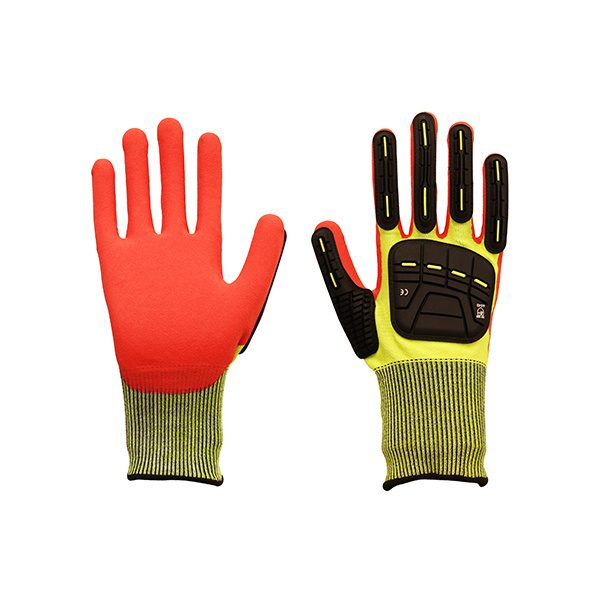
What Is TPR, and Why Is It Used in Work Gloves?
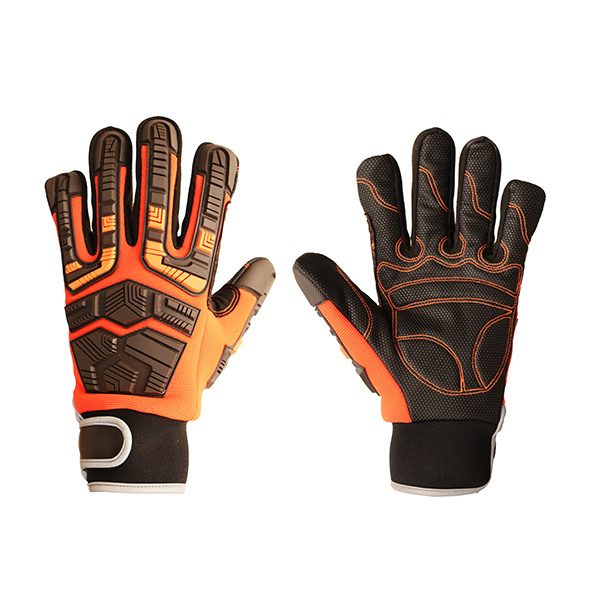
TPR stands for thermoplastic rubber (also called thermoplastic elastomer). It is an injection-molded material that combines the elasticity of rubber with the moldability of plastic. In impact gloves, soft, flexible TPR is molded into segmented panels and stitched or welded onto the back of the glove — over the knuckles, along the fingers, around the thumb crotch, and across the back of the hand.
Three properties make TPR the dominant material for impact protection:
-
Energy absorption. TPR deforms on impact and dissipates force before it reaches the bones of the hand, then returns to its original shape.
-
Flexibility. Segmented panels articulate with the hand, so workers keep nearly full dexterity — the reason TPR gloves are worn for a full shift instead of sitting in a toolbox.
-
Temperature stability. TPR stays flexible in cold-store and winter conditions where rigid plastic guards would crack.
One honest caveat buyers should know: the presence of TPR pads alone does not guarantee any specific protection level. A verified rating depends on laboratory testing and documentation — which is exactly what the next section covers.
The Two Standards That Grade Impact Protection
ANSI/ISEA 138-2019 (North America)
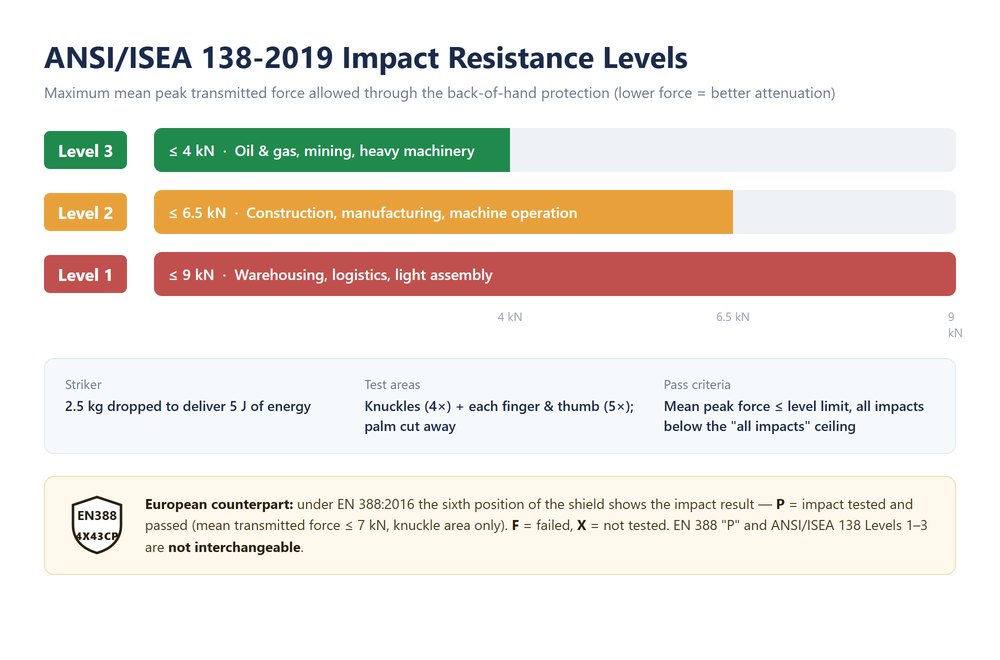
ANSI/ISEA 138-2019 is the American national standard created specifically for impact-resistant gloves. In the test, the palm of the glove is cut away, the glove is placed on a metal anvil with a force transducer underneath, and a 2.5 kg striker is dropped to deliver 5 joules of energy onto the back-of-hand areas. Knuckles are struck four times, each finger and thumb five times, and the average transmitted force determines the level:
| ANSI/ISEA 138 Level | Mean Peak Transmitted Force | Typical Applications |
|---|---|---|
| Level 1 | ≤ 9 kN | Warehousing, logistics, light assembly — incidental bumps and small dropped parts |
| Level 2 | ≤ 6.5 kN | Construction, manufacturing, machine operation — moderate crush and pinch risks |
| Level 3 | ≤ 4 kN | Oil & gas, mining, heavy equipment — severe impact and crushing hazards |
Note that lower transmitted force means a higher rating: a Level 3 glove lets less than half the force through compared with Level 1.
EN 388:2016 (Europe)
EN 388 is Europe’s broader mechanical-risk standard (abrasion, cut, tear, puncture). Its impact assessment appears as the sixth character on the EN 388 pictogram: P means the glove was impact tested and passed (a mean transmitted force of roughly 7 kN or less on the knuckle area), F means failed, and X means not tested.
Important: EN 388 "P" is a simple pass/fail mark — it is not interchangeable with ANSI/ISEA 138 Levels 1–3, and there is no conversion table between them. If your market requires graded impact performance, ask suppliers specifically for ANSI/ISEA 138 test reports. For a full walkthrough of the rest of the EN 388 shield, see our guide to EN 388 vs ANSI/ISEA 105 cut level standards.
Glove Anatomy: Where TPR Protection Should Sit
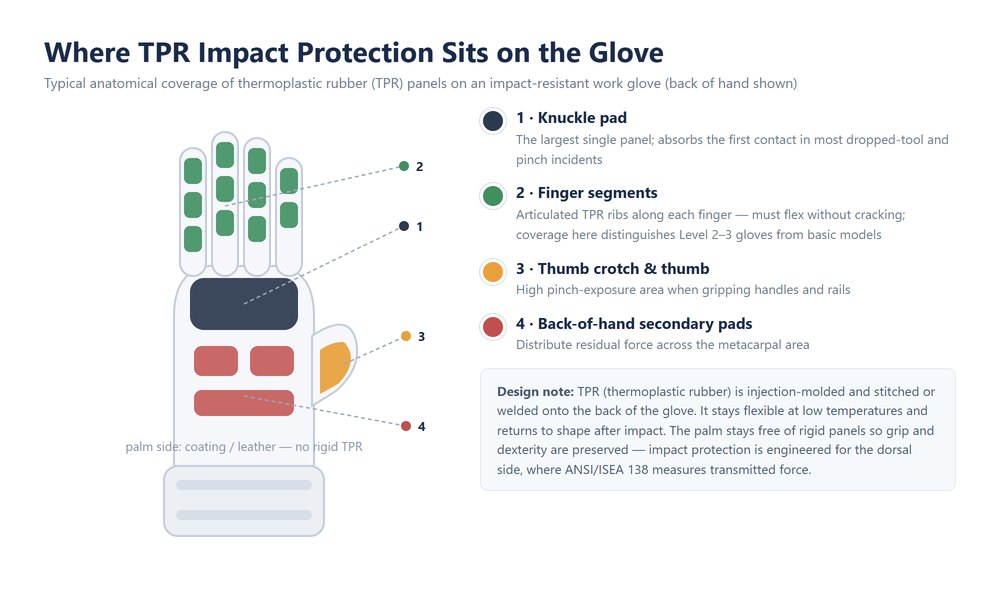
A well-designed impact glove concentrates protection exactly where ANSI/ISEA 138 measures it — the dorsal (back) side of the hand — while keeping the palm free for grip:
-
Knuckle pad — the largest single panel; takes the first contact in most dropped-tool incidents.
-
Finger segments — articulated ribs along each finger. Full finger coverage is what separates genuinely protective gloves from knuckle-only fashion designs.
-
Thumb crotch — a high pinch-exposure zone whenever workers grip handles, rails or ladder rungs.
-
Back-of-hand secondary pads — spread residual force across the metacarpal area.
The palm stays free of rigid panels (covered instead by nitrile coating or reinforced leather) so the worker retains dexterity. Impact protection is deliberately engineered for the back of the hand — padding the palm would destroy grip and control.
Beyond Impact: Combining Protection in One Glove
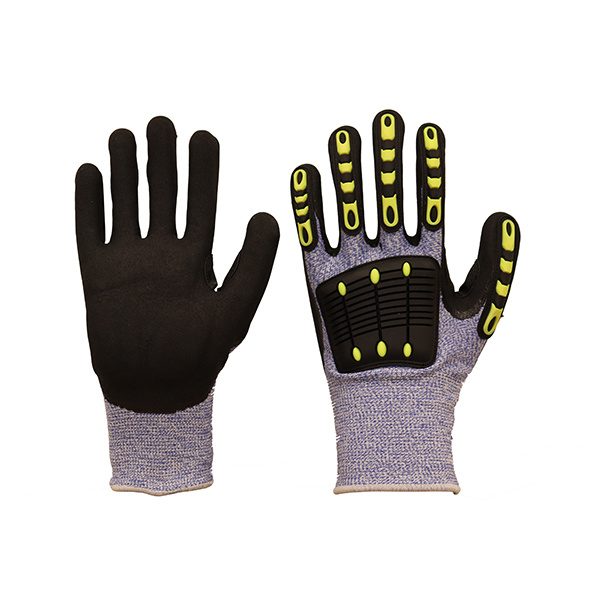
Real jobsites rarely expose hands to a single hazard. Oil-rig piping is both heavy and sharp-edged; glass-handling combines impact with cut risk; winter yards add cold. That is why modern impact gloves are usually multi-hazard designs:
-
Cut-resistant liner + TPR. Our A5 cut resistant TPR impact gloves pair a 13-gauge cut-resistant lining with sandy-nitrile palm coating and TPR panels across the fingers and back of hand — built for glass handling, metal fabrication and recycling.
-
Different cut liners for different markets. The A5 TPR sandy nitrile model pairs ANSI A4-rated cut liner protection with the same segmented TPR layout — useful when your customer specification is written in ANSI cut levels rather than EN 388 scores.
-
Cold storage + impact. The TPR impact resistant thermal work gloves add a thermal lining, spandex back-of-hand, reinforced synthetic-leather palm and a velcro wrist closure — for winter yards, cold stores and outdoor equipment work where standard TPR gloves would stiffen and lose comfort.
How to Choose the Right Impact Level: Start From the Hazard
Over-specifying wastes money and costs dexterity; under-specifying risks injury. Match the level to the dominant hazard:
| Your Work Environment | Recommended Level | Why |
|---|---|---|
| Light assembly, sorting, general material handling | Level 1 | Incidental contact with stationary objects; dexterity matters more than bulk |
| Construction, automotive repair, machine tending, pipe handling | Level 2 | Regular exposure to dropped hand tools and pinch points |
| Oil & gas, mining, heavy equipment, demolition, underground work | Level 3 | Severe crush energy from heavy tools, pipes and swinging loads |
Three practical rules from the field:
-
When in doubt, go one level up — but verify the glove is still comfortable, because a glove workers refuse to wear protects nobody.
-
Check finger coverage, not just the knuckle pad. Fingers are the most frequently injured part of the hand in pinch accidents.
-
Ask for the test report, not the marketing claim. A compliant supplier can produce the ANSI/ISEA 138 or EN 388 test documentation for the exact model number.
Inspection and Replacement
TPR panels are durable but not immortal. Retire impact gloves when:
-
a TPR panel is cracked, torn or permanently flattened — a broken segment no longer distributes force;
-
stitching that holds the panels has failed on the back of hand;
-
the coating or liner is worn through at the palm, compromising grip (the main cause of dropped-object accidents in the first place).
For daily-use industrial gloves, inspect weekly; replace immediately after any major impact event even if damage is not visible.
Buyer Checklist for Importers & Distributors
-
Confirm which standard your market needs: ANSI/ISEA 138 levels for North America, EN 388 with P for Europe.
-
Request test reports for the exact model, not a similar style.
-
Check the marking on the glove: ANSI 138 gloves carry a level pictogram; EN 388 gloves carry the four-digit-plus-letter shield.
-
Verify TPR quality: panels should flex repeatedly at −20°C without whitening or cracking.
-
Confirm OEM options if you sell under your own brand — colors, logo placement, packaging and hangtags.
Frequently Asked Questions
Are TPR impact gloves cut resistant too?
Not automatically. Basic TPR gloves use a standard liner and only protect against impact. If your job combines sharp edges with impact risk, choose a combined design — for example a cut-resistant liner rated to ANSI A4 or EN level C/D with TPR panels over it.
Does TPR protect against vibration?
No. Anti-vibration gloves use different materials (gel or air-cell pads) and are tested under ISO 10819. TPR addresses single large impacts, not continuous vibration. Some gloves offer both, but they are separate features.
What temperature range can TPR handle?
Quality TPR compounds stay flexible well below freezing (typically tested around −20°C to −30°C), which is why TPR is preferred over rigid plastics for winter and cold-store work. For sustained cold exposure, pair TPR panels with a thermal lining, as in our TPR thermal model.
Can TPR gloves be washed?
Hand-wash in warm water with mild detergent and air-dry away from direct heat. Machine drying can warp TPR panels and crack the coating. Follow the care label on the specific model.
What sizes do impact gloves come in?
Our TPR line runs from size 8 (M) to 12 (XXL). A correct fit is critical for impact gloves: an oversized glove lets panels shift away from the knuckles during a strike.
Conclusion
TPR impact gloves turn the most vulnerable part of the hand into a engineered energy-absorption zone. Understand the difference between ANSI/ISEA 138’s three graded levels and EN 388’s simple "P" mark, match the level to your real hazard profile, and always ask suppliers for test documentation of the exact model.
Looking for a manufacturer for your own impact-glove program? Browse our TPR impact-resistant glove range or contact IAN for samples and OEM options — sizes 8–12, custom branding and low-MOQ trial orders supported.