Cut Resistant Gloves for German Buyers: EN 388 Levels A–F Explained for Procurement
Why EN 388 Is the Baseline for German Glove Procurement
If you are sourcing cut resistant gloves for the German market — whether you are an importer, an industrial distributor, or a brand building its own private label line — one marking decides almost everything: EN 388. Germany’s occupational safety framework is built around the PPE Regulation (EU) 2016/425, and for hand protection against mechanical risks, EN 388 is the harmonised standard that inspectors, distributors and end users look for on the cuff label.
Unlike some markets where cut ratings are advisory, in Germany a cut resistant glove sold as PPE must carry a CE mark backed by an EU type-examination certificate. The cut level printed on the marking is not a marketing claim — it is a certified test result. That is exactly why German buyers are among the most demanding glove customers in Europe: the number has to be real, reproducible and documented.
This guide explains how the EN 388 cut rating actually works, what the A–F scale means in Newton values, how to match a level to a specific task, and what documentation your German customers will ask for. As an OEM/ODM glove factory, we at IAN produce cut resistant gloves for European importers and private label brands, so every point below reflects what we see in real purchase orders.
The EN 388 Marking: Six Symbols, One Story
A compliant glove carries a marking such as EN 388:2016 +A1:2018 4X42F. The six positions report: abrasion resistance (1–4), circular blade cut resistance (1–5, or X), tear resistance (1–4), puncture resistance (1–4), and — the fifth position — the cut level A–F. A sixth symbol (P) may appear if impact protection has been tested.
The key detail many buyers miss is that the fifth position uses a different test method from the older circular blade test. The circular blade (Coupe) test measures how many rotations a blade needs to cut through the material under a fixed 5 N load, scored 1–5. But the blade dulls quickly on modern high-performance yarns, which makes the result unreliable for premium gloves. For that reason, whenever the Coupe test reaches index 4 or 5 — or the blade dulls before the test completes — the standard requires the TDM test (ISO 13997), and the result is reported as a letter from A to F.
If you need the full six-position marking decoded symbol by symbol, we have a separate illustrated guide to the EN 388 pictogram. For a comparison with the North American system, see our EN 388 vs ANSI/ISEA 105 conversion article — useful because US customers often ask German suppliers to translate A–F levels into ANSI A-numbers.
The A–F Scale: Newton Thresholds Under ISO 13997
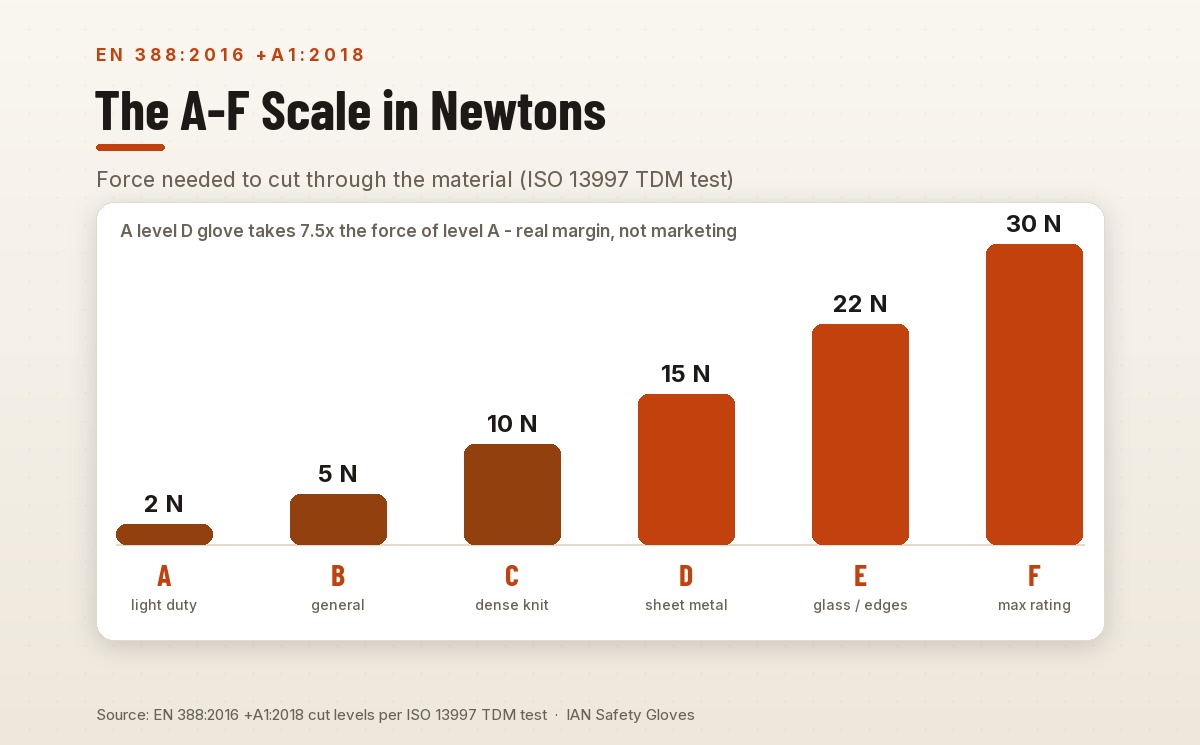
The TDM test measures the force needed to cut through the glove material with a 20 mm stroke — a much more realistic simulation of how a sharp edge actually behaves against fabric. The cut level letter corresponds directly to the measured force in Newtons:
| Cut level | Force required (ISO 13997) | Typical construction |
|---|---|---|
| A | 2 N | Basic HPPE/nylon blend, light duty |
| B | 5 N | HPPE knit, general handling |
| C | 10 N | Denser HPPE knit or blended liner |
| D | 15 N | Engineered HPPE / fibreglass blend |
| E | 22 N | High-density HPPE, multi-layer knit |
| F | 30 N | Maximum rating, specialty yarn systems |
Read the table this way: a level D glove requires 15 Newtons of force to cut through — 7.5 times more force than a level A glove. That is why moving from A2 to A4 in a metalworking environment changes the safety outcome far more than the price difference suggests.
One important note on marking format: the Coupe index (third digit in the six-symbol row, e.g. the "2" in 4X42F) and the TDM letter (fifth position) can differ for the same glove. German procurement documents increasingly specify the TDM letter only, because it is the more conservative and reproducible figure. When you brief your supplier, state explicitly that you specify cut level per ISO 13997 — not per the circular blade index.
Choosing the Right Level by Task
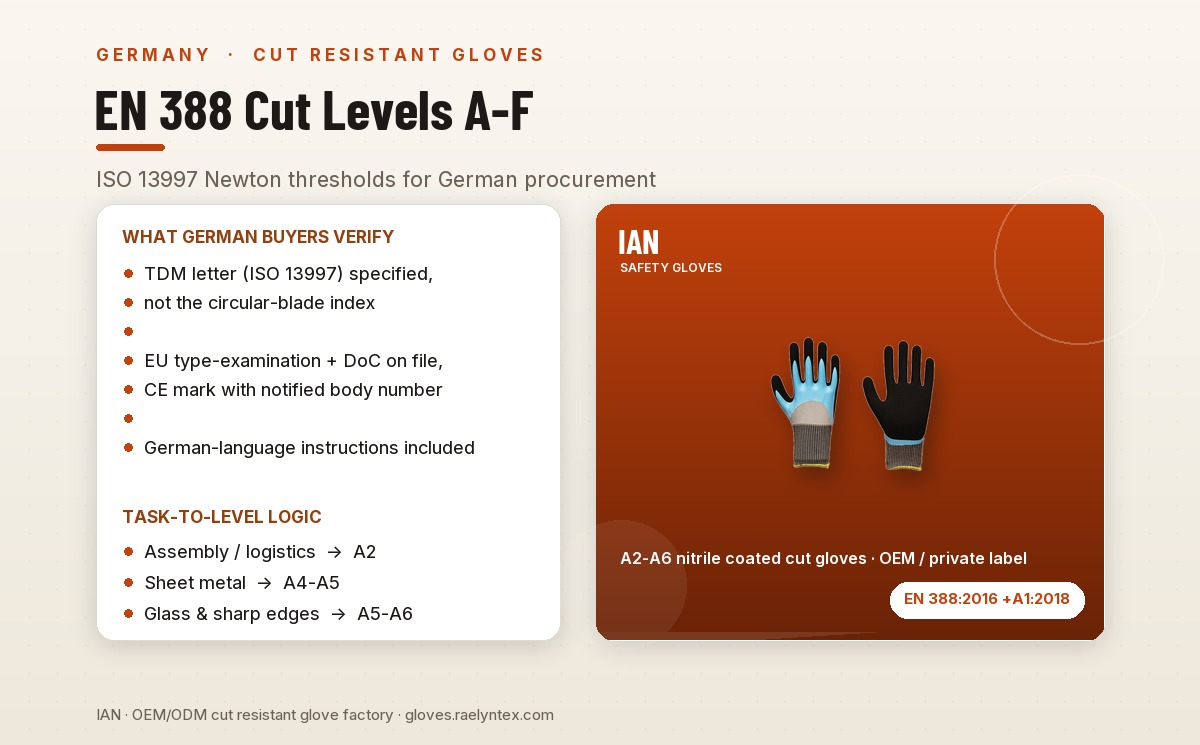
German industrial customers rarely ask for "the highest level" — they ask for the level that matches the hazard without sacrificing dexterity, because an over-gloved worker handles parts slower and more clumsily. The matrix below reflects the task-to-level logic our German customers use most often:
| Application | Recommended level | Typical glove type |
|---|---|---|
| General assembly, warehousing, logistics | A2 | Nitrile coated cut resistant gloves, 13–15 gauge |
| Appliance assembly, plastics, packaging | A2–A3 | Lightweight PU coated cut gloves |
| Metal stamping, sheet metal handling | A4–A5 | HPPE liner + sandy or foam nitrile |
| Glass handling, sheet metal with sharp edges | A5–A6 | Kevlar/HPPE blend, reinforced palm |
| Metalworking with oily parts | A4–A6 | Sandy nitrile coating for oil grip |
| Automotive assembly with impact risk | A2–A4 + impact | Cut glove with TPR back-of-hand protection |
For each of these scenarios the selection logic is the same: the liner yarn system sets the cut level, the coating sets the grip and chemical profile, and the gauge sets the dexterity. A 13-gauge A2 nitrile coated glove feels like a second skin for precision assembly, while an A6 Kevlar blend is built for glass and sharp sheet metal where the cost of one accident dwarfs the glove price.
If your programme includes impact zones — common in German automotive and machinery assembly — combine the cut rating with the impact standard: our TPR impact resistant gloves carry both EN 388 cut levels and back-of-hand impact protection, and our glass and metalworking guide shows how one glove can serve a mixed-hazard line.
What German Buyers Verify Before Ordering
Based on hundreds of enquiries from German importers, this is the checklist that decides whether a sample moves to a trial order:
-
EU type-examination certificate. Category II PPE requires a Module B type-examination by a notified body. German buyers check the four-digit notified body number on the CE mark and verify the certificate matches the exact product model.
-
Declaration of Conformity. Issued per production batch model, listing the standard (EN 388:2016 +A1:2018) and the notified body. Distributors keep it on file for market surveillance checks.
-
German-language instructions for use. The PPE Regulation requires instructions in the language of the market. Shipping English-only leaflets is one of the most common reasons a shipment gets held up at the German border or rejected in retailer audits.
-
REACH compliance of coatings and liners. Skin contact materials must comply with REACH restricted substances and SVHC requirements. Our guide to nitrile coated gloves for the German market covers this in detail — the same logic applies to cut resistant liners and their coatings.
-
Marking accuracy. The cuff label must show the exact test result. If the label says 4X42F, the certificate must say 4X42F. We have seen orders rejected because a supplier printed an A4 label on a glove certified only for level C — a credibility-destroying mistake in the German market.
-
Size range completeness. German industrial end users expect the full size run 7–11 (S–XXL). Sizing consistency across a production run matters as much as the cut level itself; see our hand measurement and sizing guide.
OEM/ODM Support for German Importers and Brands
IAN is an OEM/ODM glove factory — we manufacture cut resistant gloves under our customers’ own brands, and we do not compete with them by selling our own label in Europe. For German buyers this translates into a specific working model:
-
Custom cut levels and constructions. We develop liners and coatings to hit a target level — A2 for volume programmes, A4/A5 for metalworking, A6 blends for glass — and adjust gauge (13/15/18) to match the dexterity your customer segment demands.
-
Low MOQ trial orders. First orders start at trial quantities so you can validate the product with your industrial end users before committing to container volumes.
-
Private label and custom packaging. Your logo on the cuff label, your artwork on the header card, your language on the instructions — including German-language leaflets prepared to the Regulation’s requirements.
-
Samples before commitments. Sample pairs with the exact construction you specify, so your QA team can run their own TDM verification before the type-examination is filed.
Related Reading
-
Cut Resistant Gloves: Levels, Materials, Applications & Buyer’s Guide
-
Cut Resistant Gloves for Metalworking and Glass Manufacturing
-
PPE Regulation (EU) 2016/425 and CE Marking: Importer’s Guide
-
Nitrile Coated Gloves for Germany: EN 388 and REACH Compliance
-
Work Glove Size Guide: How to Measure Hand and Choose Right Fit