PPE Regulation (EU) 2016/425 and CE Marking: What Glove Importers Must Verify
Every few months a buyer sends us a compliance folder that looks, at first glance, completely in order. There is a CE mark on the packaging. There is an EU declaration of conformity on letterhead. There is a test report with EN 388 results in a table. And then someone checks the model number on the type-examination certificate against the model number in the purchase order, and finds they are not the same glove.
This is the single most common failure we see in European glove procurement, and it almost never comes from bad faith. It comes from suppliers who genuinely passed a certification process years ago, for a product that has since been modified, extended into a family of variants, or replaced with a cheaper palm compound — while the paper trail stayed frozen at the original approval.
This guide is written for importers, distributors and private-label brands who need to verify rather than trust. It explains what CE marking on a work glove actually asserts under Regulation (EU) 2016/425, how the risk category determines which conformity route applies, exactly which documents you are entitled to demand, how to check them in about twenty minutes, and what changed in the harmonised standards during 2026.
1. What the CE mark on a glove does and does not mean
Regulation (EU) 2016/425 replaced Directive 89/686/EEC and has applied in full since 21 April 2018. It is a regulation, not a directive, which matters for one practical reason: it applies identically in every member state without national transposition, so there is no such thing as a country-specific interpretation of what a compliant glove is.
When a manufacturer affixes the CE mark, they are making a legal declaration that the product meets the essential health and safety requirements in Annex II of the Regulation, that a conformity assessment has been carried out according to the product’s risk category, and that they hold the technical documentation to prove it. Article 17 requires the marking to be affixed visibly, legibly and indelibly on the PPE itself — and only where that is genuinely not possible, on the packaging and accompanying documents.
What the CE mark does not mean is equally important:
-
It is not a quality grade. It says a glove meets the performance levels declared for it, not that those levels are high.
-
It is not transferable. A certificate issued for one construction does not cover a different liner, a different palm compound, a different gauge, or a different cuff.
-
It is not permanent. Type-examination certificates have a maximum validity of five years, and the obligations continue after issue.
-
It is not a substitute for the paperwork. A CE mark without an accessible declaration of conformity and technical file is, from an enforcement standpoint, an unmarked product.
For a glove whose whole competitive advantage is a performance level — cut level E, a stable antistatic result, a grip that holds through oil — this distinction decides whether the product you are selling in Hamburg is the product that was tested.
2. The risk category is the hinge everything else swings on
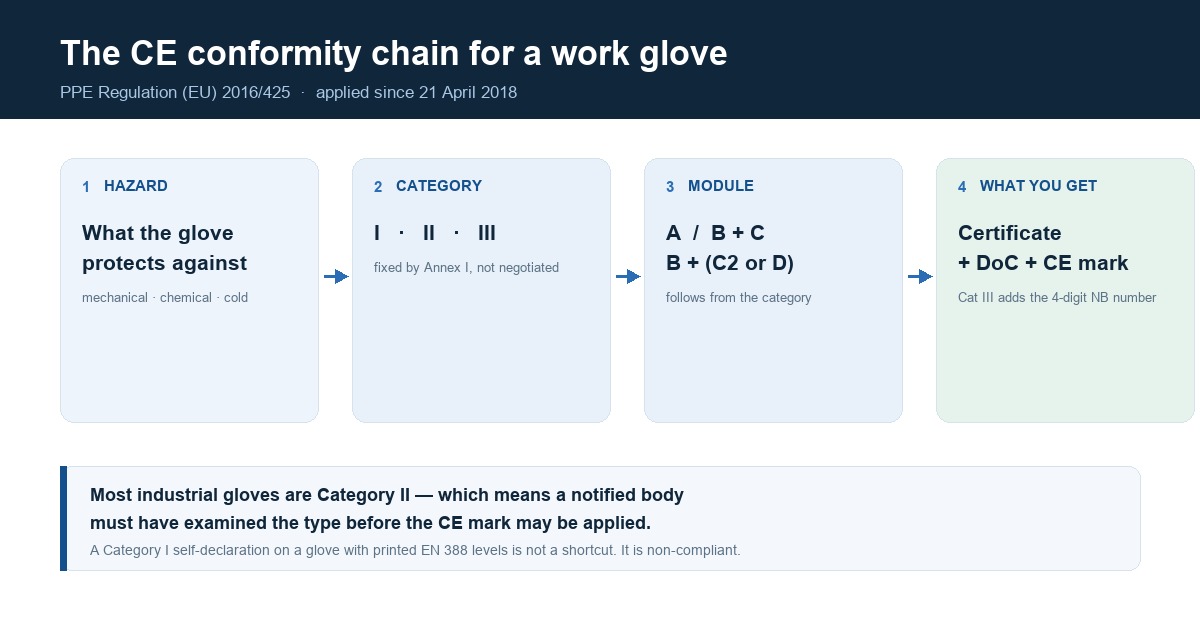
Article 18 classifies PPE into three categories by the severity of the risk it protects against, and Annex I defines them. The category is not chosen by the manufacturer or negotiated with the buyer. It follows from the hazard.
| Category | Definition (Annex I) | Where gloves usually land |
|---|---|---|
| I | Minimal risk only: superficial mechanical injury, contact with mildly aggressive cleaning agents, contact with hot surfaces below 50 °C, non-lethal atmospheric conditions, sunlight, humidity | Garden and household gloves with no declared mechanical performance. Very few industrial gloves qualify. |
| II | Every risk not covered by I or III — the default category for occupational hand protection | EN 388 mechanical protection, cut-resistant, impact/TPR, nitrile and latex coated, PU assembly, EN 511 cold protection (above −50 °C), EN 16350 antistatic |
| III | Mortal danger or serious irreversible harm: chemical and biological agents, ionising radiation, high temperature ≥100 °C, low temperature ≤ −50 °C, high-pressure jets, hand-held chainsaw cuts | EN 374 chemical protective gloves, gloves for high-voltage work, gloves for biological hazards |
The trap sits in the first row. Because Category I allows self-declaration with no notified body involved, it is dramatically cheaper and faster — and every year a supplier re-labels an industrial handling glove as Category I on the argument that the risk is "only mechanical, only minor". If a glove carries a declared EN 388 performance level, it is not a Category I product. A Category I declaration attached to a glove with a printed abrasion or cut score is not a conservative choice; it is a non-compliant one, and the importer carries part of that exposure.
3. Which conformity module each category triggers
Article 19 sets out the routes. This is where the paperwork you receive is determined, and it explains why some suppliers can produce a certificate in three days and others take four months.
| Category | Conformity assessment route | Notified body involvement | What the buyer should receive |
|---|---|---|---|
| I | Internal production control (Module A) | None | EU declaration of conformity, technical file, CE mark |
| II | EU type-examination (Module B) + conformity to type by internal production control (Module C) | Module B only; no ongoing surveillance | EU type-examination certificate + DoC + CE mark |
| III | Module B plus either Module C2 (supervised product checks at random intervals) or Module D (quality assurance of the production process) | Module B plus continuing audit or sampling | Certificate + DoC + CE mark followed by the body’s four-digit number |
Two details matter commercially. First, for Category III the four-digit identification number of the notified body must follow the CE mark, affixed by the body itself or under its instructions. If you see a plain CE mark on a chemical protective glove with no number, ask why. Second, Module D is not a one-off audit: it is a quality-system certification that the notified body maintains and can suspend, which is why a Category III supplier’s paperwork has a living audit history behind it rather than a single PDF from 2019.
4. The six documents worth demanding
A serious supplier can assemble all six within a working day. A supplier who can only produce a test report and a logo file is telling you something useful.
| Document | What it must show | Typical failure |
|---|---|---|
| EU type-examination certificate | Notified body name and four-digit number, approved model identification, applicable standards and editions, performance levels, issue and expiry date | Certificate covers "the XYZ series"; your model is not listed |
| EU declaration of conformity | Manufacturer identity, product description and type, the Regulation cited, harmonised standards applied, notified body and module, place and date, signatory | Generic template with no standard editions and no notified body reference |
| Test reports | Accredited laboratory, the actual standard and year (EN 388:2016+A1:2018), per-test results, sample description matching the product | Results quoted as a summary table with no laboratory, no sample ID, no year |
| Technical file summary | Construction, materials, layer stack, risk analysis, marking and instructions artwork. Retained by the manufacturer for ten years. You do not need the full file — you need to know it exists and what it covers | "Available on request" that never arrives |
| EU authorised representative mandate | Written mandate naming an entity established in the Union, with its address, for manufacturers outside the EU | No representative at all — the goods are then not lawfully placed on the market |
| Marking and traceability artwork | CE mark, standard numbers and performance levels, manufacturer name and address, model, batch or date code, size, care instructions, information supplied by the manufacturer | Pictograms printed without levels, or no batch code to tie the pair to the test |
The authorised representative point is the one most often lost in translation. A manufacturer outside the Union cannot simply ship; they must have a written mandate with an economic operator established in the EU, and the importer in turn must be able to put their own name and address on the product or its packaging. If you are buying from a trading company, establish which of you is the importer before the container sails, because Article 7 obligations land on whoever places the goods on the Union market.
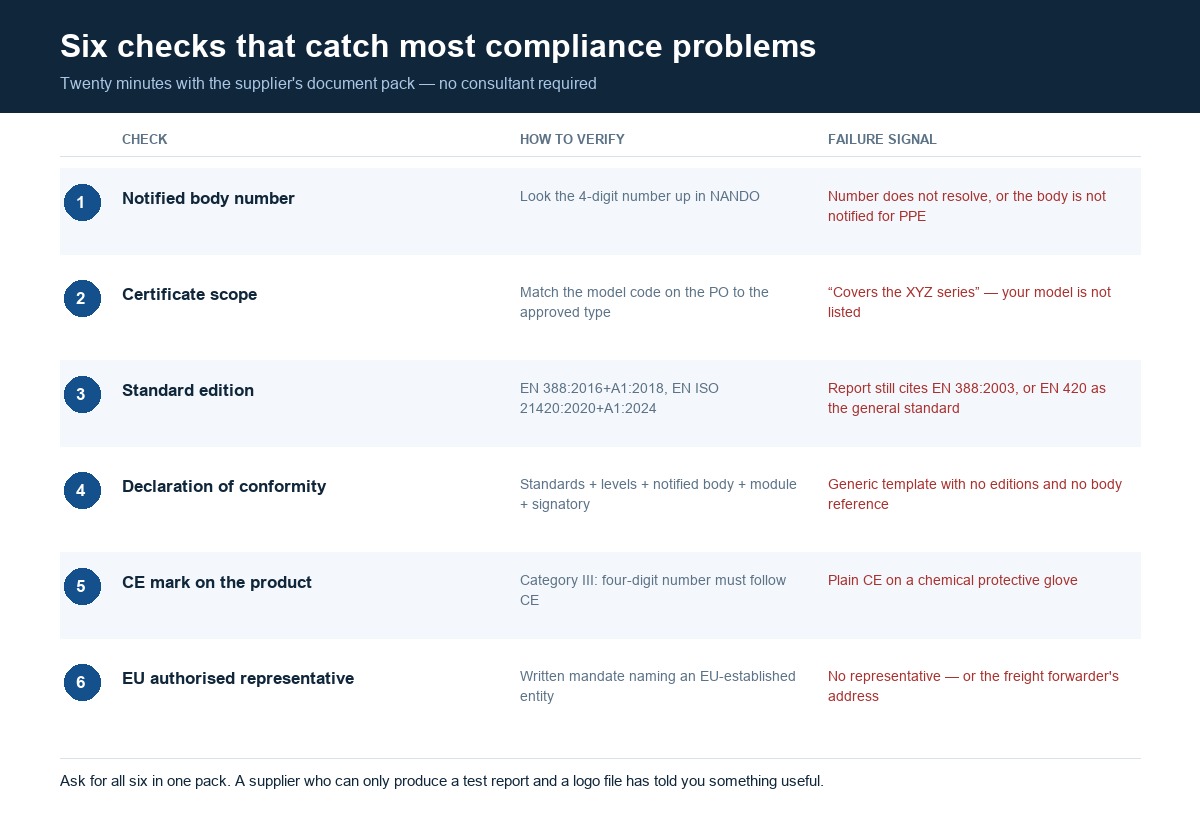
5. Twenty minutes of verification that catches most problems
None of this requires a consultant. It requires four checks.
Check the notified body number in NANDO. The Commission’s NANDO database lists every notified body, its four-digit number, the Regulation it is notified under, and the scope of tasks it is authorised to perform. A number that does not resolve, or resolves to a body not notified for PPE, ends the conversation.
Check the certificate scope against your actual model. Not the family name, not the product line — the model code on your purchase order. Then look at what the certificate says was tested: gauge, liner, coating, cuff. A certificate that approves a 15-gauge sandy nitrile glove does not approve the 13-gauge foam version your buyer prefers.
Check the standard edition. Performance claims are only meaningful against a version. EN 388:2016+A1:2018 is the reference for mechanical risk; a report quoting EN 388:2003 tells you the glove was tested against a scheme that has since been replaced, including the change in how cut resistance is expressed.
Check that the declaration matches the certificate. Same manufacturer name, same model, same notified body, same standards. Mismatches are usually administrative sloppiness from a trading company assembling a folder from three factories — which is exactly the situation you want to discover before your customer’s safety officer discovers it.
6. What changed in 2026, and what it does not mean
On 16 June 2026 the Commission published Implementing Decision (EU) 2026/1279, replacing Decision (EU) 2023/941 and consolidating the references to harmonised standards supporting Regulation (EU) 2016/425. It was corrected on 12 November 2026 by Implementing Decision (EU) 2026/2505 on specific points concerning hairdresser protective gloves, rain protective clothing, and eye and face protection.
Two consequences for glove buyers:
-
EN ISO 21420:2020+A1:2024 is the current general requirements standard for protective gloves, listed in Annex I of the decision. Its predecessor, EN 420:2003+A1:2009, remains listed in Annex II with its reference withdrawn on 16 December 2027. If a supplier’s technical file still cites EN 420 as the governing general standard with no migration plan, that is a dated file, not necessarily a non-compliant glove — but it is a conversation to have now rather than in the last quarter of 2027.
-
A new harmonised standards decision does not by itself invalidate existing certificates. What it does is shift the burden of proof: the manufacturer must consider whether the changed standards affect the product’s demonstrated conformity, and the notified body has an ongoing obligation to review approved types. So the right question is not "was your certificate issued before June 2026", but "does your technical file reflect the standards currently listed".
This is also the correct answer to the annual panic email that goes round every distributor’s inbox after a standards update: nobody needs to re-certify an entire catalogue because a decision was published. They need to check scope, edition and monitoring status, and record that they checked.
7. Eight red flags in a supplier’s compliance pack
-
A "CE certificate" that is actually a test report. Test reports are inputs to conformity assessment; they are not certificates.
-
A Category I declaration attached to a glove with declared EN 388 levels.
-
A plain CE mark on a chemical protective glove with no four-digit notified body number.
-
An expired type-examination certificate presented as current, with no renewal in progress.
-
A certificate whose approved type is a product family, with no annex listing your model.
-
A declaration of conformity citing no harmonised standards, or citing them without years.
-
No EU authorised representative, or a representative address that turns out to be the freight forwarder.
-
Marking artwork with pictograms but no performance levels — the mark becomes decoration.
8. What is coming next: digitalised conformity documents
The Omnibus IV simplification package (COM(2025) 504, procedure 2025/0134(COD)) would amend Regulation (EU) 2016/425 along with several other product regulations to require the EU declaration of conformity in electronic form, accessible via an internet address or machine-readable code, plus a "digital contact" for economic operators, with most digitalisation measures deferred by 24 months after entry into force and certain provisions deferred to 20 January 2027.
It is not something to rebuild a document workflow around today, but it is a reasonable question to put in a supplier questionnaire this quarter: can you produce your declaration of conformity as structured data, and can you point a machine-readable code at it? Suppliers who answer yes will be materially easier to keep when the requirement lands. The same logic applies to the digital product passport infrastructure now being rolled out for other product groups; gloves are not in the first wave, but the direction of travel for CE-marked goods is not in doubt.
9. The purchase order clauses that prevent all of this
Compliance problems are cheaper to prevent at the PO stage than to resolve at the port. Five clauses cover most of it:
-
Model-level certification clause: "Supplier warrants that the goods conform to EU type-examination certificate No. [x] issued by notified body [name, 4-digit number], covering model [code] as specified in Annex A."
-
Change notification clause: any change to liner, gauge, coating compound, cuff, or production site requires written notice and, where applicable, certificate amendment before shipment.
-
Document pack clause: DoC, certificate, test reports and marking artwork supplied with each shipment or on a maintained shared link, in the language of the destination market.
-
Audit right clause: right to request the technical file summary and to verify the notified body number independently.
-
Traceability clause: batch or date coding that allows any delivered pair to be tied to a production period and a test sample.
10. Frequently asked
Is a UKCA mark still needed for Great Britain? Yes, in parallel with CE for the GB market, and the two regimes are separately administered. A CE-only pack is fine for the EU and Northern Ireland; Great Britain needs its own conformity route.
Do I need a new certificate if I put my brand on the glove? Private label does not change the manufacturer of the PPE. The certificate stays with the entity that holds it; your obligations as the brand owner depend on whether you are placing the product on the market as manufacturer, importer or distributor. Get this written down, because in practice most own-brand importers are the importer and sometimes the manufacturer for the purposes of the Regulation.
How long should compliance paperwork be kept? The manufacturer keeps the technical documentation and the EU declaration of conformity for ten years after the PPE has been placed on the market. Importers keep a copy of the declaration and ensure the technical documentation can be produced on request.
Are EN 388 cut levels directly comparable with ANSI/ISEA 105? No. The two schemes use different test methods and different scales, and the conversion tables in circulation are approximate at best. If you are switching a product between markets, re-test rather than convert — we covered the mapping problems in our comparison of EN 388 and ANSI/ISEA 105.
Working with a supplier who expects to be asked
Raelyn Textile Technology manufactures coated work gloves in China for European distributors and private-label brands, across nitrile coated, latex coated, cut resistant, ESD and antistatic, and TPR impact resistant lines. Our technical files are maintained against the currently listed harmonised standards, and the document pack described in section 4 is issued as standard for EU-bound orders rather than on request.
If you are auditing an existing supplier’s paperwork and want a second opinion on what is missing, or you need to know what a specific glove in our range is certified to before you specify it, send the details through the contact form — we answer compliance questions with the certificate number and the standard edition, not with adjectives. You can also see the full range on the products page, read how to decode the six digits of the EN 388 pictogram, or see how the same logic applies to EN 16350 antistatic certification and to the US hand protection requirement under OSHA 29 CFR 1910.138.
This article summarises Regulation (EU) 2016/425 and the harmonised standards listed in Implementing Decision (EU) 2026/1279 for procurement purposes. It is not legal advice; for a specific product or market, confirm the applicable requirements with your notified body or a qualified compliance adviser.
Related reading: PU coated gloves buyer’s guide · cut resistant gloves buyer’s guide · ESD and anti-static gloves buyer’s guide · gardening gloves buyer’s guide