Nitrile Coated Gloves for German Industrial Buyers: EN 388 Ratings and REACH Compliance
German industrial buyers rarely open a nitrile glove enquiry with a price question. They open it with a document request: EN 388 test report, EU declaration of conformity, REACH statement, and — increasingly — a question about which harmonised standard edition the certificate was issued against. That order is not politeness. It reflects how the purchase will be defended internally when the Berufsgenossenschaft inspector or the customer audit arrives.
This guide is for German distributors and private-label buyers sourcing nitrile coated gloves from Asia. It covers the three layers that decide whether a container clears goods-in — the PPE Regulation, EN 388 marking and REACH — plus the German national layer above them, and the specification language worth putting into the purchase order.
1. Start with the risk category, not the glove
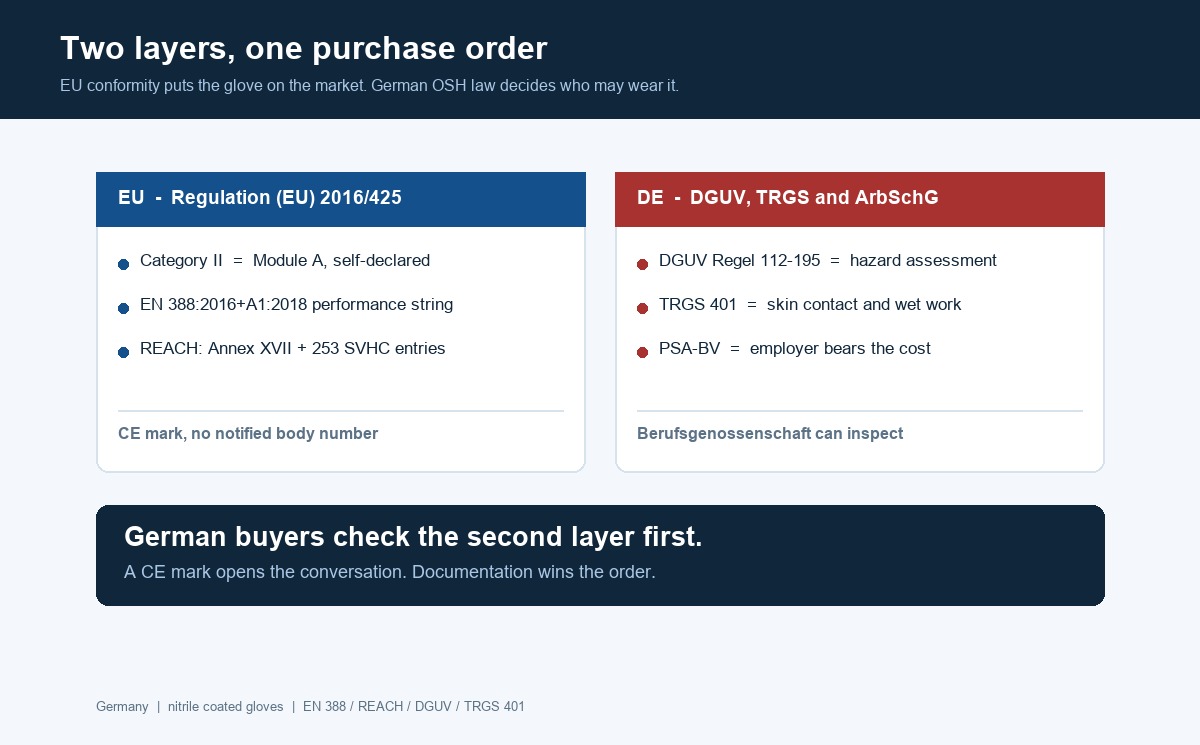
Under Regulation (EU) 2016/425, a general-handling nitrile coated glove falls into Category II — intermediate risk. That single classification determines almost everything about the paperwork:
-
Category II is self-certified. The manufacturer carries out the conformity assessment internally (Module A), draws up the technical file, issues the EU declaration of conformity and affixes the CE mark. No notified body number appears after the CE mark.
-
Category III — chemical permeation, high-temperature, and other risks of serious irreversible harm — requires a notified body: Module B type-examination combined with Module C2 or Module D surveillance. Here a four-digit notified body number must follow the CE mark, and the certificate has a maximum validity of five years.
The practical consequence: a nitrile palm glove carrying a four-digit number after the CE mark is not Category II, and a Category III glove with no notified body number is defective. Both errors are common in offers assembled from a competitor’s datasheet. The full document chain is set out in our guide to PPE Regulation (EU) 2016/425 and CE marking.
One date matters for 2026 renewals. Commission Implementing Decision (EU) 2026/1279 of 12 June 2026 replaced Decision (EU) 2023/941 and consolidated the harmonised standards supporting the Regulation. EN ISO 21420:2020+A1:2024 now sits in Annex I with presumption of conformity; EN 420:2003+A1:2009 moves to the transition list, where its presumption ends on 16 December 2027. A certificate issued against EN 420 is not illegal today, but it needs re-issuing before that date — worth asking about before signing a three-year framework.
2. Reading the EN 388 string on a nitrile palm
The current edition is EN 388:2016+A1:2018. Six positions, always in the same order: abrasion, coupe cut, tear, puncture, ISO 13997 cut, impact.
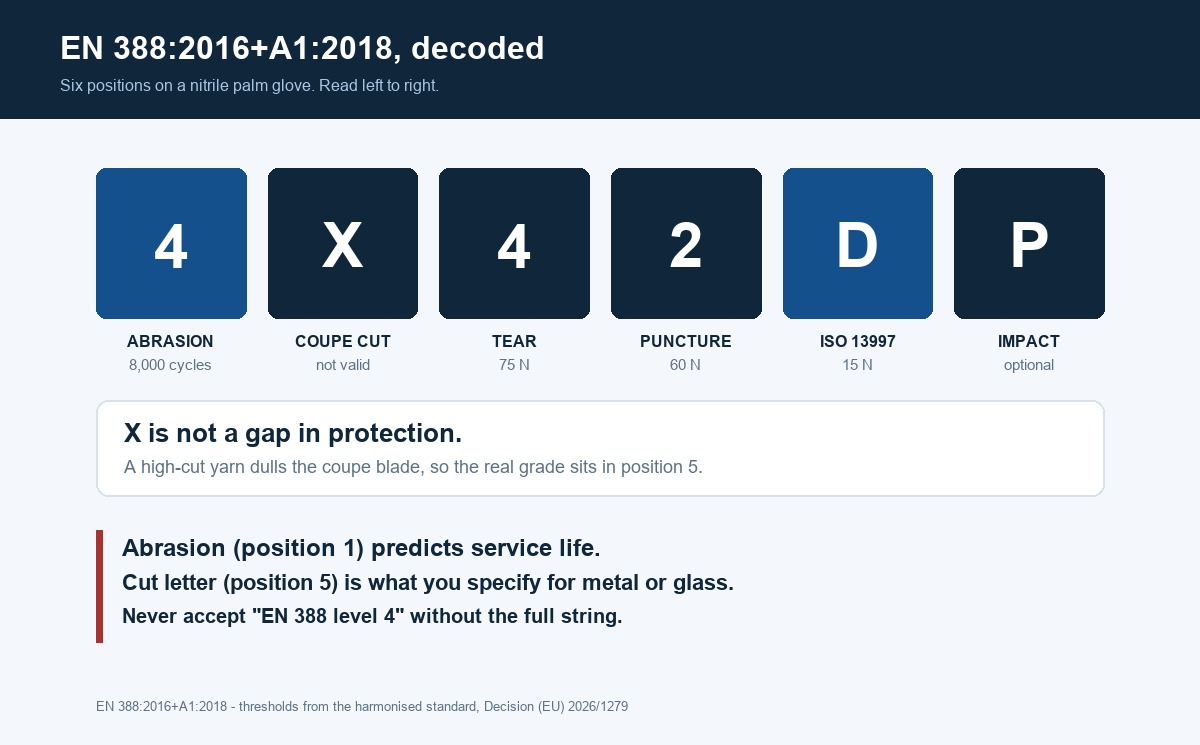
Three positions decide most nitrile glove disputes:
-
Abrasion (position 1, 0–4). Level 4 means 8,000 cycles or more; level 3 starts at 2,000. On a dipped nitrile palm, abrasion is largely a function of compound quality and coating thickness — this is the number that predicts service life in handling work, and the one worth arguing about. A single-dip 13-gauge palm at abrasion 4 is achievable; a claim of 4 combined with an unusually low price deserves the test report.
-
Coupe cut (position 2, 0–5 or X). The rotating blade blunts as it cuts, which flatters high-performance yarns. That is why the 2016 revision added the TDM test, and why a modern cut-rated glove often shows X in position 2 with the real answer in position 5. An X is not a missing test — it is the correct marking for a yarn the coupe method cannot grade.
-
ISO 13997 / TDM cut (position 5, A–F). A straight blade under increasing load: A ≥ 2 N, B ≥ 5 N, C ≥ 10 N, D ≥ 15 N, E ≥ 22 N, F ≥ 30 N. For a nitrile glove used on sheet metal or glass, this letter is the one to specify. Our six-digit EN 388 pictogram walkthrough decodes every position with worked examples.
Two buying rules follow. First, never let a supplier quote a single number — "EN 388 level 4" is not a statement, because four different properties are scored 0–4. Second, do not compare an EN 388 letter with an ANSI/ISEA 105 level as if they converted: they are different test procedures and units. If your customer also sells into North America, read EN 388 versus ANSI/ISEA 105 before writing a dual claim.
3. The German layer: DGUV, TRGS 401 and the cost rule
EU conformity gets the glove onto the market. German occupational safety law decides whether your customer can issue it to a worker.
DGUV Regel 112-195 ("Benutzung von Schutzhandschuhen") is the operative rule for selection and use: a documented hazard assessment, gloves matched to the identified risk, provision free of charge, fit testing across sizes, instruction on donning and doffing, and records of the selection rationale. The cost rule is statutory — under § 3(3) ArbSchG and the PSA-Benutzungsverordnung (PSA-BV), the employer pays for PPE. A distributor quoting a glove that fails the hazard assessment is not losing a margin argument; they are creating a documentation gap for their customer.
TRGS 401 governs skin contact with hazardous substances, and it is where nitrile gloves are most often mis-specified. Prolonged wear of liquid-tight gloves causes maceration and loss of barrier function, so German site rules often require a liner under a coated glove rather than longer wear of the same pair. And powdered or protein-rich natural rubber gloves are not to be worn — the allergen and asthma risk is settled German practice. That single rule is one of the strongest arguments for nitrile in German plants, and worth naming explicitly in a quotation.
4. REACH: the three numbers checked at goods-in
REACH is where a technically excellent glove fails on chemistry. For nitrile coated industrial gloves, German buyers test or request evidence on three restriction entries:
-
Annex XVII entry 50 — PAH. A 1 mg/kg limit applies to each of eight polycyclic aromatic hydrocarbons in rubber or plastic components that come into contact with skin. Coatings and rubberised cuffs are in scope.
-
Annex XVII entry 61 — DMF (dimethyl fumarate). 0.1 mg/kg in the article or any part of it, with no market placement above that level. The mould-prevention sachet in a carton is the classic failure point, not the glove.
-
Azo colourants. Restricted under Annex XVII for textiles and leather; relevant the moment a liner or cuff is dyed, and the reason "any colour you like" is a riskier answer than it sounds.
Above the restriction list sits the SVHC candidate list. ECHA’s update of 4 February 2026 added n-hexane and bisphenol AF and its salts, bringing the list to 253 entries. The duty that matters for a glove is Article 33: if a candidate-list substance is present above 0.1 % w/w in the article, the recipient must receive enough information for safe use, and consumers must be answered within 45 days. Where the tonnage thresholds are met, SCIP notification also applies.
Finally, EN ISO 21420:2020+A1:2024 pulls several of these into the product standard itself. It sets innocuousness limits — chromium VI in leather below 3 mg/kg, pH 3.5–9.5, nickel release from metal parts, azo dyes, PAH, and dimethylformamide below 1,000 mg/kg in polyurethane-containing material — and it makes batch traceability mandatory: date of manufacture and/or batch number on every glove. That last requirement is the one most Asian factories still fail, and it is cheap to fix before the order ships rather than after.
5. Specification language that survives an audit
German buyers get better offers when the enquiry is unambiguous. Five lines do most of the work:
-
Construction: 13-gauge or 15-gauge seamless knit liner, nitrile palm dip, palm thickness range in millimetres, coating type (sandy, foam or smooth).
-
Performance: minimum EN 388 code, position by position — for example abrasion 4, ISO 13997 cut at least C — tested to EN 388:2016+A1:2018, with the report reference.
-
Category and documents: PPE Category II, Module A; supply EU declaration of conformity, test reports, REACH statement covering Annex XVII entries 50 and 61 plus the current SVHC list, and EN ISO 21420 innocuousness data.
-
Traceability: batch number and month/year of manufacture printed on each glove or on the polybag, not only on the carton.
-
Packaging: German-language user information per EN ISO 21420, size marking, and a declaration that no DMF sachets are used in the export carton.
Where the application is precision handling rather than general handling, the coating choice matters more than the gauge: smooth nitrile for dry component handling, sandy nitrile where oil or coolant is present, and abrasion-resistant sandy nitrile for abrasive parts that destroy a standard palm in days. Buyers dealing with oily stamped parts usually land on oil-resistant nitrile, while assembly lines that need grip on smooth plastic housings tend to prefer a dotted palm. If the risk includes sharp edges underneath the mechanical hazard, a cut level A4 nitrile glove is the usual starting point.
Sizing is the quiet cause of most complaints. German workforces span a wide hand circumference range, and a glove that is one size small fails at the cuff within a shift. Take the measurements from our work glove size guide and specify the size curve in the order, not just the total quantity.
6. Lead time, and why the paperwork should start first
Sea freight from Ningbo to Hamburg or Bremerhaven runs roughly four to five weeks port to port, plus clearance and inland delivery. A first order against a new specification realistically needs six to eight weeks from artwork approval to goods-in, because the EN 388 report and REACH statement should be generated against the exact construction being shipped — not borrowed from a sister model. Chemistry and mechanical testing only run in parallel with production if the sample is frozen early. Change the liner gauge after the report is issued and the report no longer describes the product in the container; a German audit will find it. Freeze the construction, test it, then produce.
7. What we can supply
We manufacture nitrile coated gloves for industrial handling, and we supply the documentation German buyers ask for: EN 388 reports against the current edition, EU declaration of conformity, REACH statements covering the restriction list and the current SVHC candidate list, and batch-level traceability on the product. Our product ranges cover palm-coated nitrile from 13 to 18 gauge in smooth, sandy, foam and dotted finishes, with cut-resistant options from A2 to A5.
If you are specifying for a German site, send the hazard description and the size curve rather than a competitor’s part number — we will come back with a construction, the performance levels it can hold, and the documents that support them. Start at contact us, or read more about our factory and certifications. For chemical protection or antistatic handling gloves, our notes on EN 16350 antistatic requirements cover the electrostatic side of the same story, and the news archive tracks standards updates as they publish.
Related reading: industrial buyer’s checklist for nitrile coated gloves