Gardening Gloves Buyer Guide: Materials, Coatings and Thorn Protection
A gardener will forgive a scratch on the knee long before a blister on the palm. The glove is the tool that touches everything — wet soil, thorny canes, fertiliser, rough timber — and yet it is the piece of kit most people buy last and replace most often. This guide organises the whole market around one question: what job is the glove actually doing? Answer that, and the material, coating and cuff length all follow. Browse our full range in the gardening gloves collection.
The Four Jobs Every Gardening Glove Must Do
Strip away the marketing and a gardening glove has four measurable jobs:
-
Grip wet surfaces. Soil, roots and tools are almost always damp. A smooth palm that slips when wet is the number one reason gloves get thrown in the shed drawer.
-
Resist punctures. Thorns, briars and cane ends are pointed loads. They defeat fabric differently than blades do — more on this below.
-
Breathe. Hands sweat. A glove worn for two hours of weeding must let moisture escape or it comes off, and an off-glove protects nothing.
-
Keep the dirt out. A snug wrist or extended cuff stops soil, mulch and insects getting inside the glove.
Every popular gardening glove is a different trade-off between these four. There is no single "best" — only the best match for the task in front of you.
Glove Materials and Coatings Compared
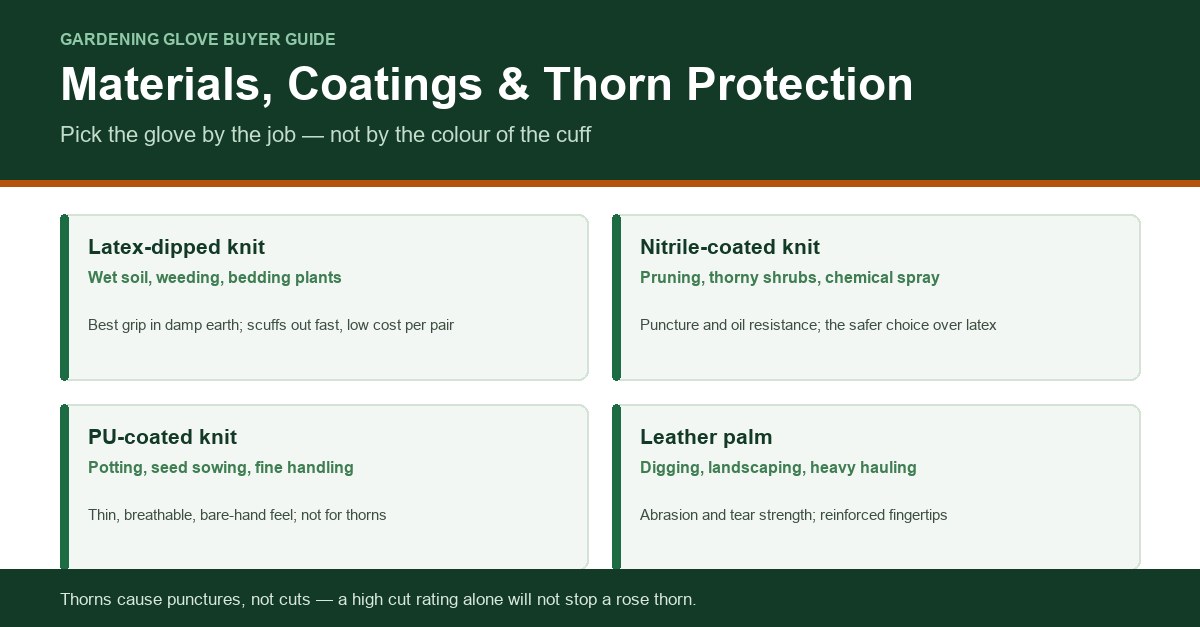
Latex-Dipped Knit
The classic gardening glove: a cotton or polyester knit shell with a latex coating on the palm and fingertips. Crinkle (rough) latex finish grips wet soil exceptionally well and shrugs off abrasion from sand and grit. Latex stays flexible in cool weather better than most coatings, which is why it dominates spring and autumn ranges. Trade-offs: it scuffs out faster than nitrile, and latex triggers skin allergies in a minority of users. It is the right default for weeding and general bedding work, and its low cost per pair makes it the volume seller for retailers.
Nitrile-Coated Knit
A nitrile coating is the upgrade pick. Nitrile resists oils, fertilisers and many garden chemicals far better than latex, and a fully-dipped nitrile palm keeps water out of the liner. Foam and sandy (textured) nitrile finishes hold grip on wet tools and smooth pots. For thorny work, a heavy nitrile dip on a dense knit is noticeably harder for briars to penetrate than a light latex coating. If your customers prune roses or handle anything chemical, this is the glove to recommend.
PU-Coated Knit
Polyurethane (PU) coatings are the thinnest of the three. A PU palm on a 13-gauge liner keeps nearly bare-hand feel, which gardeners love for potting, seed sowing and deadheading. The trade-off is protection: PU is a precision coating, not a barrier — no match for thorns, and it can flake when worked hard in damp soil. Position it as the comfort and dexterity option, priced and stocked accordingly.
Leather and Leather-Palm Gloves
Goatskin and pigskin leather remain unbeatable for digging, hauling and rough landscaping. Leather resists abrasion and tearing by bulk, keeps gripping when damp, and a reinforced palm-plus-fingertip construction survives seasons of spade work. Full-leather gauntlets (welding-style) are the traditional answer to serious thorn work — rose growers and blackberry clearers still swear by them. Cost and stiffness are the trade-offs; they are not gloves for sowing seeds.
Thorn Proof Gloves: What Actually Stops a Thorn
"Thorn proof" is the most-searched phrase in this category, so it deserves an honest engineering answer. A thorn is a puncture load, not a cut. That distinction matters because the industry’s headline numbers — EN388 cut levels, ANSI/ISEA A-ratings — measure cut resistance against a blade. A glove can score a high cut rating and still lose to a rose thorn, which slowly spreads fibres apart rather than slicing them. If your customers compare ratings, our EN388 pictogram guide explains which digit means what. For puncture-minded buyers, see our cut resistant gloves line for the high-performance options.
What genuinely defeats thorns, in order of effectiveness:
-
Leather thickness. A thorn slides across full-grain goatskin rather than through it.
-
Dense, heavily-dipped fabric. Multiple coats of nitrile on a thick knit leave no open path for the spike.
-
Layer distance. A long cuff that covers wrist and lower forearm stops the most common thorn injury — not on the palm, but the thin skin of the arm reaching past the cane.
Match the Glove to the Task
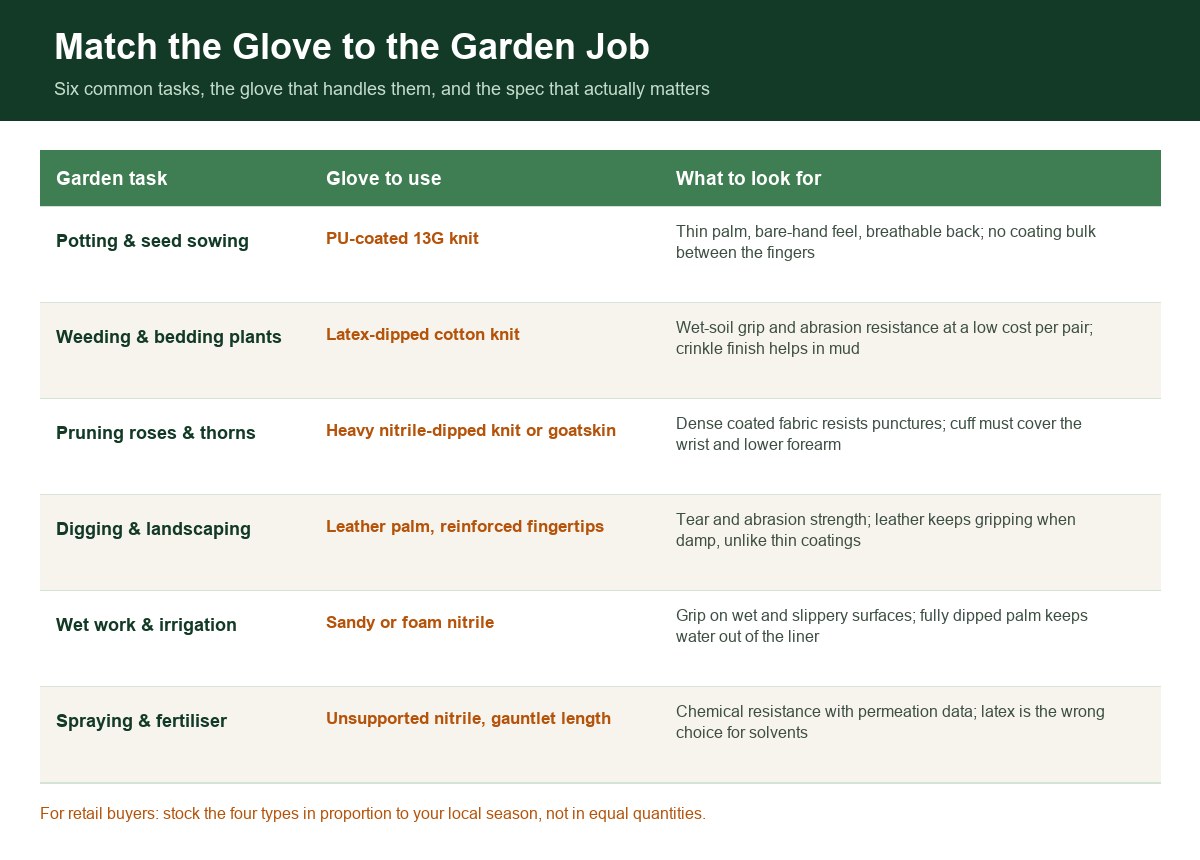
The matrix below is the version we recommend printing for the shop wall or including in a wholesale catalogue — it answers "which glove?" with a task instead of a spec sheet.
Fit, Sizing and Cuff Length
A glove that fights the hand gets taken off, and an off-glove has zero protection. Two fit rules cover most complaints: measure the palm circumference and match it to the size chart rather than guessing by habit, and always try the glove with the fingers slightly curled — a palm that bags when the hand closes is a size too big. Our work glove size guide has the measuring method and conversion chart. For cuff style: knit wrists suit everyday work, safety cuffs (open slits) suit frequent on-off jobs, and gauntlets belong on thorn and chemical duty.
Care and Lifespan
Coated knit gloves last dramatically longer with two habits: rinse off soil and fertiliser residue after use (fertiliser salts slowly rot coatings), and dry them away from direct heat, which stiffens latex and cracks PU. Leather gloves need an occasional leather conditioner and should never be machine-dried. A coated knit worn a few hours a week should deliver a season or more; leather, several seasons.
Frequently Asked Questions
Are nitrile gardening gloves better than latex?
For thorns, oils and chemicals — yes. For pure wet-soil grip on a budget, crinkle latex still holds its own. Stock both: latex for volume, nitrile for the premium tier.
What gloves stop rose thorns?
Full-leather gauntlets are the traditional answer; a heavy nitrile-dipped dense knit with a long cuff is the modern lightweight alternative. Any thin single-dip coating will be defeated.
Can gardening gloves be washed?
Coated knits: hand-wash in lukewarm water, air dry. Leather: wipe clean, condition, never tumble dry. Machine washing deforms coated palms.
Do gloves protect against fertiliser and pesticides?
Only nitrile with verified chemical-resistance data — and for spraying, an unsupported (unlined) nitrile gauntlet, not a coated knit. Latex is the wrong material for most solvent-based products.
Stocking Gardening Gloves for Retail and Wholesale
For garden centres, hardware chains and private-label buyers, the assortment that sells is not six similar gloves — it is one glove per job, in the right proportion for your local season: latex-dipped as the spring volume line, nitrile as the premium tier, PU for the precision gardener, leather for the landscaping customer. We manufacture all four families with private-label packaging, custom colours and low MOQs. Browse the product catalogue or request a quotation with your specification.
Related reading: foam nitrile coated gardening gloves · clear PU coated gardening gloves · printed polyester gardening work gloves · kids latex coated gardening gloves