Sandy Nitrile vs Foam Nitrile vs Smooth Nitrile: Which Coating Grip Do You Need?
Ask three suppliers for "nitrile coated gloves" and you can receive three products that feel nothing alike: one slippery and thin, one soft like a sponge, one rough enough to file a fingernail. All three are nitrile. The polymer is the same; the surface is not — and on a wet or oily job, the surface is what decides whether the glove grips or the part ends up on the floor.
This guide is about that surface. It compares sandy, foam and smooth nitrile as three different engineering answers to the same physics problem, explains how each is actually made, where each one fails after a few weeks of use, and how to write a purchase order that gets you the finish you approved rather than a cheaper lookalike.
1. Why a wet surface defeats a perfectly good glove
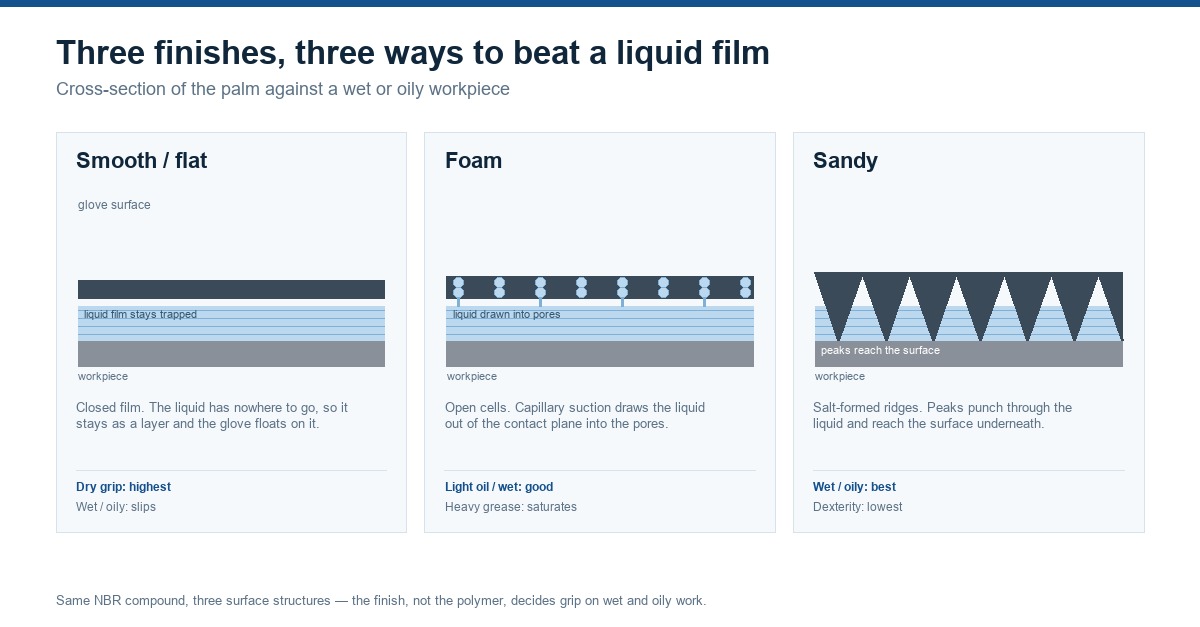
Grip is friction, and friction depends on two surfaces touching. Introduce a liquid film between them and the glove no longer touches the object at all — it floats on the liquid. This is the same mechanism as aquaplaning: the rougher or more porous the surface, the more easily it breaks the film and re-establishes real contact.
Every nitrile finish is one of three strategies for beating that film:
-
Displace it mechanically. Build peaks that punch through the liquid layer and reach the solid underneath. This is what a sandy finish does.
-
Absorb it. Build open pores that draw liquid away from the contact plane by capillary action, like a sponge. This is what a foam finish does.
-
Prevent it from reaching the hand at all. Build a continuous, non-porous film that is itself the barrier. This is what a smooth (flat) finish does — excellent against liquids, but it offers no mechanism to grip through them.
Once you see the three finishes that way, the selection stops being a matter of preference and becomes a question about what liquid is on the workpiece.
2. How each finish is actually made
The differences start on the production line, and they explain both the price and the failure modes later. This is the version we use when explaining quotations to buyers:
| Finish | Production route | Surface structure | Cost driver |
|---|---|---|---|
| Smooth / flat | Single dip into compounded NBR, cured as a continuous film. No texturing step. | Closed, non-porous skin. Tacky when dry, glassy when wet. | Lowest — one dip, no washing, fastest cycle |
| Foam | Air or a foaming agent is whipped into the liquid nitrile before dipping; cells form as the film cures. | Open-cell, sponge-like network. Cell size decides foam vs micro-foam. | Moderate — formulation control, drying care to avoid collapsing cells |
| Sandy | First a base dip; while still tacky, fine salt crystals (or mannite) are applied; after curing the particles are washed out, leaving craters, sometimes sealed with a thin topcoat. | Random peaks and craters — effectively micro-grit bonded into the film. | Highest — extra dip, particulate, and a heavy wash step with high water consumption |
| Micro-foam | Foam process with a finer, more tightly controlled cell structure and thinner deposit. | Very fine pores; softer hand, thinner film. | Higher than standard foam — tighter process window |
Two commercial consequences follow directly from that table. First, the sandy process is genuinely more expensive to run — not a marketing premium. Second, it consumes a lot of water in the washing stage, which increasingly matters to EU buyers running supplier sustainability audits: if a supplier claims a sandy finish without any wastewater discussion, that claim is worth a follow-up question.
3. Performance: where each finish wins and loses
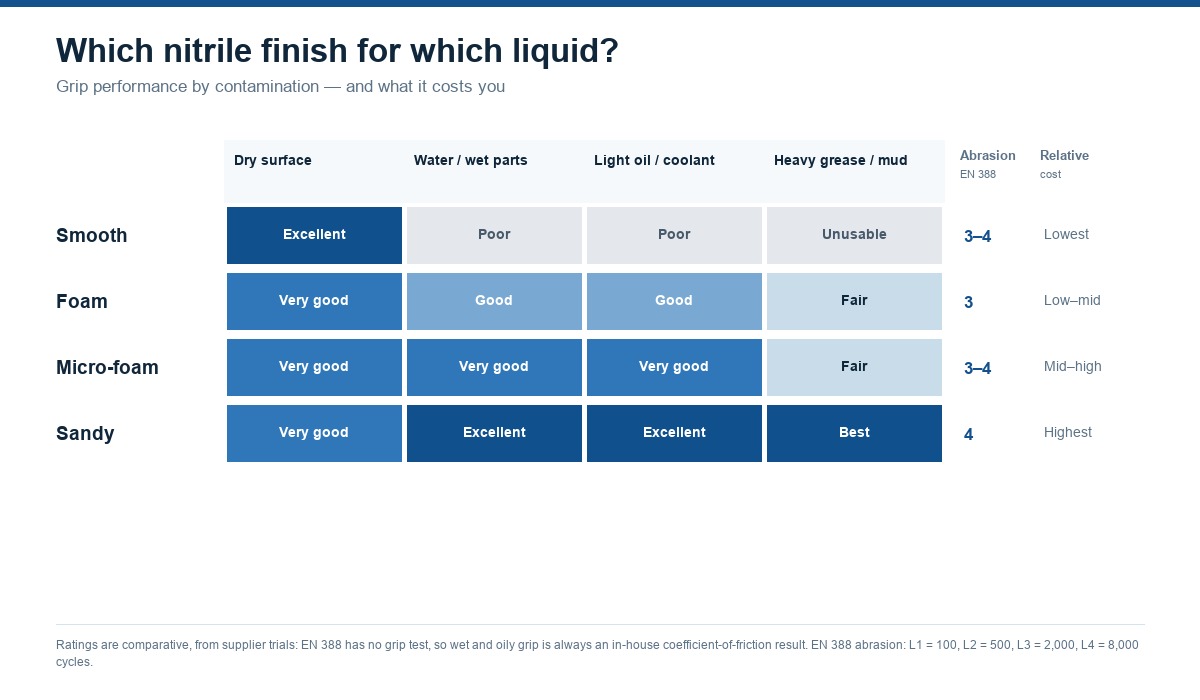
The matrix below is our working summary after years of customer trials. It is deliberately qualitative on grip, because no standard test exists for it, and quantitative only where a standard does exist — abrasion.
| Property | Smooth | Foam | Micro-foam | Sandy |
|---|---|---|---|---|
| Dry grip | Excellent (highest tack) | Very good | Very good | Very good, slightly abrasive feel |
| Grip on water / wet parts | Poor — film forms, slips | Good | Very good | Excellent |
| Grip on light oil / coolant | Poor | Good (absorbs, then saturates) | Very good | Excellent |
| Grip on heavy grease / mud | Unusable | Fair — pores clog | Fair | Best available in nitrile |
| Abrasion (EN 388, typical) | Level 3–4 on a good liner | Level 3 | Level 3–4 | Level 4 most often achievable |
| Breathability | Poorest — sealed skin | Best | Best | Poor — thick, dense film |
| Dexterity / tactile feedback | High (thin film) | High | Highest of the nitriles | Lowest — noticeably stiffer |
| Liquid barrier | Best (non-porous) | Weak — liquids wick through | Weak | Good at the surface, but not a chemical barrier |
| Relative cost | Lowest | Low–mid | Mid–high | Highest |
On abrasion, the EN 388 scale is worth knowing precisely because suppliers quote "Level 4 abrasion" loosely. The test abrades the palm under controlled pressure and records the cycles to breakthrough: Level 1 = 100 cycles, Level 2 = 500, Level 3 = 2,000, Level 4 = 8,000. Level 4 is not just "better" than Level 1 — it is eighty times the cycles. If you want the full shield decoded, our six-digit EN 388 guide covers every position.
4. The failure modes that show up in month two
Laboratory comparisons are tidy; real gloves are not. These are the four patterns that generate complaints in the field, and each one is predictable from the finish:
-
Foam saturation. An open-cell coating absorbs oil until it is full. On a heavy-grease job a foam glove grips beautifully for the first twenty minutes and then behaves like a smooth one — except softer. Foam is a light-oil and wet-part solution, not a heavy-grease solution.
-
Sandy wear at the fingertips. The peaks that provide grip are the same peaks that wear first. On abrasive handling (concrete, castings, frozen cartons) the texture flattens at index fingertip and thumb long before the palm goes, and grip quietly degrades. Buying sandy for abrasion life is right; buying it for a job where the fingertip wears through in a fortnight is not.
-
Micro-foam flaking. Thinner foam deposits can begin to flake or delaminate at flex points when the liner flexes sharply, especially after repeated washing. It is a comfort-first product and should be treated as one.
-
Clammy hands in smooth nitrile. A sealed film does not breathe. On a full shift this matters: sweat inside a glove softens the skin, reduces grip from the inside, and workers start removing gloves — the exact behaviour that causes the incidents the glove was bought to prevent.
There is also a spec-sheet gap worth naming: EN 388 contains no grip test. There is no standard pass/fail for wet grip, so any supplier claiming "tested grip" is quoting an in-house coefficient-of-friction protocol. Ask what surface, what lubricant, what load and what sample size — a serious supplier will have an answer, and it is also a fair way to compare two candidates before you commit to a container.
5. Matching the finish to the job
Most applications resolve into one of these rows. Where a buyer is between two finishes, the tie-break is usually cost per use rather than price per pair:
| Working condition | Finish to specify | Why |
|---|---|---|
| Dry assembly, packaging, warehousing | Smooth, or micro-foam if hands get sweaty | Maximum dry tack and tactile feel at the lowest cost |
| Light oil, coolant mist, damp parts | Foam or micro-foam | Capillary absorption plus breathability keeps hands dry and grip stable |
| Heavy grease, engine work, oily castings | Sandy (double-dipped if possible) | Ridges displace thick lubricant instead of floating on it |
| Outdoor wet work, muddy materials | Sandy, or crinkle latex where no oil is present | Texture sheds water and mud; latex beats nitrile on pure wet grip |
| Precision parts, small fasteners, inspection | Micro-foam on an 18-gauge liner | Thinnest nitrile film with usable wet grip |
| Handling wet or oily sheet metal edges | Sandy over a cut-resistant liner (A2–A4) | Grip without giving up cut protection — see A2 sandy nitrile cut gloves |
Product examples from our own range, since these are the builds we quote most often: smooth nitrile palm-coated gloves for dry handling, A4 foam nitrile cut-resistant gloves where cut risk sits alongside light oil, and abrasion-resistant sandy nitrile gloves for heavy, greasy, abrasive work. Garden programmes usually want the softer middle ground — foam nitrile gardening gloves — because soil is abrasive but rarely oily.
6. Coverage and gauge matter as much as texture
Two specification details are routinely left out, and both change performance more than most buyers expect:
-
Dip coverage. Palm dip protects the palm and leaves the back breathable. Three-quarter dip adds knuckle coverage. Full dip gives the best liquid barrier and stops wicking up the liner — but it eliminates breathability, so it is the wrong choice for a hot, dry assembly line and the right choice for wet handling. Coverage is also what stops liquid travelling up the knit and soaking the back of the hand.
-
Gauge. The liner’s knit gauge sets the ceiling on dexterity. A 13-gauge liner with sandy nitrile is a workhorse; 15-gauge with foam is noticeably more tactile; 18-gauge with micro-foam is a precision glove. Putting a thick sandy coating on an 18-gauge liner wastes the liner’s dexterity, and putting micro-foam on a 10-gauge liner wastes the coating’s sensitivity.
One combination deserves a warning: full-dipped foam nitrile. Foam is porous by design, so a full dip does not create a waterproof glove — it creates a glove that holds water against the skin. If the requirement is genuinely wet handling, specify smooth nitrile full dip or a supported nitrile glove instead.
7. What to write in the purchase order
"Nitrile coated, sandy finish" is not a specification; it is a category. Eight lines close the gap between the sample you approved and the container you receive:
-
Coating chemistry and finish — "NBR, sandy, double dip" rather than "nitrile".
-
Dip coverage — palm, three-quarter or full.
-
Coating weight — grams per pair or palm thickness in mm; this is the single best proxy for abrasion life and cost.
-
Liner — fibre, gauge (13/15/18) and colour.
-
EN 388 result — all four mechanical digits, plus the abrasion level expressed in cycles if abrasion life is critical.
-
Grip validation — the in-house CoF test method and a wet/oily sample protocol you both accept.
-
Wash durability — number of wash cycles the coating must survive without delamination or measurable grip loss.
-
Consistency controls — colour tolerance, texture depth, and the AQL for coating defects such as bare patches and pinholes.
If you are comparing quotations, ask each supplier for lines 3, 5 and 6. Price differences between "sandy nitrile" offers are almost always coating weight and liner quality differences wearing the same label.
8. Cost per use, not price per pair
A sandy glove typically costs more per pair than a smooth one, and on a greasy job it is still the cheaper glove — because it survives longer and because dropped parts and injuries cost far more than the difference. The arithmetic worth doing is simple:
Cost per use = price per pair ÷ (pairs worn per worker per month × months of service life)
Run that on a real site and the ranking often inverts. Where two finishes genuinely tie on cost per use, choose on the secondary criteria that affect compliance: if the smoother glove is more comfortable, workers will keep it on, and a glove that stays on all shift outperforms a technically superior glove that spends the afternoon in a pocket.
Frequently asked questions
Is sandy nitrile more durable than foam nitrile?
Generally yes for abrasive handling. The double-dip structure and thicker film usually reach EN 388 Level 4 abrasion, while foam typically lands at Level 3. But durability at the fingertip depends on the liner and the coating weight, not on the texture alone.
Can foam nitrile be used with oil?
With light oil and coolant, yes — that is what the open cells are for. With heavy grease it saturates and stops working. If the part is dripping, specify sandy.
Why does my smooth nitrile glove slip when wet?
Because a continuous film cannot break the liquid layer between glove and part. Smooth nitrile is a dry-grip and barrier product; it is not designed to grip through water.
Does a rougher coating cut better?
No. Texture affects grip and abrasion, not cut resistance. Cut performance comes from the liner — glass, HPPE, steel or basalt yarns — and is reported separately in the EN 388 cut position. Our nitrile coated gloves overview explains how the builds differ.
Which finish is best for food handling?
Smooth or micro-foam, because porous coatings retain residue and are harder to clean. Check the food-contact declaration and the wash regime before choosing texture.
Can I get all three finishes on the same liner?
Usually yes. Most 13- and 15-gauge liners can be supplied with smooth, foam, micro-foam or sandy coating, which is why the finish should be specified explicitly on the PO rather than assumed from a catalogue photo.
Next step
Send us the working condition — the liquid on the part, the material being handled, the shift length and your target EN 388 result — and we will send two or three candidate builds at different price points, with coating weights stated and samples you can trial on the line instead of on a desk.
Request sandy / foam / smooth nitrile samples → or browse the full coated glove range.
Related reading: how industrial buyers specify nitrile coated gloves