Work Glove Size Guide: How to Measure Your Hand and Choose the Right Fit
A glove that fits well protects better. Too loose, and you lose dexterity and grip. Too tight, and the seams stress, the coating cracks, and your hands fatigue faster. Yet sizing is one of the most overlooked details in industrial glove procurement.
This guide shows you how to measure a hand for work gloves, how to convert those numbers into standard sizes, and what to adjust for different coatings, liners, and job tasks.
Why Glove Fit Matters for Safety and Cost
Fit directly affects three things buyers care about:
-
Safety. A loose glove can get caught in rotating machinery or slip off during a critical grip. A tight glove limits finger movement and reduces tactile feedback.
-
Dexterity. Precision assembly, electronics work, and small-part handling need a close fit. Bulkier styles like thermal or TPR impact gloves naturally trade some dexterity for protection.
-
Glove life. Constant stretching accelerates coating failure at the fingertips and palms. The right size gives even load distribution, which is especially important for coated work gloves.
For buyers sourcing gloves in bulk, getting the size mix right also reduces returns, replacement orders, and downtime.
Two Measurements You Need
Industrial glove sizing is based on two simple hand measurements:
-
Hand circumference. Wrap a soft tape measure around the palm, just below the knuckles, excluding the thumb.
-
Hand length. Measure from the base of the palm (where it meets the wrist) to the tip of the middle finger.
Always measure the dominant hand. If a worker is right-handed, measure the right hand; if left-handed, measure the left. Record both numbers in centimeters for the most reliable conversion.
Work Glove Size Chart: US, EU and CM Conversion
The table below converts hand circumference into the most common sizing systems used by PPE suppliers and distributors.
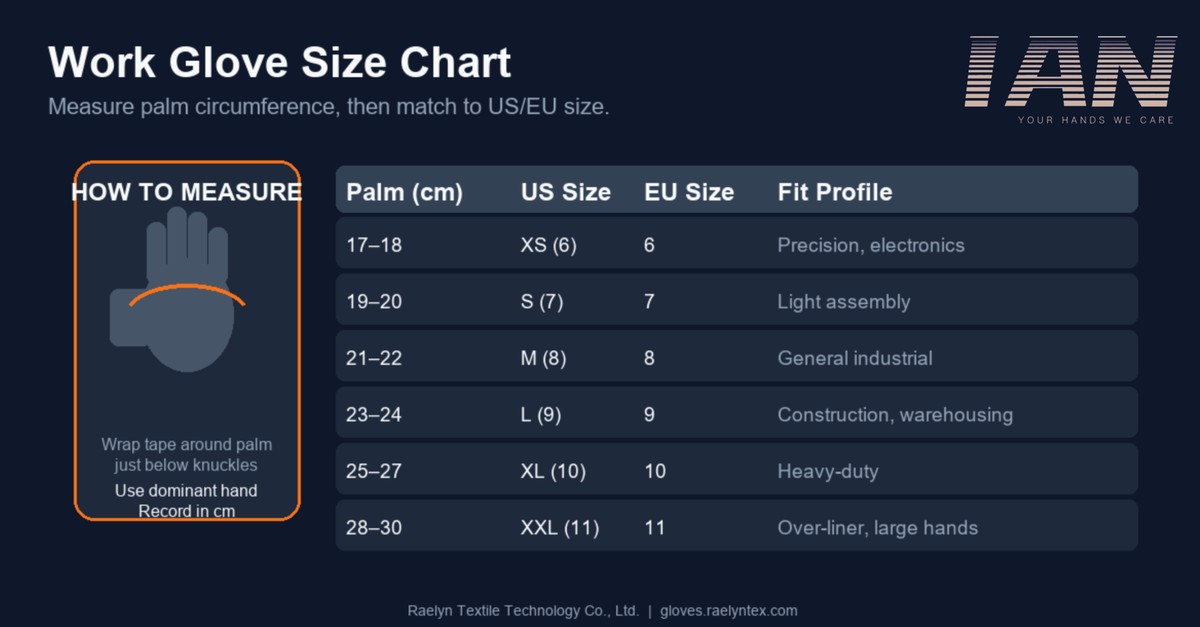
| Hand Circumference (cm) | US Size | EU Size | Best Fit Profile |
|---|---|---|---|
| 17–18 cm | XS (6) | 6 | Small hands, precision work, electronics assembly |
| 19–20 cm | S (7) | 7 | Light assembly, packaging, inspection tasks |
| 21–22 cm | M (8) | 8 | General industrial work; most common male size |
| 23–24 cm | L (9) | 9 | Construction, warehousing, material handling |
| 25–27 cm | XL (10) | 10 | Heavy-duty applications, larger hands |
| 28–30 cm | XXL (11) | 11 | Extra-large hands or gloves worn over liners |
Note: Some brands label sizes numerically (6, 7, 8, etc.), while others use XS–XXL. When in doubt, order by the centimeter measurement rather than the letter label.
How to Read a Supplier Size Chart
Not every factory uses the same tolerance. When reviewing a supplier’s size chart, check these three points:
-
Measurement basis. Is the chart based on palm circumference, hand length, or both? Asian factories often use circumference only; European brands may list both.
-
Tolerance range. A ±0.5 cm tolerance is normal. Anything wider suggests inconsistent cutting.
-
Coating type. Dipped gloves can fit more snugly than sewn gloves because the coating adds structure. Sandy nitrile and foam nitrile may feel tighter than smooth latex of the same nominal size.
If you are placing a mixed-size order for a workforce, ask the supplier for a physical sample set in sizes S through XL before committing to bulk production.
Sizing Adjustments by Glove Type
Nitrile-Coated Gloves
Nitrile shells are thin and conform closely to the hand. Choose true-to-size for assembly work, or go up one size if the glove will be worn over a thin liner in cold conditions. View nitrile-coated gloves.
Latex-Coated Gloves
Latex has more natural stretch than nitrile, so a slightly snug fit usually relaxes after a few hours of wear. Avoid sizing up unless the worker needs room for a liner. View latex-coated gloves.
PU-Coated Gloves
Polyurethane coatings are ultra-thin and designed for precision. These gloves should fit close to the skin without wrinkles at the fingertips. View PU-coated gloves.
Cut-Resistant Gloves
High-cut-level gloves use denser yarns like HPPE, fiberglass, or steel, which offer less stretch. If the worker is between sizes, choose the larger size to prevent seam stress. View cut-resistant gloves.
Thermal and Impact Gloves
These styles are intentionally bulkier. A little extra room is expected, but the glove should still allow a secure grip on tools and controls.
Common Sizing Mistakes
-
Guessing by shoe or clothing size. Hand proportions vary widely. Always measure.
-
Ignoring finger length. A glove that fits the palm but leaves fingertips exposed offers poor protection and grip.
-
Ordering one size for everyone. A workforce rarely fits into a single size. A typical bulk order mix is 10% S, 25% M, 40% L, 20% XL, 5% XXL.
-
Not accounting for liners. Winter or chemical gloves may be worn over a thin cotton liner; size up accordingly.
FAQ
Should I size up or down if my measurement falls between two sizes?
For coated work gloves, size up if the glove will be worn for more than four hours at a time or if a liner is needed. Size down only for precision tasks where maximum fingertip control is required.
Do men’s and women’s work gloves use different sizing?
Most industrial gloves are unisex and sized by hand circumference. Women’s-specific cuts exist but are less common in B2B industrial lines. The key is matching the measurement, not the gender label.
How do I check glove fit quickly?
Put the glove on and make a fist. The palm should not feel stretched, and the fingertips should not press hard against the inside of the glove. You should be able to touch your thumb to each fingertip without excess material bunching.
Get the Right Size for Your Team
Ordering gloves in bulk does not have to mean guessing at sizes. Send us your team’s hand measurements or ask for a sample sizing set, and we will recommend the right size mix for your application.
Request a sample sizing set or browse our cut-resistant glove range.