Oily Parts Handling: Why Sandy Nitrile Outgrips Smooth Coatings (Machining & Metalworking Guide)
Why Smooth Coatings Slip on Oily Parts
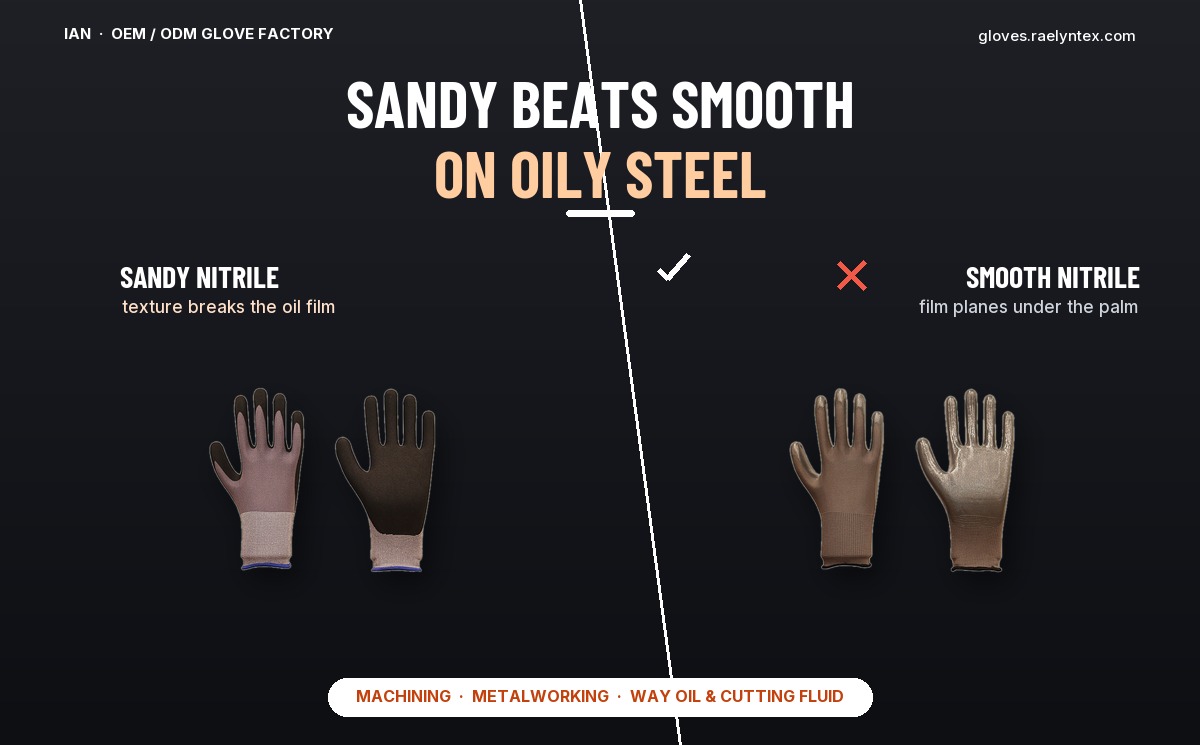
Walk down the secondary operations aisle of any machining plant — tapping, deburring, inspection after the coolant flood — and you will see the same workaround everywhere: operators wearing a smooth nitrile coated glove in one hand and a shop rag in the other, because the glove skates across wet steel. The problem is not the nitrile itself. Nitrile is the right polymer for oil contact: it resists swelling, does not stiffen in oil the way latex can, and cleans up with a simple rinse. The problem is the finish. A smooth coating presents a continuous, unbroken film to the workpiece. On a dry part that film grips fine. On a part smeared with way oil, cutting fluid or anti-rust oil, the film hydroplanes — a thin layer of oil sits between the coating and the metal, and the coefficient of friction collapses to something close to ice on glass.
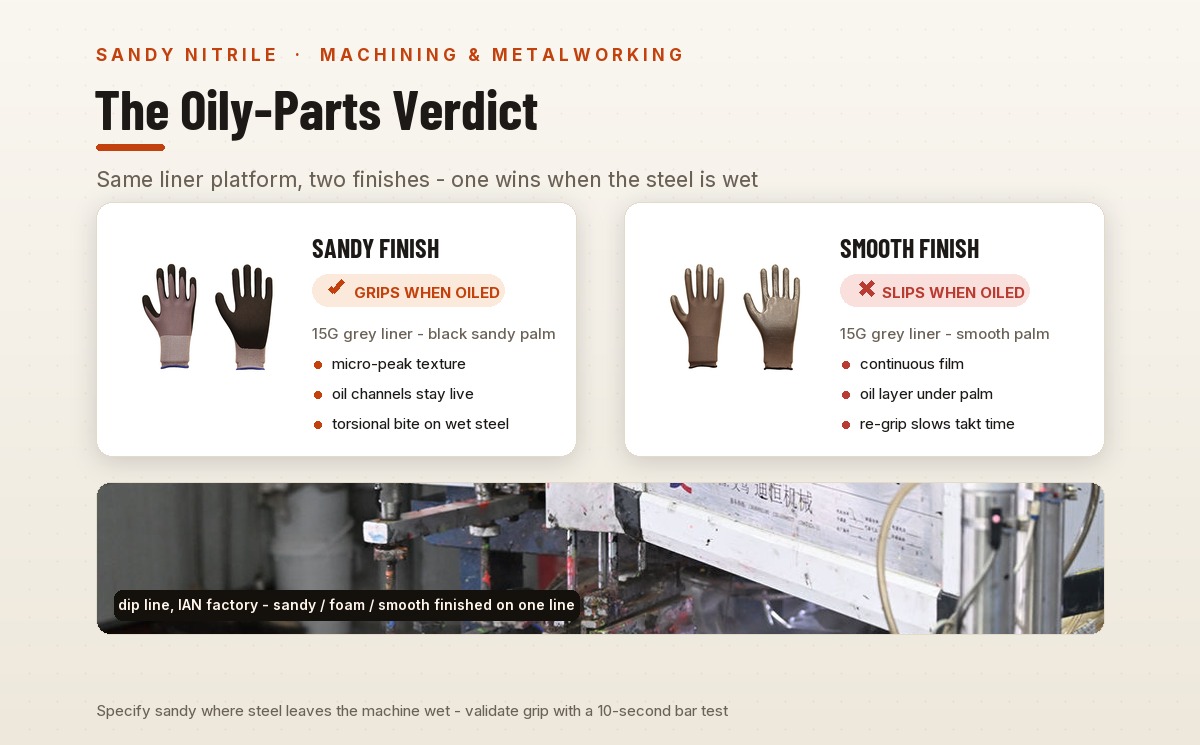
That failure mode is expensive in ways that never show up on a PPE invoice. Parts get skived by fingernails when a grip slips during insertion. Operators re-grip three or four times per cycle, which slows takt time and fatigues the forearm. And when handling drops, gloves get pulled off and left on the machine bed — which defeats the entire reason the plant specified hand protection for its oil-rich zones in the first place.
What a Sandy Finish Actually Does
A sandy (sometimes called grit or textured) nitrile finish attacks the oil film mechanically. During dipping, a fine mineral texturing agent is applied to the wet coating, so the cured palm carries millions of micro-peaks across the surface. Three things follow:
-
The oil film gets broken. Contact happens at the texture peaks, not across a continuous plane. Instead of one unbroken oil layer under the palm, the film is interrupted thousands of times per square centimetre, so the rubber-to-metal contact area stays live.
-
Channels give the oil somewhere to go. The valleys between peaks act as micro-grooves that bleed displaced oil away from the contact zone as the grip closes — the same principle as tyre tread on a wet road.
-
Grip holds in every direction. Because the texture is omnidirectional, the glove resists slip under torsion and shear, not just straight pull. For threading, twisting fittings and seating bearings, that torsional bite matters more than raw pinch force.
The practical result buyers report after switching: one glove instead of glove-plus-rag, fewer dropped blanks, and — because sandy finishes add texture without adding coating weight — no penalty in dexterity for small-part handling.
Sandy vs Foam vs Smooth at a Glance
All three finishes are nitrile; the difference is the surface structure. Foam nitrile (open cells that absorb thin oil films) sits between the two extremes. We break the full decision tree down in Sandy Nitrile vs Foam Nitrile vs Smooth Nitrile: Which Coating Grip Do You Need? — the short version for machining environments:
| Finish | Heavy way oil / cutting fluid | Light oil mist | Dry precision parts |
|---|---|---|---|
| Sandy nitrile | Best — texture breaks the film | Excellent | Very good |
| Foam nitrile | Good — absorbs thin films, saturates when soaked | Best | Good |
| Smooth nitrile | Poor — planing on wet steel | Good | Best — cleanest contact |
If your parts leave the machine visibly wet, sandy wins. If the environment is mist-dominant with mostly dry contact, foam is the better cost point. Smooth remains right for dry assembly and cleanroom-adjacent work where particle generation matters more than grip.
Matching the Coating to the Task
Across a typical metalworking plant the right answer changes by station, not by factory. Three placements cover most programmes:
-
CNC tending and deburring — sandy nitrile. Coolant-wet chips, way-oil films on fixtures and constant part contact make this the flagship application. Pair a sandy palm with a cut-resistant liner where sharp swarf is present: our A4 nitrile coated cut resistant gloves keep EN 388 cut performance under a grippy coating.
-
Stamping and press shops — sandy or dotted. Blanks are oiled by design. Where the Sandy programme is over-spec for light blank handling, nitrile dotted anti-slip gloves deliver targeted grip points at a lower cost per pair.
-
Oil-resistant general handling — dedicated oil programme. For hydraulics, gearbox assembly and maintenance where oil exposure is continuous, see the oil resistant nitrile work gloves line, which pairs sandy palms with liners chosen for chemical wash-down.
For buyers planning the wider program, our overview of nitrile coated gloves maps every finish, gauge and cuff option we manufacture, and the machining-specific placement guidance pairs naturally with task-based cut selection — see ANSI A2–A6 selection by task for the swarf-heavy stations.
Liner and Gauge Choices for Oil-Rich Shops
The coating gets the attention, but the liner decides how the glove survives a double-shift soak-and-wash cycle:
-
15G polyester/nylon is the machining default. Thin enough to keep tactile feel on small parts, dense enough that cutting fluid does not wick through to the skin. The abrasion resistant sandy nitrile work gloves in our range use a 15G grey liner under a black sandy palm — the dark coating hides oil staining between washes.
-
13G for heavier stock handling. Where bars, forgings or large castings dominate, a 13G liner adds the padding and tensile margin that 15G gives up.
-
Breathability beats coating coverage. A palm-only dip with a knitted back lets oil mist evaporate instead of trapping it against the skin. Full-dip versions belong in immersion-adjacent stations, not at the machining centre.
What the Standards Do — and Don’t — Tell You About Grip
Here is the uncomfortable truth for specification writers: neither EN 388 nor ANSI/ISEA 105 measures grip. EN 388 rates abrasion (level 1–4), and ANSI/ISEA 105 rates abrasion to 10,000 cycles — both tests run on dry rotary abrasive. A smooth coating and a sandy coating can carry identical abrasion scores while behaving nothing alike on an oiled bar. That is why grip claims should be validated the way your operators will use the glove: a simple line test — lift an oil-coated steel bar of your actual stock size, hold for ten seconds, rotate 45°, and watch for slip — separates finishes more reliably than any datasheet number. Abrasion level still matters (sandy finishes typically reach EN 388 abrasion level 3–4 on our 15G builds), but treat it as the durability floor, not the grip answer. Canadian buyers reconciling EN 388 data with provincial OHS paperwork can see how we package this in our Canadian distributor guide.
Specifying Sandy Nitrile Gloves from IAN
As an OEM/ODM factory, we treat the sandy programme as a configurable platform rather than a catalogue SKU:
-
Coating choice per station: sandy, foam or smooth from the same liner platform, so one size curve covers the whole plant.
-
Liner customisation: 13G/15G/18G, polyester or nylon, grey or coloured liners, and terry knuckle reinforcement for high-cycle stations.
-
Private label: your logo on the cuff print, header bag or blister card — send us your spec and we return a counter-sample for line trial.
-
Low-MOQ sampling: trial quantities for line tests before container commitment, with EN 388 test reports supplied per model.
The fastest path is a two-week sample round: send the oil type (way oil, soluble coolant or anti-rust), the part weight and the station list; we return sandy and foam variants on the same liner for a side-by-side line trial. Facilities that want the full factory picture — capacity, audit reports and QC flow — can start at our factory profile.
Quick Buyer FAQ
Does the sandy texture shed particles into coolant? The texturing agent is locked into the cured nitrile film; shedding is negligible in normal handling. For wash-down stations we recommend a post-wash rinse inspection in the first week, which is standard practice for any new glove introduction.
Can sandy finish be combined with cut resistance? Yes — sandy nitrile over an HPPE-blend liner is one of our most requested combinations for machining swarf zones; see the cut resistant gloves range for liner options.
What about latex coatings for the same stations? Crinkle latex grips wet concrete and rough stock well but degrades faster in petroleum-based oils; the trade-off is covered in our latex coated gloves guide, and for electronics-adjacent stations the answer is usually PU — see PU coated gloves.
Bottom line: on oily parts, the finish decides the grip. Specify sandy nitrile where the steel is wet, validate with a ten-second bar test, and let the liner gauge handle comfort. The full comparison lives in our coating comparison guide, and the latest factory and market notes are collected in IAN news.