Winter Work Gloves for Cold Storage: Insulation, Coatings and Grip That Stay Flexible Below Zero
A glove that feels warm in a heated office is not the same glove that works at −25 °C on a picking line at 4 a.m. Cold-storage buyers learn this the expensive way: the sample passes the touch test, the first pallet gets handled, and within forty minutes the coating has stiffened into something closer to a plastic bag than a work glove. Grips slip, hands get wet, and the gloves come off — which is the worst outcome of all, because bare hands in a freezer are colder than any glove.
This guide is written from the factory side of that conversation. It explains how EN 511 actually rates cold protection, which insulation builds hold warmth after a shift rather than for ten minutes, which coatings stay flexible below zero, and what to write into a purchase order so the gloves you receive match the ones you approved.
1. Cold is two different hazards, and they need two different answers
Almost every failed winter glove specification starts with treating "cold" as a single number. It is not. Heat leaves a hand in two completely separate ways, and a glove can be excellent against one while being poor against the other:
-
Convective cold — heat carried away by cold air moving past the hand. This is wind chill, open loading bays, chilled-air curtains at a warehouse door, and the general ambient temperature of a cold store. The fix is trapped air: loft, fleece, a thick liner.
-
Contact cold — heat pulled straight out of the hand the moment it grips a cold solid. Frozen cartons, steel racking, chilled valves, ice-crusted pallets. The fix is a palm and finger construction with enough thermal resistance at the contact surface, which is a different property from overall loft.
This is why a bulky acrylic glove with a fluffy lining can feel wonderful walking into the freezer and still be painful after five minutes of carrying frozen boxes: it insulates against air, but its thin nitrile palm transmits contact cold almost instantly. If your workers spend the shift holding cold things rather than merely standing in cold air, contact cold is the rating to chase.
There is a third factor that quietly dominates both: moisture. Water conducts heat roughly twenty-five times faster than air, so a glove that is wet inside is not a slightly worse glove — it is a fundamentally different, much colder object. Any winter glove strategy that does not manage water is a strategy that fails halfway through the shift. We come back to this in section 5.
2. Read the EN 511 code properly — it is three results, not one warmth score
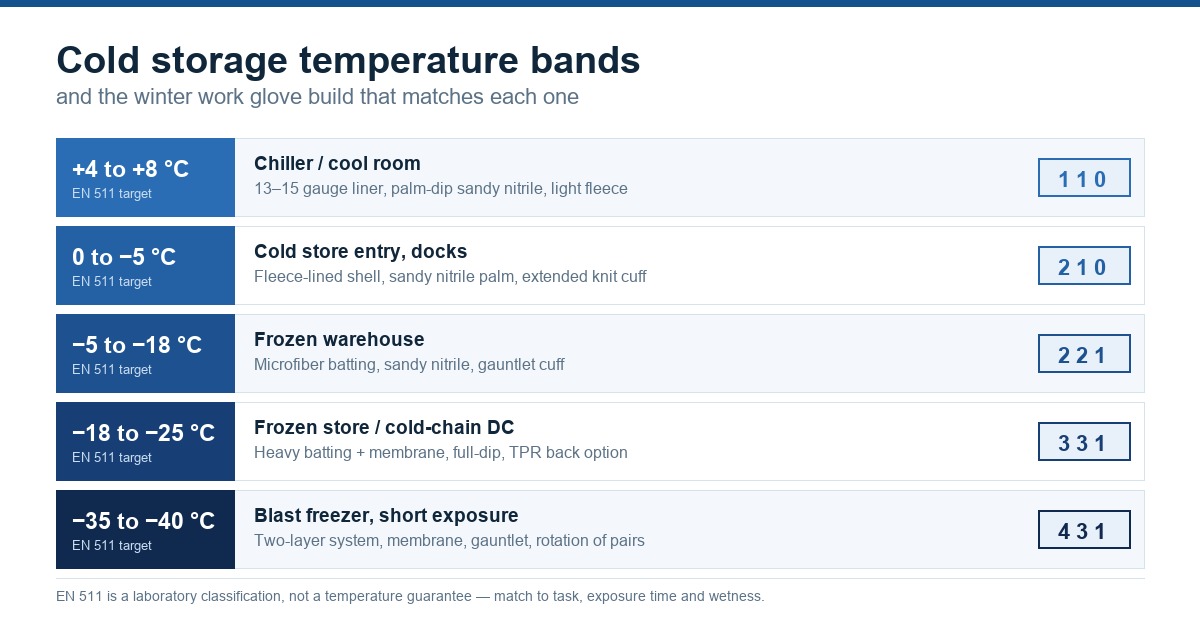
EN 511:2006 is the European standard for protective gloves against cold. Its marking carries three positions, and buyers routinely collapse them into a single "warmth level", which is how the wrong glove gets approved:
| Position | Property | Scale | What the level means |
|---|---|---|---|
| 1st | Convective cold | 0 – 4 | Thermal insulation against cold air, expressed as ITR: L1 = 0.10 to <0.15, L2 = 0.15 to <0.22, L3 = 0.22 to <0.30, L4 ≥ 0.30 m²·K/W |
| 2nd | Contact cold | 0 – 4 | Thermal resistance when touching a cold solid, R: L1 = 0.025 to <0.050, L2 = 0.050 to <0.100, L3 = 0.100 to <0.150, L4 ≥ 0.150 m²·K/W |
| 3rd | Water penetration | 0 or 1 | 0 = water penetrated during the timed immersion test; 1 = no leakage within the test period |
Three reading rules that prevent most sourcing mistakes:
-
A marking of 3 2 1 is not "better" than 4 1 1 — it is a different balance. The first glove insulates well against air and reasonably well against contact; the second is a lofted glove with a thin palm, strong in cold air and weak on cold steel. Match the position to the exposure, not to the biggest number.
-
X and 0 mean opposite things. X means that test was not performed. 0 means it was performed and the glove did not reach Level 1. A glove marked 3 X 1 is not evidence of poor contact-cold performance; it means nobody tested it, which for a freezer project is arguably worse.
-
EN 511 is a laboratory classification, not a temperature promise. No EN 511 level certifies a glove as safe at a specific ambient temperature. Level 4 does not mean "rated to −40 °C". Real exposure time, activity level, wind, wetness and individual circulation all move the answer, which is why a workplace risk assessment sits above the label.
Two related markings matter alongside it. EN 388 covers mechanical risk, and virtually every winter glove needs it — frozen cartons and steel racking are abrasive, and freezer floors are where hands get trapped. If you are unsure how to read the shield, our six-digit EN 388 guide walks through each position. General requirements such as sizing and dexterity now sit in EN ISO 21420 rather than the older EN 420, and dexterity is not part of the EN 511 result — a glove can be thermally excellent and still be too stiff to close a zip tie.
Outside Europe there is no equivalent three-digit cold marking. US buyers typically use EN 511 test data as the comparison tool, then confirm on site, because OSHA 29 CFR 1910.138 puts the selection duty on the employer rather than naming a glove standard. That makes the supplier’s test report the only hard evidence you will get — ask for it by glove code, not by generic catalogue page.
3. What actually keeps a hand warm: the four-layer stack
Insulation is only one of four layers, and in cold storage the layer most people forget is the one that matters most. A properly built winter glove reads from the inside out:
-
Liner / insulation — traps still air next to the skin. Fleece, terry loop, brushed acrylic, wool blend or microfiber batting.
-
Membrane (when specified) — a thin waterproof-breathable film that stops liquid water while letting some vapour escape. This is the layer that decides whether a wet shift is survivable.
-
Shell — knit or woven body that holds everything together and carries the mechanical properties.
-
Coating — palm or full dip that supplies grip, abrasion resistance and, in full-dip builds, water resistance without a separate membrane.
Lining choice drives both warmth and cost, so it is where quotations diverge most. The comparison below is the one we use internally when a buyer asks for "something warm but not too expensive":
| Lining / insulation | Warmth per thickness | Behaviour when damp | Best fit |
|---|---|---|---|
| Brushed acrylic fleece | Moderate | Keeps some loft, dries slowly | High-volume winter gloves above −10 °C; best cost position |
| Polyester fleece / terry loop | Moderate | Moderate; terry pads wick better | General handling, cool rooms 0 to +8 °C |
| Microfiber batting (Thinsulate-type) | High | Retains loft well; still loses performance if soaked through | Frozen stores −18 to −25 °C where bulk must stay manageable |
| Merino wool blend | High for its weight | Best-in-class — warms while damp | Wet-cold outdoor work, premium retail programmes |
| Bamboo fibre blend | Moderate | Soft, good moisture handling, low odour | Garden and cool-weather seasonal lines — see our bamboo fibre foam latex glove |
| Foam / open-cell pad | Moderate, bulky | Holds water and stays wet — avoid for freezer work | Dry cold only |
One practical note on loft: warmth comes from trapped air, and trapped air needs volume. A glove that is warm enough for −25 °C will be bulky, and no marketing claim changes that. If a buyer asks for "Level 4 warmth with bare-hand dexterity", the honest answer is a layered system — a thin liner under a heavier outer glove that comes off for fine tasks — rather than a single product that does not exist.
4. Coatings that stay flexible below zero
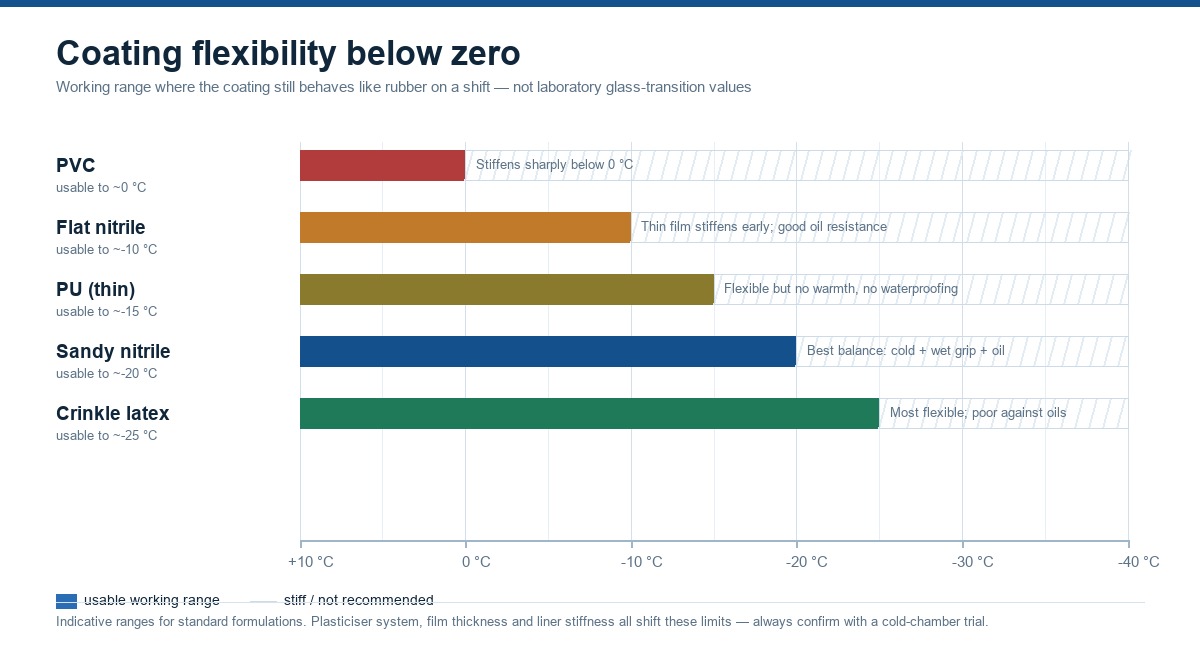
Every polymer has a temperature below which it stops behaving like rubber. When a coating crosses that line it does not fail visibly; it simply stops conforming to what it grips, and grip strength drops faster than most buyers expect. The chart below shows the working range we treat as realistic for standard formulations — not laboratory glass-transition values, but the range where the glove still behaves like a glove on a shift:
| Coating | Cold behaviour | Grip when wet / cold | Oil resistance |
|---|---|---|---|
| Flat (smooth) nitrile | Noticeably stiff below about −10 °C; thin films stiffen first | Poor on wet or icy surfaces | Excellent |
| Sandy nitrile | Serviceable to roughly −20 °C; the open texture stiffens less than a flat film | Best all-round choice for wet cold — the standard for freezer handling | Excellent |
| Foam nitrile | Similar to sandy but softer, more air in the film | Good wet grip, less abrasion life than sandy | Good |
| Crinkle latex | Most flexible of the common coatings, usable to about −25 °C | Excellent on dry and damp; poor on grease | Poor — swells in oils and solvents |
| PU | Thin films stay flexible to about −15 °C but offer little warmth and no waterproofing | Good dry grip, weak in wet cold | Moderate |
| PVC | Stiffens sharply below about 0 °C — the wrong choice for freezer work despite the low price | Reasonable in slush, but the stiff palm defeats it | Good |
The practical defaults that follow from this:
-
Freezer and frozen-food handling: sandy nitrile palm on an insulated liner. It is the only common coating that combines cold flexibility, oil tolerance and genuine grip on frost. Our TPR impact-resistant thermal work glove is built on exactly this combination, because freezer work also brings knuckle and back-of-hand impacts from racking and pallet corners.
-
Wet, near-freezing outdoor work (rain, sleet, docks): crinkle latex gives the best cold flexibility and dry-to-damp grip. Where oil or fuel is present, switch to nitrile and accept a stiffer feel. See heavy-duty crinkle latex gloves for the thicker end of that range.
-
Chilled rooms at 0 to +8 °C: you do not need a heavy build. A 13- or 15-gauge liner with a palm-dipped nitrile coating and a light fleece is usually enough, and dexterity stays far better.
-
Anything with oil plus cold: PVC and latex both lose — PVC to stiffness, latex to swelling. Nitrile is the only sensible answer.
5. The wet-cold problem: why the membrane decision comes before the lining decision
In a cold store the relative humidity is low, so water mostly arrives from three directions: condensation when a glove moves between temperature zones, meltwater from frozen packaging, and the worker’s own sweat. All three end up inside the glove, and once the insulation is wet the EN 511 number on the cuff describes a glove you no longer have.
Two constructions solve this, with a real trade-off:
-
Waterproof-breathable membrane + separate liner. Highest comfort, lets some sweat vapour out, keeps liquid water out. Costs more, adds a production step, and needs a careful glove design so the membrane is not punctured at the seams.
-
Full-dip coating (nitrile or latex) over an insulated liner. Cheaper and very robust, genuinely waterproof, but not breathable — sweat builds up on long shifts, so the liner must manage moisture and the worker needs a spare pair mid-shift. Our waterproof latex-coated gloves are the conventional version of this build.
Palm-dipped and three-quarter-dipped gloves are not waterproof, and no coating coverage can make them so. They are the right choice for dry cold and for active work where breathability matters more than water resistance — but if a buyer’s spec says "freezer, wet product, full shift", a palm-dip glove will fail on day one regardless of how good its EN 511 convective rating looks.
One more detail that separates a workable winter glove from an expensive one: cuff length. A knitted wrist lets cold air and meltwater straight down the sleeve. For freezer and outdoor winter work, a gauntlet or at least an extended knit cuff with an elastic or hook-and-loop closure is not a luxury — it is the difference between a warm hand and a cold wrist for eight hours.
6. Fit and layering: the cheapest way to lose warmth is a glove that is too tight
A glove that is too small compresses the insulation and restricts blood flow, and both effects make the hand colder. Buyers who run a winter programme across several sites should treat sizing as part of the thermal specification, not as an afterthought — our work glove size guide covers measurement and fit checks.
Two practical rules from the production floor:
-
Size up for liners and heavy builds. A worker who normally takes size 9 in a 13-gauge PU-coated assembly glove often needs a 10 in a fleece-lined freezer glove. If the trial pair is "snug but fine" in the warm room, it will be painful at −20 °C.
-
Layer for dexterity, not for vanity. Thin conductive liner plus a heavier outer glove gives a worker the option to strip the outer layer for scanning, labelling or a phone call without exposing bare skin. That single change removes most of the "gloves come off" behaviour that drives cold injuries.
7. A ten-point specification checklist for your next purchase order
Most winter glove disputes are not about quality; they are about a purchase order that did not say enough. Each line below is something a factory can commit to and a buyer can verify on the pre-production sample:
-
EN 511 result by position — for example "2 2 1", stated as a claim you will verify in the test report, not just "cold resistant".
-
EN 388 result — the mechanical scores required by the task, especially abrasion and tear for frozen cartons.
-
Target ambient temperature and shift length — the two inputs that make the rating meaningful.
-
Contact-cold exposure — what the worker actually holds, and for how long.
-
Lining type and weight — e.g. "microfiber batting, 120 g/m² brushed polyester", not "thermal lining".
-
Membrane yes/no, and if yes, which type.
-
Coating and dip coverage — palm, three-quarter or full dip; smooth, sandy or foam finish.
-
Gauge and cuff — knit gauge, cuff length, closure type.
-
Colour and branding — high-visibility cuffs genuinely reduce lost gloves in a dim freezer aisle.
-
Wash and dry instructions — and the number of wash cycles the coating is expected to survive.
If you want a starting point rather than a blank page, our product range covers insulated builds from light chilled-room gloves to TPR-reinforced thermal gloves, and we will quote against a specification like the one above rather than against a generic catalogue number.
8. Care: how gloves actually die in a freezer operation
Cold gloves rarely wear out; they get wet and stay wet. Three habits extend service life more than any material upgrade:
-
Dry at room temperature, never on a radiator or blower. Direct heat hardens coatings and can delaminate a membrane. Air movement at ambient temperature is faster and safer.
-
Two pairs per worker per shift for wet-cold and freezer work. Alternating pairs is cheaper than replacing gloves every three weeks, and it is the single most effective way to keep insulation dry.
-
Wash per the supplier’s instruction, and dry fully before storage. Residual detergent film holds moisture and quietly kills the breathability of a membrane.
Cost per use, not price per pair, is the number worth tracking. A cheap PVC glove at half the price that lasts a third as long costs more, and it costs a cold worker as well.
Frequently asked questions
What does EN 511 2 2 1 mean?
Convective cold Level 2, contact cold Level 2, and water penetration Level 1. In plain terms: moderate insulation against cold air, moderate resistance to contact cold, and no water leakage during the immersion test. It is a sensible specification for chilled and light frozen work, but not for a −25 °C blast freezer.
Is a higher EN 511 number always better?
No. Higher is warmer, but warmth arrives with bulk, and bulk costs dexterity, which is itself a safety property. Match the rating to the exposure and the task; a Level 2 glove that the worker keeps on all shift beats a Level 4 glove that comes off after twenty minutes.
Can I use ordinary nitrile-coated work gloves in a freezer?
For short entries into a chiller, yes. For prolonged frozen work, no: the coating stiffens, the liner has no meaningful insulation, and contact cold will reach the hand through a thin palm within minutes.
Are anti-static gloves needed in a cold store?
Only if the area handles static-sensitive goods or flammable atmospheres. Cold and ESD requirements can be combined, but they are separate specifications — see our EN 16350 antistatic guide for the electrostatic side.
Do winter work gloves need impact protection?
In freezer warehouses, often yes. Racking beams, pallet corners and frozen blocks produce exactly the knuckle and back-of-hand impacts that TPR impact protection is designed for, and a cold hand reacts more slowly to them. For the rating side of that specification, see ANSI/ISEA 138 impact levels explained.
Next step
If you are building a winter or cold-storage programme for the coming season, send us the ambient temperature, the product handled, shift length and the EN 511 target. We will come back with two or three builds at different price points, with test reports attached and samples you can put through a real shift rather than a ten-second handshake.