Latex Coated Gloves: The Complete Buyer’s Guide (Crinkle, Foam, Double Dip)
Natural rubber latex is still the palm coating of choice wherever water is on the work surface. It grips wet lumber, wet cartons, wet produce and wet tools better than any other common coating, it stays flexible in cold weather better than nitrile, and it costs less per pair than almost anything else you can dip a knit liner into. But latex also has real limits: it swells and degrades on contact with petroleum oils, it needs thoughtful storage away from UV and ozone, and it raises a latex allergy question that every institutional buyer must be able to answer.
This guide is written for importers, wholesalers and brand buyers who are adding or reviewing a latex coated line. It walks through the three commercial finishes — crinkle, foam and double dip — then the liner gauge, the coverage options, the temperature and chemical reality, the allergy guidance, the EN 388 paperwork, and what an OEM factory like IAN can customise when you build the line under your own label. Every claim in the oil and allergy sections follows published guidance, and we have linked the product pages behind each finish so you can move straight from spec to RFQ.
Why Latex Still Owns Wet-Condition Grip
Latex is natural rubber: a water dispersion of rubber particles tapped from rubber trees, stabilised with ammonia, and formulated into the dipping compound that coats the liner. When a coated glove is cured, the latex forms an elastic film that behaves quite differently from a synthetic film. It stretches further, recovers faster, and keeps its softness at low temperatures where nitrile film noticeably stiffens.
The grip story is mostly about surface texture. A crinkled latex palm is wrinkled on purpose: during curing, the wet film is textured so it dries into ridges that work like tyre tread, channelling water away from the contact patch between glove and object. On a wet shovel handle or a soaked carton, that texture is the difference between one grab and three retries. Foam finishes do the same job through open cells, and double dip builds the texture in a second layer. This is why, across our own latex coated gloves programme, the wet-handling models are nearly all crinkle or sandy finishes.
Latex also has an elasticity advantage that buyers only notice in wear trials. Because the film recovers rather than permanently deforming, a latex palm stays comfortable through a long shift of repetitive gripping, and it tolerates flexing at temperatures where stiffer coatings start to crack. For cold-store, outdoor winter and early-morning logistics work, that flexibility is a genuine safety property, not a comfort nicety — a coating that cracks at 0 ℃ stops gripping.
Crinkle, Foam and Double Dip: The Three Finishes Explained
Almost every latex glove on the market falls into one of three finish families. Choosing between them is the single most important decision in this category, because the finish — not the brand — decides how the glove behaves on your buyers’ work surfaces.
Crinkle latex: the wet-grip workhorse
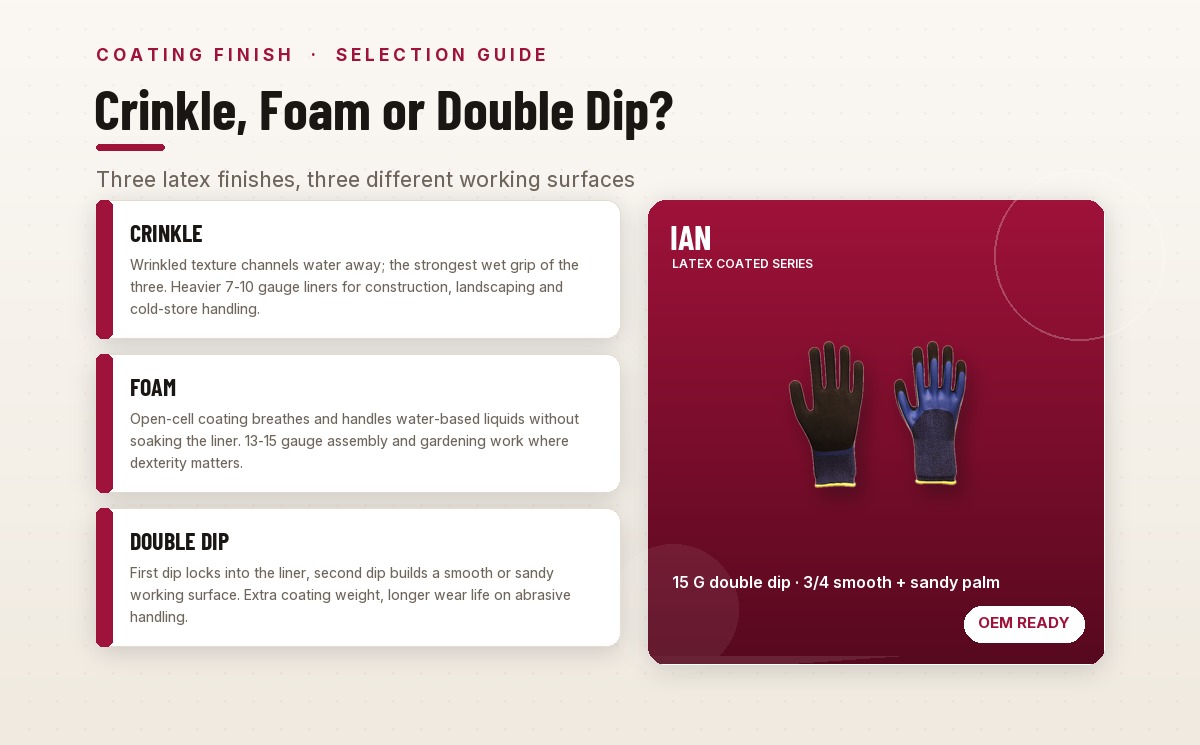
Crinkle latex is the classic finish on general-purpose and heavy-duty coated gloves. The wrinkled surface maximises friction in every direction, which is why it dominates construction, landscaping, material handling and demolition. On a 10 gauge heavy duty latex crinkle work glove, the coating is deliberately thick so the wrinkles stay open under load; on lighter liners the same finish gives everyday grip on dry and damp goods. If your market’s headline task involves water — rain, wash-down, wet timber, produce — crinkle is the default answer. Our crinkle latex coated work gloves page shows the range at a glance.
Foam latex: breathable grip for longer wear
Foam latex leaves an open-cell structure in the film. The cells let water-based liquids pass through the contact patch instead of pooling under the palm, and they let air move, which reduces the clammy feeling that drives workers to pull gloves off. Foam finishes sit mostly on 13 to 15 gauge liners for assembly, logistics and gardening work. Our foam latex palm coated work gloves and the bamboo-fibre eco-friendly foam latex glove are the two models private-label retail buyers reorder most often — the bamboo liner story carries real weight on garden-centre shelves, as we cover in the separate gardening gloves buyer guide.
Double dip: two layers for heavy handling
Double dip builds the coating in two passes. The first dip penetrates and locks into the liner; the second pass adds the working surface, either smooth (for a sealed, easy-to-clean film) or sandy/textured (for aggressive grip). The result is a heavier coating weight that resists abrasion longer on rough surfaces and keeps gripping after single-dip palms have rounded over. It costs more per pair, so it earns its place where gloves wear out fast — abrasive blocks, concrete, scrap handling. Our double dip sandy latex work gloves use a 3/4 smooth-plus-sandy construction that buyers typically put into masonry and landscaping programmes, and the thickened latex coated gloves article shows the same logic applied to construction and maintenance work.
Liner Gauge: 7, 10, 13 or 15
Gauge is the number of knit stitches per inch on the liner, and it sets the whole feel of the glove. Lower gauge means a thicker, chunkier liner; higher gauge means a finer, more dexterous one.
-
7 gauge — the heavy-duty end. Thick cotton or polyester loops, big air volume, maximum padding under the coating. Classic construction and cold-handling shell.
-
10 gauge — the general-purpose standard for crinkle latex. Enough substance to carry a heavy coating, still workable for handling tasks. Most crinkle latex programmes live here.
-
13 gauge — the fine-line standard. Our 13 gauge latex crinkle coated gloves show how a finer liner changes the same crinkle finish into a general handling and retail product.
-
15 gauge — dexterity-first. Thin nylon or blended liners for precision picking and light assembly, where the coating is kept minimal.
Match gauge to the smallest object your buyers’ workers handle. If the smallest thing grabbed is a brick or a pipe, 7–10 gauge with a crinkle finish is right; if it is a fastener or a seedling plug, 13–15 gauge with foam or light crinkle is the better spec. Sizing then follows the same logic we use across all coated gloves — hand circumference paired with hand length — which is set out step by step in our work glove size guide. An ill-fitting coated glove fails in the field no matter how good the coating is.
Where Latex Wins — and Where It Fails
Latex has a well-defined performance envelope. Selling it honestly inside that envelope is what keeps complaint rates low and reorders high.
Wins. Water-based wet grip is the headline: wet handling of any kind, from irrigation pipe to fish boxes to rain-day logistics. Cold flexibility is second — latex films stay elastic well below the temperatures where nitrile stiffens, which is why latex coated models anchor our winter work gloves guide for cold storage and outdoor work. Cost per pair is third: natural rubber dipping compounds are cheaper than comparable nitrile systems, and the price gap survives into bulk quotations.
Fails. Petroleum products are the hard limit. Natural rubber swells, softens and loses structure on contact with oils, greases, fuels and most hydrocarbon solvents — a latex palm used in machining or engine work will visibly degrade within a shift or two. Published glove-selector data is consistent on this: latex resists water, alcohols and some ketones, and is poor against hydrocarbons and organic solvents. If the job involves oil, the honest answer is a nitrile coating — the trade-offs are laid out in our nitrile coated gloves overview, the finish-by-finish comparison in sandy vs foam vs smooth nitrile, and the coating-choice article Nitrile vs Latex vs PU coated gloves. For buyers who want a middle path on dexterity rather than oil duty, our PU coated gloves buyer’s guide covers the third major coating family in the same depth.
Temperature. Formulation matters, but as a spec range, most work-glove latex compounds stay serviceable from roughly -20 ℃ to +80 ℃: below that, the film eventually stiffens; above it, the film softens and can turn tacky. Treat any temperature claim on a datasheet as formulation-specific and ask the factory for the tested range of the actual compound — this is one of the questions we answer per model, not per category.
Storage. Latex degrades under UV and ozone exposure. Gloves that live on a truck dashboard, an outdoor rack or under shop skylights harden and crack months earlier than the same pair kept in a carton. Stock rotation and opaque packaging belong in your import plan, and we pack OEM orders accordingly.
The Allergy Question Buyers Ask First
Natural rubber latex proteins can cause Type I (immediate) allergic reactions in sensitised people. The reference guidance here is the 1997 NIOSH Alert Preventing Allergic Reactions to Natural Rubber Latex in the Workplace (DHHS (NIOSH) Publication No. 97-135), which reports sensitisation in roughly 1–6% of the general population and 8–12% of regularly exposed healthcare workers, and recommends choosing reduced-protein, powder-free gloves when latex is used, and substituting non-latex materials wherever possible.
Context matters for coated work gloves. The NIOSH figures come from powdered examination gloves worn all day, every day, in healthcare settings — a very different exposure from a knit-lined industrial glove where only the palm carries latex and the liner blocks most skin contact. Coated work gloves are not powdered, and protein migration is far lower. But "far lower" is not "none", and sensitisation worsens with repeated exposure rather than improving.
The practical protocol we recommend to distributors and institutional buyers:
-
Screen for latex allergy history when onboarding crews onto latex-heavy tasks, and offer a nitrile-coated alternative in the same size run as the swap option.
-
Prefer reduced-protein, low-ammonia dipping compounds — ask your factory which compounds their latex line uses; this is a standard question we answer at RFQ stage.
-
For food-contact-adjacent or shared-bin programmes where you cannot survey every worker, default the coating choice to nitrile. A coating choice should never create an HR problem.
-
Train workers to report itching, redness or respiratory symptoms after glove use and to switch materials early — early substitution stops sensitisation from progressing.
For buyers weighing the two coatings directly, our articles on latex vs nitrile gloves and on judging nitrile glove quality cover the comparison from the distributor’s side.
Coverage: Palm Dip, 3/4 Dip or Full Dip
Beyond finish and gauge, coverage decides cost, breathability and the tasks a glove can hold.
-
Palm dip — coating on palm and fingers only. Maximum breathability, minimum cost. The default for general handling and retail gardening.
-
3/4 dip — coating wraps past the knuckles toward the back. Suits grip-heavy work where objects brush the back of the hand; the double dip sandy models above use this coverage.
-
Full dip / fully coated — the whole glove, often with a latex or double-latex layer, for wet work where liquid runs onto the back of the hand. Breathability drops, protection in genuinely soaked tasks rises. Our waterproof latex coated work gloves page covers the fully coated models, including smooth and sandy full-dip variants.
A useful buyer’s shortcut: price sensitivity and dry conditions point to palm dip; mixed wet work points to 3/4 dip with texture; standing water points to full dip plus a cuff decision (knit wrist vs safety cuff). Garden retail sits almost entirely in palm-dip foam latex, which is why our gardening gloves category is structured that way.
EN 388 Ratings and the CE Paperwork
Latex coated general-handling gloves sold into Europe sit under the PPE framework, and the mechanical-hazard pictogram on the datasheet is EN 388. The four digits (abrasion, cut, tear, puncture) plus the letter or cross for ISO 13997 cut and the impact position tell you far more than the coating name does — a soft crinkle latex palm and a dense double dip palm will carry different abrasion digits on the same liner. Do not assume ratings by category; read them per model, using our EN 388 pictogram explainer as the reference for every position.
The regulatory layer above the standard is Regulation (EU) 2016/425. Depending on the declared risk category, the glove needs the corresponding conformity module and paperwork — certificate scope matching the ordered model, the correct standard edition, and a declaration of conformity from the importer’s side. We walk through that verification path in the PPE Regulation and CE marking guide; for latex coated general-handling lines the practical takeaway is simple: collect the EN 388 test report and the CE documentation per model at sampling stage, not after the container ships.
Building the Line as an OEM Programme
IAN is an OEM/ODM glove factory — we do not export under our own brand, we build glove programmes under yours. A latex coated line is one of the fastest categories to customise, because the variables are physical and visible:
-
Coating — crinkle, foam, smooth double dip or sandy double dip, with compound colour matched to your palette.
-
Liner — cotton, polyester, blends, or bamboo-fibre for eco retail; 7/10/13/15 gauge to match the task.
-
Coverage and cuff — palm, 3/4 or full dip; knit wrist, safety cuff or extended cuff.
-
Branding — woven label, heat transfer or printed hand tag with your logo, plus private-label retail packaging: header cards, polybags, display boxes.
-
Compliance file — EN 388 test reports and CE documentation per model, prepared for your import paperwork.
Mixed-category buyers often start a latex line alongside a nitrile or PU programme so the size runs and packaging share tooling — our nitrile and PU coated categories use the same OEM workflow, and the factory behind all three is introduced on our about page with the production floor shown. Low-MOQ trial orders are normal: sample the two or three finish/gauge combinations you are torn between, run a one-week wear trial with your end users, and let the wear patterns settle the spec before the pallet order.
A Five-Step Checklist Before You Order
-
Name the surface. Water-based wet work → latex crinkle or sandy; oily work → nitrile, not latex; fine dry parts → PU or light foam latex.
-
Pick gauge by the smallest object handled. Brick/pipe → 7–10; fasteners/plants → 13–15.
-
Check the pictogram per model and pull the EN 388 report and CE file at sampling.
-
Ask the allergy protocol question — which compound, reduced-protein or not, and what the nitrile swap option is.
-
Plan storage and rotation. Opaque cartons, shaded warehouse, first-in-first-out; latex does not forgive a season on a sunny pallet.
Frequently Asked Questions
Can latex coated gloves be used with oils or fuels?
No. Natural rubber swells and degrades on contact with petroleum oils, greases and hydrocarbon solvents. Spec a nitrile coating for any oil-adjacent task; latex is for water-based wet grip.
Do latex coated gloves cause latex allergies?
They carry natural rubber proteins, so the risk is not zero, but coated work gloves expose skin far less than powdered latex examination gloves — no powder carrier, liner blocking most contact. Follow the NIOSH guidance: screen workers with latex allergy history, prefer reduced-protein compounds, and keep a nitrile alternative available for sensitised workers.
Which finish should a retail gardening line use?
Foam latex on a 13 gauge cotton or bamboo liner, palm dip, knit wrist. It is breathable for long wear, grips wet soil and pots, and carries the lowest cost per pair for high-volume private label. See the foam latex models and the gardening buyer guide linked above.
What is the minimum order for an OEM latex line?
Trial orders at low MOQ are normal so you can run a wear test before committing volume. Contact us through the contact page or browse the full product range on products.html, and we will quote the finish, gauge and packaging combination you spec.
Latex coated gloves are not complicated — they are one natural rubber film with three finishes, four gauges and three coverages. Get the surface condition and the allergy protocol right, verify the pictogram per model, and the category will be one of the quiet, dependable reorders in your catalogue. When you are ready to build it under your own label, start from the latex coated gloves range and talk to the factory directly.