EN 16350 Explained: Antistatic Glove Requirements for EU Cleanrooms and EV Battery Lines
Anyone sourcing gloves for an electronics EPA in Europe eventually hits the same sentence in a specification: "Coated gloves must comply with EN 16350." And a surprising number of quotations get stuck here, because EN 16350 is a young, narrow standard that is easy to misread. This guide explains what the standard actually requires, where it sits inside the EN 388 marking, how it relates to IEC 61340-5-1 and ANSI/ESD S20.20, and what an EU buyer should verify before approving a sample.
1. Where EN 16350 sits: the 6th digit of EN 388
EN 16350:2014 is the European test standard for the electrostatic properties of protective gloves. It is not a standalone quality mark you will find printed on a cuff. Since EN 388:2016 was updated, EN 16350 lives inside the familiar six-digit EN 388 pictogram code as the 6th digit:
-
X — the glove was not tested for electrostatic properties (this is what you get with ordinary PU-coated or nitrile-coated work gloves).
-
1 — the glove was tested and passed EN 16350. That is the only value allowed; unlike abrasion or cut resistance, there are no levels.
So a marking reading EN 388 – 4131X1 means: good abrasion, moderate cut, no TDM cut test performed, but electrostatic performance tested and passed. If a supplier’s datasheet claims "antistatic" while the 6th digit shows X, the claim is not backed by the standard.
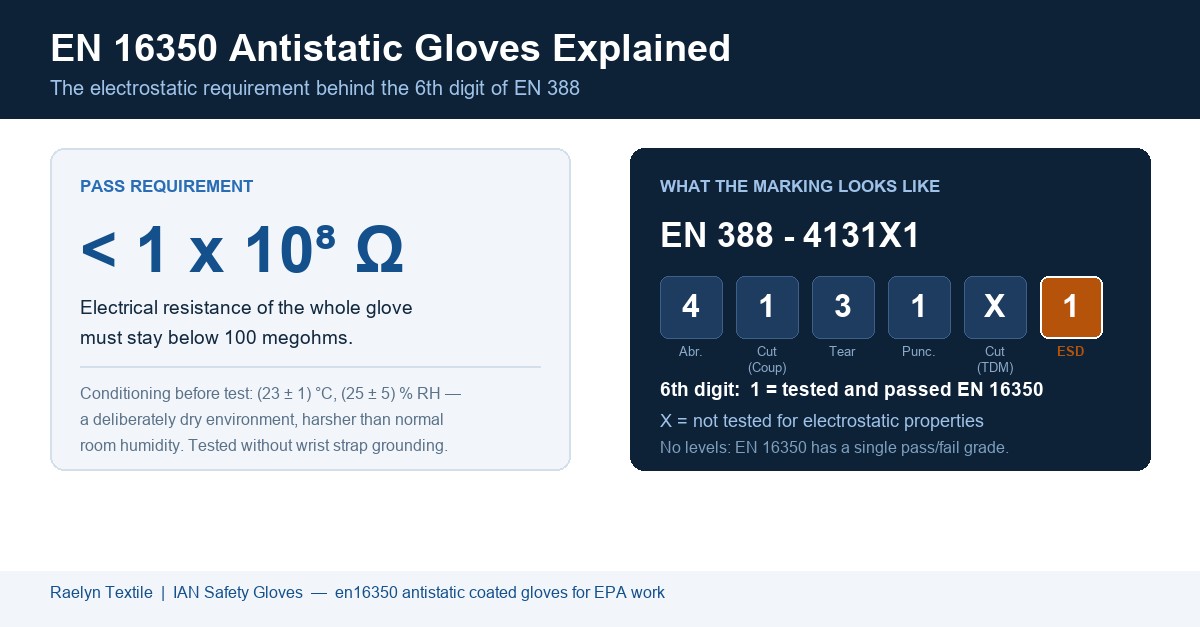
2. The requirement: resistance below 1 × 10⁸ Ω — under deliberately dry conditions
To pass, the electrical resistance of the complete glove must stay below 1 × 10⁸ Ω (100 megohms) when measured as delivered. Two details make this test tougher than it sounds:
-
Dry conditioning. Gloves are conditioned at (23 ± 1) °C and only (25 ± 5) % relative humidity before testing. A glove that only conducts because it absorbed ambient moisture will fail in this dry state — which is exactly the point, because dry winter air is when electrostatic problems peak.
-
The whole glove is the current path. Resistance is measured through the glove itself, not through a wrist strap. A coated glove cannot lean on external grounding to pass.
This is why genuine EN 16350 gloves are built differently, not just relabelled: the conductive path has to be woven or coated into the product.
3. EN 16350 vs IEC 61340-5-1 vs ANSI/ESD S20.20
Buyers often mix up three documents that operate at different levels. The table below is the version we use in customer communications:
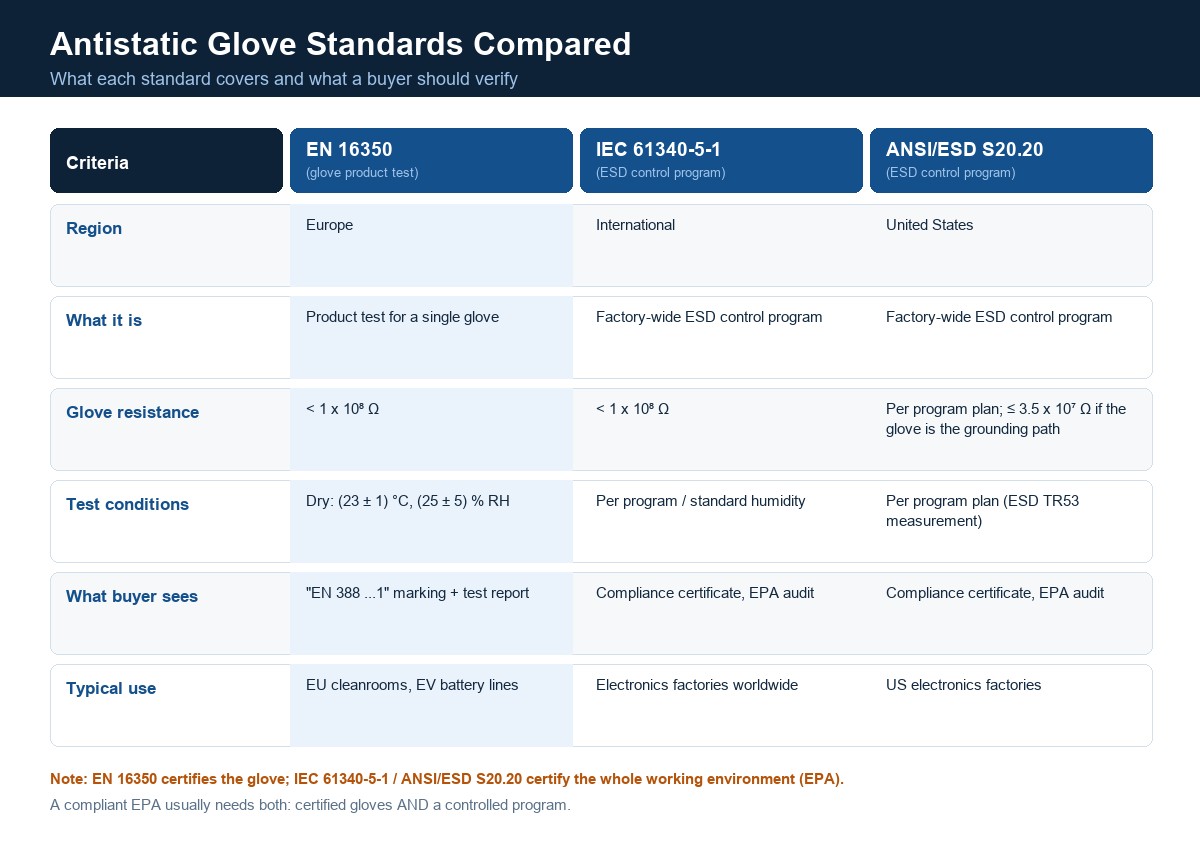
The short version: EN 16350 certifies a glove; IEC 61340-5-1 and ANSI/ESD S20.20 certify a working environment. An EPA (electrostatic protected area) built to IEC 61340-5-1 or S20.20 will normally specify gloves with resistance below 1 × 10⁸ Ω — and if the glove doubles as the operator’s grounding path, the person-to-ground system must stay at or below 3.5 × 10⁷ Ω. For EU projects the practical answer is usually both: a program-compliant EPA and gloves marked EN 388 …1.
4. How an antistatic coated glove is actually built
Knitted liners are natural insulators — polyester and acrylic fibres happily hold charge. Antistatic coated gloves solve this in one of three ways:
-
Carbon or conductive filament knitted into the liner. The classic construction for anti-static gloves: a grid of carbon-rich yarn runs through the shell, giving charge a path from the skin side to the coating.
-
Full or fingertip conductive coating. In a carbon-fiber ESD fingertip-coated glove, only the fingertips are coated — the standard pattern for cleanroom and precision electronics work where you need bare-finger feel on small parts.
-
Static-dissipative polymer coatings. Anti-static PU-coated ESD gloves combine a thin, low-particulate PU palm with a conductive liner; the PU layer keeps surface charge from accumulating while staying light enough for assembly work.
What you should not expect: an antistatic glove is dissipative, not shielding, and it is not electrical-insulating PPE. It manages static build-up on a person handling ESD-sensitive devices; it does not protect against live circuits, and it does not replace the grounding program around it.
5. EU cleanrooms and EV battery lines: where the standard bites
Demand for certified antistatic gloves in Europe concentrates in two very different workplaces:
-
Cleanrooms and electronics assembly. Modern semiconductors and displays can be damaged by discharges far below what a human can feel — well under 100 V. Here antistatic performance pairs with low linting and, for many lines, a fingertip-coated design for dexterity.
-
EV battery and power-electronics production. This is the fast-growing one. Module and pack assembly combines ESD-sensitive battery management electronics with sharp metal enclosures, so buyers increasingly specify combined performance: electrostatic compliance plus meaningful mechanical scores. (If your risk assessment also involves impact or cut hazards, our explainers on TPR impact protection and cut-resistant gloves cover the mechanical side.)
German, Hungarian and Spanish battery plants tend to write EN 16350 into the spec directly; suppliers who can quote a test report with the sample win the evaluation before price is even discussed.
6. A five-point verification checklist for buyers
-
Check the 6th digit. The EN 388 marking on the datasheet and the cuff must end in 1, not X.
-
Ask for the test report, not the logo. A third-party report should show resistance values measured under the dry conditioning described above — ideally for the actual model and size you are buying.
-
Ask how washing affects resistance. Conductive filaments can break or migrate through laundering; if your operation reuses gloves, ask for resistance data after the number of wash cycles you actually run.
-
Balance the mechanical scores. An EN 16350 pass says nothing about abrasion or cut resistance. Read the full six-digit code, or use our EN 388 vs ANSI cut-level conversion guide if your spec references ANSI numbers.
-
Confirm batch consistency. Resistance is a batch-sensitive property. Ask how the manufacturer controls liner yarn lots between production runs — this is the question that separates glove makers from traders.
7. FAQ
Is "antistatic" the same as "ESD-safe"?
In practice, yes, for gloves: both describe static-dissipative hand protection. "ESD-safe" is informal; EN 16350 is the European test that makes the claim verifiable.
Does EN 16350 expire?
The standard itself is versioned (the current edition is EN 16350:2014). What matters for procurement is that the glove was tested to the current edition and that your supplier can still produce the report.
Can a disposable nitrile glove pass EN 16350?
Some cleanroom-grade disposables claim low static, but they are typically qualified under IEC 61340-5-1 program requirements rather than marked with an EN 388 code. If a datasheet shows an EN 388 six-digit mark on a disposable, treat it with suspicion — disposables are rarely tested to EN 388’s mechanical levels.
We use wrist straps. Do we still need EN 16350 gloves?
Usually yes. The wrist strap grounds the operator, but a charge-holding glove over the strap path (or used by visiting staff without straps) can still isolate components. Most EPA procedures specify dissipative gloves regardless.
Talk to a manufacturer, not a catalogue
We produce antistatic coated gloves — full-PU, fingertip-coated carbon-fiber and nitrile versions — and we can supply the EN 16350 test documentation with your sample, along with honest guidance on which construction fits your line. Browse our anti-static glove range or send us your specification for a sample and quotation.