How to Choose ESD Gloves for Electronics Assembly, PCB Handling and Precision Manufacturing
How to Choose ESD Gloves for Electronics Assembly, PCB Handling and Precision Manufacturing
In electronics manufacturing, choosing the right gloves involves more than protecting workers’ hands. Operators frequently handle printed circuit boards, electronic components and precision parts that may be sensitive to electrostatic discharge (ESD).
The appropriate glove depends on the task, the materials being handled and the facility’s ESD control requirements. A glove suitable for component inspection may not be the most practical choice for general assembly or repetitive material handling.
Different Electronics Applications Require Different Gloves
During PCB assembly, workers may need to pick up small components, position boards or operate precision tools. These tasks require flexibility and fingertip control.
Component inspection places particular emphasis on dexterity and handling accuracy. Operators may prefer a lightweight glove that allows them to manipulate small parts without unnecessary bulk.
For general electronics manufacturing, glove selection may also involve durability, coating coverage and comfort during extended shifts.
Rather than selecting one glove for every workstation, manufacturers should evaluate the actual handling requirements of each operation.Manufacturers comparing different glove constructions can explore our range of anti-static gloves before selecting products for workstation evaluation.
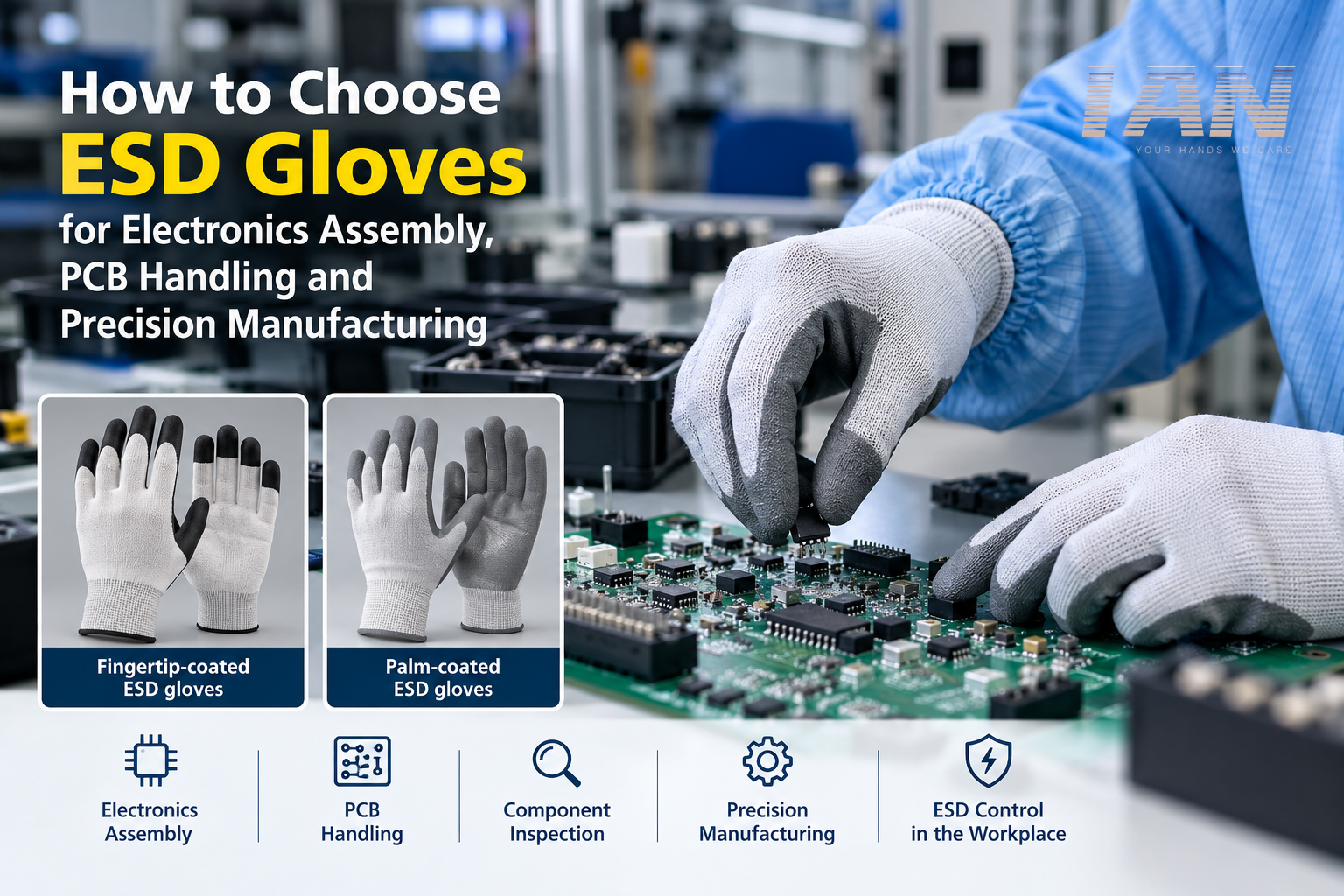
Fingertip-Coated vs. Palm-Coated ESD Gloves

Fingertip-coated ESD gloves
PU coating on the fingertips can provide localized grip while retaining flexibility across much of the hand. This construction may suit precision handling and small-component assembly, depending on the workstation’s requirements.One example is IAN’s 13 Gauge Carbon Fiber Antistatic ESD Gloves, which combine a carbon-fiber liner with PU-coated fingertips.

Palm-coated ESD gloves
A PU palm coating provides a larger gripping surface. It may be useful when operators regularly handle boards, tools or other items that require more contact across the palm.Buyers considering broader coating coverage can review IAN’s 13 Gauge Anti-Static PU Coated ESD Gloves as a palm-coated option.
Neither construction is automatically suitable for every ESD-controlled environment. Buyers should evaluate both the handling performance and the relevant electrical test data.
Carbon Fiber and Other Glove Materials
Carbon fiber is incorporated into certain ESD glove liners to support static-control performance. However, the presence of carbon fiber alone does not establish a glove’s electrical resistance or suitability for a particular ESD control program.
Liner composition, coating construction, manufacturing consistency and test conditions all matter.
Electronics manufacturers should request appropriate technical information and evaluate glove samples under their actual working conditions.For more information on conductive fibers, electrical resistance and test methods, read our ESD glove resistance and testing guide.
Dexterity and Comfort During Extended Assembly Work
Fine assembly tasks often involve repetitive hand movements and prolonged glove use.
A lightweight knitted construction can help maintain flexibility, while the coating pattern affects how the operator grips components and tools.
Buyers should consider glove fit, available sizes, coating coverage and the operator’s ability to perform the required task comfortably.
Sample evaluations across different workstations can help identify practical differences that are not immediately apparent from product specifications.For a broader overview of glove materials, coating options and purchasing considerations, see our ESD gloves buyer’s guide.
Evaluating ESD Gloves Before Bulk Purchasing
For PPE distributors and electronics manufacturers, a useful purchasing evaluation should cover the intended application, glove construction, required electrical performance and production consistency.
ESD gloves should be considered within the facility’s overall ESD control program rather than as a standalone solution.
Before confirming a bulk order, buyers should request relevant test information, review the product specifications and arrange sample testing where appropriate.
IAN Safety Gloves offers different anti-static and ESD glove constructions for electronics-related applications. If you are evaluating gloves for a specific production process, you can request a recommendation or sample by sharing your handling requirements, preferred coating coverage and purchasing specifications.