ESD Glove Resistance Explained: Conductive Fibers, Testing & ANSI/ESD Requirements
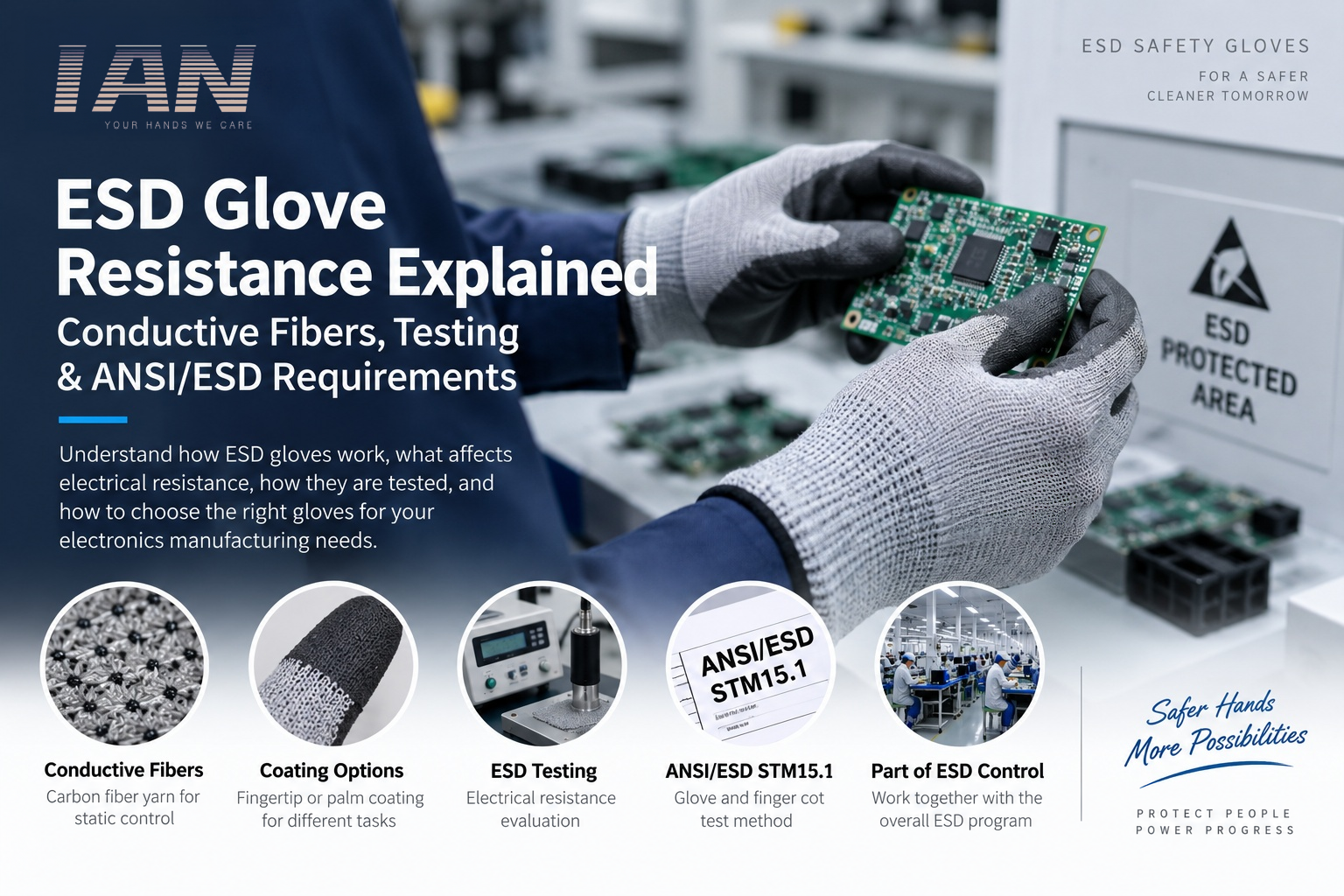
ESD Glove Resistance Explained: Conductive Fibers, Testing & ANSI/ESD Requirements
In electronics manufacturing, choosing an ESD glove involves more than deciding whether a glove is labeled “anti-static” or “ESD safe.”
For buyers, engineers and production teams, one of the more important questions is how the glove behaves electrically when it becomes part of an ESD-controlled work process. That brings several factors into the discussion: the construction of the liner, the use of conductive fibers, coating coverage, electrical resistance and the test method used to evaluate the glove.
These details matter because an ESD glove does not work independently of the person wearing it, the workstation and the wider ESD control program.
Why Electrical Resistance Matters in ESD Gloves
Static electricity becomes a concern when charge builds up and is discharged in an uncontrolled way. In electronics assembly and component handling, even a discharge that is not noticeable to the worker may be relevant to sensitive devices.
An ESD glove therefore should not be evaluated only by its mechanical properties or surface coating.
For a buyer, a more useful set of questions is:
What is the glove made from? How is conductivity introduced into the glove construction? What resistance requirement applies to the intended process? Which test method is being used? How will the glove interact with the rest of the ESD control system?
This makes resistance a specification issue rather than just a marketing description.
Conductive Fibers and Glove Construction
Many ESD gloves use yarn constructions that incorporate conductive materials. Carbon fiber is one common example. Conductive fibers can be integrated with other textile fibers to give the knitted liner electrical characteristics suitable for static-control applications while maintaining flexibility for precision work.
However, the presence of carbon fiber alone does not define the complete performance of a glove.
Gauge, yarn structure, coating material and coating coverage can influence how the finished glove feels and performs during electronics assembly. Buyers should therefore evaluate the finished glove rather than treating “carbon fiber” as a complete specification by itself.
Fingertip Coating vs Palm Coating
Coating coverage is another practical consideration.
PU-coated fingertips are often used where workers need precise handling of small parts. Palm-coated designs provide broader coating coverage across the working surface of the hand.
Neither construction is automatically the better ESD glove. The choice should depend on the production task, required dexterity, grip requirements and the electrical performance specification established for the workplace.
IAN’s 13 Gauge Carbon Fiber Antistatic ESD Gloves provide one example of a carbon-fiber liner with fingertip PU coating, while the 13 Gauge Anti-Static PU Coated ESD Gloves provide a palm-coated option for buyers evaluating different glove constructions.
For a broader overview of glove construction, coating options and selection factors, see our ESD gloves & anti-static gloves buyer’s guide.
Understanding ESD Glove Testing
Electrical claims should be supported by an appropriate test method.
Terms such as “anti-static,” “conductive” and “static dissipative” should not simply be treated as interchangeable product labels. A test result only becomes meaningful when the buyer understands what was tested, under which method and against what requirement.
Where a project has a specific electrical requirement, buyers should request the relevant specification and supporting test documentation before placing an order.
What Is ANSI/ESD STM15.1?
ANSI/ESD STM15.1 is a test method associated with the electrical resistance of gloves and finger cots used in ESD applications.
It should be distinguished from the broader role of ANSI/ESD S20.20.
ANSI/ESD STM15.1 relates to testing gloves and finger cots.
ANSI/ESD S20.20 relates to the wider ESD control program.
The distinction matters because testing an individual glove does not by itself establish the performance of an entire production environment.
ESD Gloves Are Part of a Larger Control System
A glove is only one element of ESD control.
Electronics manufacturing environments may also manage personnel grounding, work surfaces, flooring, footwear, packaging and handling procedures. This is why buyers should avoid evaluating an ESD glove in isolation.
A glove suitable for one production process may not automatically meet another facility’s requirements. The specification should come from the actual process requirement rather than from a generic request for an “ESD glove.”
What Industrial Buyers Should Confirm Before Ordering
Before bulk purchasing, buyers should confirm:
-
intended application and components being handled;
-
liner material and conductive-fiber construction;
-
fingertip or palm coating configuration;
-
glove gauge and required dexterity;
-
required electrical resistance or ESD performance;
-
applicable test method;
-
supporting test documentation where required;
-
sample performance under actual working conditions.
Sample evaluation can help buyers consider electrical requirements together with fit, dexterity, grip and worker acceptance before standardizing a glove.
Selecting ESD Gloves for Your Production Requirements
There is no single ESD glove specification appropriate for every electronics manufacturing process. PCB handling, component inspection, electronics assembly and precision manufacturing can place different demands on the glove.
To see how these selection factors apply to actual production tasks, explore our guide to ESD gloves for electronics assembly and PCB handling.
IAN Safety Gloves offers anti-static gloves with different liner and coating constructions for electronics and precision-handling applications.
If your project has a defined resistance requirement, coating preference or testing requirement, request a recommendation or sample and provide the application details. This gives both sides a clearer basis for evaluating the appropriate glove before bulk purchasing.