How To Choose Cut Resistant Gloves for Metalworking, Glass Handling And Manufacturing
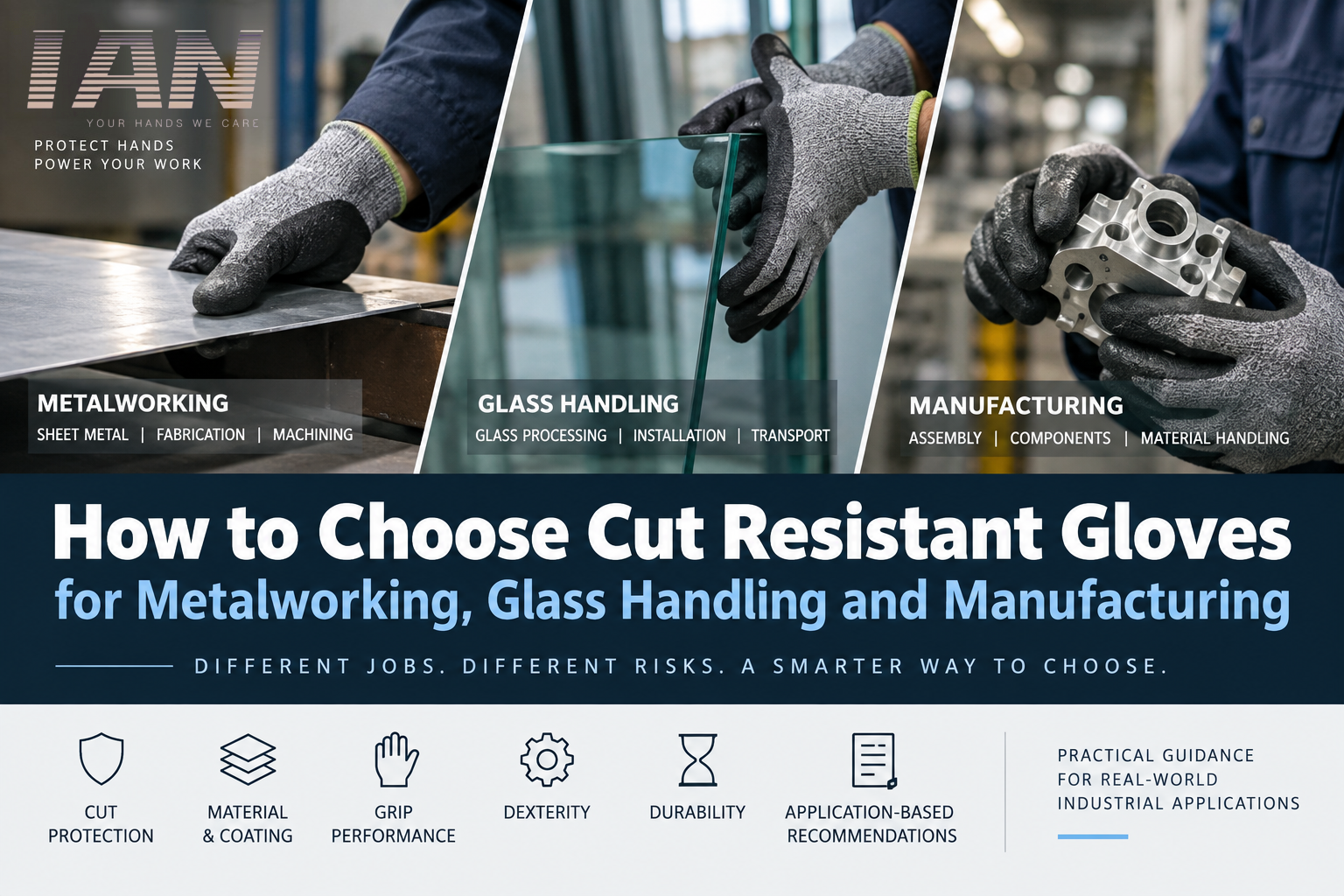
A worker lifting a large sheet of metal does not use a glove in the same way as someone assembling small stamped components. A glass handler faces a different combination of edge, grip and breakage risks again.
Yet these jobs are often grouped under the same purchasing request:
“We need cut resistant gloves.”
That description is usually not enough.
For industrial buyers, the useful question is not simply how much cut resistance a glove offers. It is how the glove performs while workers grip, lift, position and repeatedly handle the actual material.
This is particularly important in metalworking, glass handling and manufacturing, where sharp edges may be only one part of the hand-protection problem.
Start With the Material Being Handled
Before comparing glove models, look at the object creating the hazard.
Sheet metal can expose workers to burrs and sharp unfinished edges. Fabricated parts may combine cut hazards with oil or machining fluids. Glass can present sharp edges while also requiring secure grip and careful handling. Smaller manufactured components may demand much more fingertip control.
These differences affect glove selection.
A purchasing specification should therefore begin with questions such as:
-
What material is being handled?
-
Are the edges finished, unfinished or unpredictable?
-
Is the surface dry, oily or wet?
-
How heavy is the part?
-
Does the worker carry it or manipulate it precisely?
-
How frequently is the task repeated?
-
Are puncture, abrasion or impact hazards present as well?
This task-based approach is also consistent with OSHA’s hand-protection requirements, which call for selection based on the glove’s performance characteristics relative to the task, workplace conditions, duration of use and identified hazards.
Sheet Metal Handling: Sharp Edges Are Only Part of the Problem
Sheet metal presents one of the clearest applications for cut-resistant hand protection.
Workers may handle raw sheets, stamped pieces, ductwork, fabricated panels or unfinished components. Depending on the process, edges can be sharp enough to cause serious lacerations.
But specifying a glove only by cut level can miss an important part of the job.
A worker also needs to control the material.
Large sheets require a secure grip. Smaller fabricated parts may require more dexterity. If oil is present, the coating has to perform under conditions very different from dry handling.
This means the glove specification needs to balance:
cut protection + grip + coating + dexterity + durability
For relatively light fabrication and component handling, a thinner construction may provide the control workers need.
As edge severity and exposure increase, buyers may move toward higher cut-resistant constructions while still evaluating whether the glove remains practical for repeated handling.
Metal Fabrication: Consider the Entire Work Cycle
Metal fabrication is not one task.
A worker may move material, position a component, operate equipment, inspect a finished part and transfer it to the next process—all while wearing the same pair of gloves.
That makes real-world usability important.
For example, a glove that performs well while carrying material may feel too bulky when the worker needs to handle smaller components. Conversely, a very thin glove may provide excellent dexterity but insufficient protection for rough unfinished edges.
Buyers should examine where the glove is used throughout the process rather than evaluating only one moment of exposure.
For fabrication environments, useful specifications often include the required cut resistance, liner gauge, coating type, coating coverage and grip finish.
Oily Metal Parts Change the Grip Requirement
Oil can change an otherwise straightforward glove selection.
A glove may feel secure on a clean metal component but perform very differently once machining oil or lubricant is introduced.
Poor grip can cause workers to squeeze harder, increase fatigue and reduce control of the part.
For these applications, nitrile-coated constructions are often worth evaluating.
Foam or sandy nitrile finishes can be selected according to the required grip characteristics and working conditions. A double-coated construction may also be appropriate where buyers need additional coating coverage or durability.
The important point is that the coating should be selected alongside the cut-resistant liner—not after it.
Glass Handling Requires Both Protection and Control
Glass handling presents a different problem.
The obvious concern is contact with sharp edges or broken material. But maintaining control of the glass is equally important.
A glove that reduces tactile feedback too much may make careful positioning more difficult. A coating that does not provide sufficient grip can create additional handling risk.
The requirements can also vary substantially between:
-
finished glass panels,
-
raw glass edges,
-
window manufacturing,
-
glass processing,
-
installation,
-
and handling broken or waste glass.
For this reason, buyers should avoid treating “glass gloves” as one universal specification.
The size and weight of the glass, edge condition, surface condition and handling method should all be discussed with the supplier before finalizing the glove construction.
Manufacturing and Assembly Often Need More Dexterity
Not every manufacturing cut hazard requires a heavy glove.
Automotive components, stamped parts, appliance components and general industrial assemblies can contain edges that justify cut protection while still requiring workers to manipulate relatively small parts.
Here, dexterity becomes much more important.
Glove gauge, liner construction and coating thickness can affect how easily a worker can pick up fasteners, position components or operate tools.
A finer-gauge glove can generally offer a different hand feel from a heavier construction, although gauge alone does not determine overall performance.
The goal is to provide sufficient protection without introducing unnecessary bulk.
Nitrile or PU: The Application Should Decide
Both nitrile and PU coatings are used on cut-resistant industrial gloves, but they serve different purchasing priorities.
When Nitrile Makes Sense
Nitrile is commonly considered for applications where grip and abrasion resistance are important.
It can be particularly useful in:
-
metal fabrication,
-
automotive manufacturing,
-
machinery work,
-
maintenance,
-
material handling,
-
and environments where parts may carry oil.
Different nitrile finishes also allow the grip characteristics to be adjusted for the application.
When PU Makes Sense
PU coatings are generally thinner and can provide good tactile sensitivity.
That makes them worth considering for:
-
precision assembly,
-
controlled component handling,
-
inspection,
-
light fabrication,
-
and tasks where fingertip movement matters.
The choice should therefore not be reduced to “nitrile versus PU.”
A better question is:
What does the worker need to feel and grip during the task?
Gauge Matters, but It Does Not Tell the Whole Story
Buyers frequently compare 13-gauge, 15-gauge and other liner constructions.
Gauge is useful because it helps describe the knitting density of the glove, but it should not be interpreted as a protection rating.
Two gloves with different gauges can also differ in yarn composition, cut-resistant fibers, reinforcement and coating.
A 13-gauge construction may suit one industrial application, while a finer 15-gauge glove may be preferable where dexterity is more important.
The final choice should be based on the complete glove rather than one specification line.
Reinforcement Can Matter in High-Wear Areas
Cut resistance and wear resistance are related purchasing concerns, but they are not the same thing.
Some industrial tasks repeatedly wear the same areas of a glove.
The thumb crotch is a common example.
When workers repeatedly grip sheet material or components, reinforcement in this area can help address localized wear.
For buyers comparing gloves for fabrication, glass or repetitive material handling, it is worth asking whether reinforcement is available and whether the application actually needs it.
Adding features without an application reason can increase cost without improving the worker’s experience.
How Should Buyers Compare A2, A4 and A6 Options?
Protection level still matters, but it should now be viewed in the context of the task.
An A2 construction may make sense for lighter industrial handling where dexterity remains a priority.
An A4 option can provide a useful middle position for more demanding component and metal handling.
A6 constructions may be evaluated where workers face greater exposure to sharp glass, sheet metal or fabricated edges.
The exact choice should come from the hazard assessment rather than a generic industry label.
For a detailed explanation of the classification itself, buyers can refer to our ANSI Cut Resistance Levels A1–A9 guide rather than treating the application name as a substitute for risk assessment.
Why Samples Should Be Tested on the Actual Line
A technical data sheet can narrow the options, but it cannot reproduce the customer’s production line.
Before approving a volume order, samples should ideally be tested in the real application.
Ask workers to evaluate:
-
grip on the actual material,
-
dexterity during normal operations,
-
comfort over a realistic wearing period,
-
coating wear,
-
liner movement,
-
fit,
-
and control of the part.
Feedback should also come from more than one wearer where possible.
A glove that looks ideal on paper may perform differently after several hours of repetitive handling.
What to Include in an RFQ for Industrial Cut Resistant Gloves
A useful RFQ gives the manufacturer enough information to recommend a construction rather than simply quote a generic glove.
For metalworking, glass and manufacturing applications, include:
-
material being handled,
-
edge condition,
-
required or target cut level,
-
dry/oily/wet conditions,
-
preferred coating if already known,
-
coating coverage,
-
required dexterity,
-
glove gauge if specified,
-
reinforcement requirements,
-
sizes,
-
estimated order quantity,
-
target market,
-
packaging,
-
logo or private-label requirements,
-
and any required test or compliance documentation.
Photos of the application or an existing glove specification can also make technical comparison more accurate.
Choose the Glove Around the Work
There is no single cut-resistant glove that is automatically best for metalworking, glass handling and manufacturing.
The useful specification comes from understanding what is sharp, what must be gripped, how precisely the worker must move, and what conditions are present during the job.
Cut level remains important, but it works together with liner construction, gauge, coating, grip and reinforcement.
If you are building a broader glove specification, our Cut Resistant Gloves Buyer’s Guide covers the relationship between protection levels, materials and coatings. For a deeper explanation of A1–A9 classifications, see our ANSI Cut Resistance Levels guide.
IAN Safety Gloves works with distributors, importers and PPE brands on cut-resistant glove specifications for industrial applications. When requesting a recommendation or sample, send us information about the material being handled, working conditions, required protection level, coating preference, sizes and target market so that the available constructions can be compared more effectively.