PU Coated Gloves: The Complete Buyer’s Guide (Materials, Gauges, ESD and Cleanroom)
Polyurethane (PU) coated gloves have quietly become the default hand protection for precision assembly, electronics manufacturing, quality inspection and light industrial handling across Europe and Asia. Walk into any automotive sub-assembly line, any SMT workshop or any high-mix warehouse picking station, and the gloves on the line are more likely than not a thin knitted liner with a micro-thin PU palm. Yet for something so common, PU coated gloves are specified badly surprisingly often: buyers pick the wrong gauge, order them for oily work they cannot handle, or treat an "anti-static" hang tag as if it were a measurable ESD control.
This guide is the reference we give to our own distributor and OEM customers at IAN Safety Gloves. It covers what a PU coating actually is, how gauge changes fit and feel, where PU wins and where it fails, how to read EN 388 codes on a PU glove, what EN 16350 and IEC 61340-5-1 really demand for ESD work, and how to choose for cleanroom environments — ending with a procurement checklist you can paste into a purchase order. If you want to compare PU against other coatings first, our nitrile vs latex vs PU comparison covers that decision in depth.

1. What exactly is a PU coated glove?
A PU coated glove is a seamless knitted liner — usually nylon or polyester — with a thin layer of polyurethane applied to the palm (and sometimes the fingertips or the full hand). Polyurethane is a polymer that can be formulated as a water-based dispersion and cured on the liner at relatively low coat weight, which is why PU coatings can be made dramatically thinner than dipped nitrile or latex while still forming a continuous grip layer.
Three properties follow from that construction and explain most of PU’s market position:
-
High dry grip with a non-sticky feel. PU has a naturally high coefficient of friction on smooth, dry surfaces — plastic parts, cardboard, coated metal, glass. Workers describe it as "biting" the part rather than sticking to it, which is exactly what precision pick-and-place work needs.
-
Maximum tactile feedback. Because the coating is thin and the liners are fine-gauge, a PU glove is the closest you can get to bare-hand feel while still wearing PPE. This is why 18-gauge and 21-gauge PU gloves dominate electronics micro-assembly.
-
Breathability. PU is microporous: the palm is coated but the back of the hand usually stays uncoated knit, and even the palm film passes some air. For all-day wear in warm shops, this matters more than most buyers expect.
The same porosity is also PU’s defining weakness, which we will come back to: oil and water films soak through the coating rather than sitting on top of it. Browse our full range of PU coated gloves to see how the gauge and liner combinations differ in practice.
2. Gauge: the spec that decides fit, feel and durability
Gauge is the number of knitting needles per inch on the machine that made the liner. More needles per inch means a finer, thinner, tighter knit; fewer needles means a thicker, more robust liner. Gauge does not change the protection rating by itself — it changes fit, dexterity and wear life, which is why it should be the first parameter you fix when specifying a PU glove.
| Gauge | Liner character | Typical PU glove use |
|---|---|---|
| 10G | Thick, robust knit | Heavy general handling; rarely PU coated |
| 13G | Standard industrial knit | General assembly, warehousing, automotive sub-assembly — the workhorse |
| 15G | Fine, close-fitting | Small parts, inspection, electronics assembly |
| 18G | Very fine, high dexterity | Precision assembly, component handling, cleanroom use |
| 21G | Ultra-fine, "second skin" | Micro-assembly, laboratory and inspection work; lowest abrasion life |
Two practical rules fall out of this table. First, moving from 13G to 15G or 18G is the cheapest productivity upgrade you can give a team that handles small parts: fewer dropped components, fewer glove-removal "moments" that expose bare hands. Our 13 gauge PU coated work gloves remain the best-value choice for mixed duties where durability still matters, while a lightweight PU coated glove in a finer gauge suits workers whose complaint is bulk rather than wear.
Second, TPU is not a typo. A 15-gauge liner can also be coated with thermoplastic polyurethane, which is slightly more abrasion-tolerant than standard PU at a similar thickness — our 15 gauge TPU coated work gloves are the usual upgrade path when a customer likes 15G fit but sees faster palm wear than the application justifies. If you need a plain primer on reading gauge claims from any supplier, remember the one-line definition: gauge = needles per inch; higher = thinner and more dexterous, lower = thicker and more durable.
3. Liner materials: nylon, polyester and HPPE
The liner carries the fit, the wicking and — when cut-resistant yarns are used — the cut rating. Three liners cover almost every PU glove specification:
-
Nylon is the default. It is elastic, form-fitting and quick-drying, which is why most ESD PU palm coated nylon gloves feel closer to the hand than their polyester equivalents.
-
Polyester costs less, holds colour well (useful when you colour-code sizes or departments) and is slightly softer for all-day light duty. Our polyester PU coated work gloves are the usual choice for high-volume general handling where unit cost drives the decision.
-
HPPE and cut-resistant blends bring the cut protection. PU pairs naturally with cut liners because the thin coating preserves the dexterity the liner provides — a typical build is an HPPE/nylon shell with an ANSI A4 rating under a PU palm, like our A4 cut resistant PU coated gloves. The PU coating adds grip and abrasion on top of the liner’s cut performance without fattening the hand.
One mistake to avoid: do not ask a PU glove to be a cut glove by thickness. Cut level comes from the yarn system; the coating contributes almost nothing to it. If your application needs A4–A6, start from the liner and then decide the coating, not the reverse.
4. Where PU wins — and where it fails
PU’s fit-for-purpose map is unusually sharp, which makes specification easy if you are honest about the work environment:
PU wins when:
-
Parts are dry and smooth — plastics, electronics, coated metals, glass, cardboard. PU’s dry grip is the best of any common coating at equal thickness.
-
Dexterity is the bottleneck. Precision assembly, inspection, picking small SKUs, quality control.
-
Shift comfort matters. Breathable palm plus uncoated back means less hand sweat than full-dip nitrile.
-
Low linting matters — a cured PU film sheds far less fibre than an uncoated knit.
PU fails when:
-
Oily or wet parts. PU is microporous: oil and water films wick through to the skin within minutes. For oil-soaked work, foam or sandy nitrile is the correct coating — see our breakdown of sandy vs foam vs smooth nitrile.
-
Sustained heat. PU softens near 80 °C; it is not a heat glove and is not tested to EN 407. Keep PU gloves away from hot surfaces and freshly moulded parts.
-
Chemical exposure. A thin PU palm is not a chemical barrier. Chemical protection needs EN ISO 374-tested dipped gloves, not a mechanical-risk PU glove.
-
Heavy abrasion. A 21G PU glove on rough concrete will wear through quickly. Match gauge and coating weight to wear severity.
5. Reading EN 388 on a PU coated glove
PU gloves sold into the EU carry the EN 388 hammer pictogram under PPE Regulation (EU) 2016/425 — if you need the regulatory frame first, our PPE Regulation and CE marking guide for importers explains what the paperwork behind that mark must contain. The mechanical code itself has up to six characters, and for a typical PU glove the interesting positions are abrasion and the cut pair:
-
Position 1 — Abrasion (0–4): sandpaper cycles until the palm wears through. Level 1 = 100 cycles, level 2 = 500, level 3 = 2,000, level 4 = 8,000. A quality 13G PU glove should reach abrasion level 3–4; ultra-fine 18–21G gloves commonly sit at level 2–3, and that is a fair trade for dexterity, not a defect.
-
Position 2 — Coupe cut (0–5 or X): the rotating-blade index. High-performance yarns can blunt the blade and void this test, which is when an X appears and the TDM letter becomes the reference.
-
Position 5 — ISO 13997 TDM cut (A–F): the straight-blade force test, from A (≥2 N) to F (≥30 N). On standard PU gloves you will often see A or B; cut liners with PU palms reach C–E depending on the yarn.
A representative code for a 13G PU general-purpose glove is 4132X or similar: abrasion 4 (8,000 cycles), coupe 1, tear 3 (≥50 N), puncture 2 (≥60 N), TDM not tested. Do not average the digits or compare gloves by "total score" — each position answers a different question. Our step-by-step walkthrough of all six digits of the EN 388 pictogram covers the edge cases, including why an X in position 2 is usually good news.
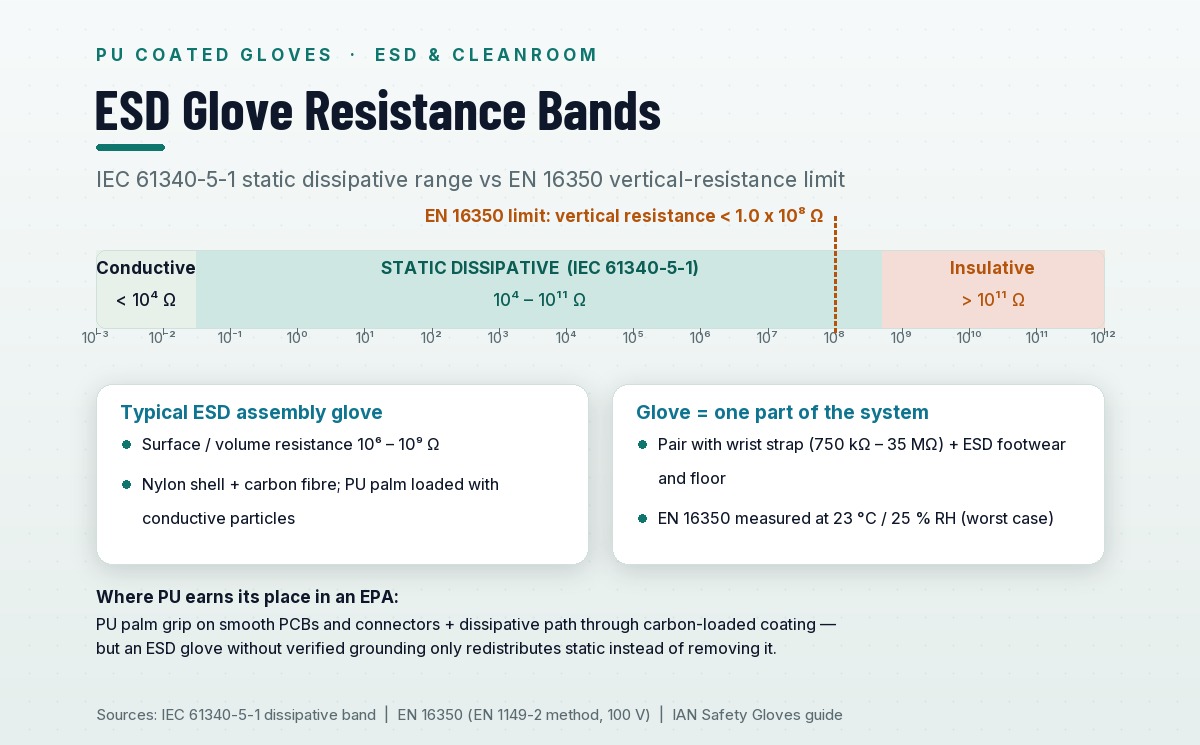
6. ESD and anti-static: what EN 16350 and IEC 61340-5-1 actually require
This is where PU coated glove buying gets technical, because electronics is PU’s largest market and the terminology on datasheets is loose. Two different frameworks matter:
EN 16350 — the glove-specific EU standard
EN 16350 defines the electrostatic requirement for protective gloves, aimed at explosive atmospheres (ATEX) but widely cited for electronics too. It measures vertical resistance through the material using the EN 1149-2 method at 100 ± 5 V, under deliberately harsh conditions — 23 °C and 25 % relative humidity — and requires every specimen to measure below 1.0 × 10⁸ Ω. The 25 % RH condition is what makes the standard demanding: in dry air, resistance rises, so a glove that passes has genuine conductive pathways (carbon fibre in the yarn or conductive filler in the coating), not just ambient moisture doing the work.
One condition matters as much as the number: an antistatic glove only dissipates charge if the wearer is grounded. EN 16350 explicitly assumes the glove works together with antistatic footwear, a dissipative floor and, where needed, wrist straps. A dissipative glove on an ungrounded worker just moves the charge around.
IEC 61340-5-1 — the EPA program standard
IEC 61340-5-1 (technically equivalent to ANSI/ESD S20.20 in North America) is not a product standard — it defines the requirements for an entire electrostatic protected area (EPA): grounding, personnel paths, packaging, verification plans. Inside that system, materials used in the EPA should sit in the static dissipative band, roughly 10⁴ to 10¹¹ Ω, and quality ESD assembly gloves typically measure 10⁶ to 10⁹ Ω surface or volume resistance depending on the method reported. Ask any supplier two questions about their ESD glove datasheet: which test method produced the number (surface, volume, or as-worn through-glove), and at what humidity it was measured — numbers from different methods are not interchangeable.
For procurement, the working translation is simple:
-
A glove marked "anti-static" with no test data promises nothing — it is not a defined term in IEC 61340-5-1.
-
A glove claiming EN 16350 has a verifiable pass/fail criterion (vertical resistance < 10⁸ Ω, every specimen) plus CE-type documentation you can audit.
-
A glove quoted with a resistance band (10⁶–10⁹ Ω) against IEC 61340-5-1 methods is the normal specification for electronics EPAs — insist on the method and conditions in writing.
Our deeper explainer on EN 16350 requirements for cleanrooms and EV battery lines covers the test setup and documentation in detail, and our anti-static PU coated ESD gloves are specified with the measured resistance range and method on the datasheet.
7. Cleanroom selection: keeping particulates down
PU coated gloves are the standard hand covering in ISO Class 7 (general electronics assembly) cleanrooms and, in their low-lint variants, at the edge of ISO Class 5 (semiconductor) work. Three cleanroom-specific checks separate a good specification from a marketing one:
-
Linting construction. A seamless fine-gauge knit with a cured PU film sheds far less than an uncoated or heavily textured glove. For semiconductor and optics work, ask for laundered-cleanroom-packaged gloves with particle count data, not just "clean" packaging.
-
Washability. PU gloves tolerate limited laundering, but repeated washing raises electrical resistance as conductive fibres fatigue — if your ESD program verifies gloves periodically, set the verification interval to the wash cycle, not the calendar.
-
Extractables and ionic content. Forwafer and PCB work, request the supplier’s ionic extractable data. Nitrile-dipped full-dip gloves are often specified for chemical handling inside cleanrooms instead, keeping PU for dry component handling.
Where the task is gardening-adjacent rather than industrial — nurseries and light horticulture use PU for its dry grip and dexterity too — our PU coated gardening work gloves and printed PU coated gardening gloves apply the same construction at retail specifications.
8. PU coated glove procurement checklist
Before you release a PO for PU coated gloves, pin down these ten points. Each one corresponds to a real failure mode we have seen in after-sales claims:
-
1. Gauge stated per liner (13G / 15G / 18G) — not just "thin". Confirm it in the sample, in writing, on the carton.
-
2. Liner material — nylon for fit, polyester for cost, HPPE blend for cut. Mixed liners change both feel and price.
-
3. Coating coverage — palm only, palm plus fingertips, or full dip. Palm coating maximises breathability; fingertips add wear life where it counts.
-
4. EN 388 code per position, with the test certificate from the notified body — not a catalogue number alone. Importers into the EU should also hold the Module B certificate and Declaration of Conformity; see our CE documentation checklist.
-
5. Abrasion level matched to duty cycle. Level 3–4 for high-wear handling; accept level 2–3 on ultra-fine gauges deliberately.
-
6. ESD claims with numbers — resistance band, test method, humidity. EN 16350 pass for ATEX-relevant orders; IEC 61340-5-1 method data for electronics EPAs.
-
7. Environment audit — confirm dry conditions. If oil is present anywhere in the station, specify foam nitrile instead; our German-market nitrile compliance guide covers the oily-work selection logic.
-
8. Size run and hand survey. PU gloves only grip when they fit the palm; run a size survey before container quantities. Our glove size guide gives you the measurement sheet to hand out.
-
9. Packaging and labelling per market — EU languages, CE pictogram, lot codes for traceability.
-
10. Sample trial before the container. Two weeks on the line beats any datasheet; measure wear-outs per week, complaints, and dropped-part incidents.
9. Frequently asked questions
Are PU coated gloves food safe?
Only if the specific glove is certified for food contact — PU as a material is not automatically food-approved. Do not infer food use from a mechanical-risk CE mark; ask for the food contact declaration for the specific model and lot.
Can PU coated gloves be washed and reused?
Light laundering is possible, but every wash cycle raises electrical resistance (as conductive fibres fatigue) and abrades the thin film. For ESD-critical use, tie glove verification to the wash count; for general handling, PU gloves are normally specified as limited-reuse consumables rather than laundered assets.
Why do my PU gloves feel slippery on oily parts?
Because oil soaks through the microporous coating and lubricates the grip surface. This is inherent to PU, not a quality defect. Switch that station to foam or sandy nitrile and keep PU for dry zones.
What is the difference between anti-static and ESD gloves?
"Anti-static" is a marketing term with no defined test in IEC 61340-5-1; "ESD" should mean the glove has a measured resistance within the dissipative band with the method stated. Buy on numbers, not labels.
Which gauge should a warehouse choose?
13G for mixed handling and carton work where abrasion life matters; 15G where small-pick accuracy dominates. Most warehouses standardise on 13G and keep a 15G or 18G SKU for the picking station.
Conclusion: specify by environment first
PU coated gloves are the highest-dexterity, most comfortable coating available for dry, precision work — and the wrong choice the moment oil, sustained heat or chemicals enter the picture. Fix the environment first, then gauge, then liner, then the compliance numbers, and the specification writes itself. The full range of PU coated gloves referenced in this guide is open for sampling, and our team can map any of the constructions above to your line conditions — contact IAN Safety Gloves for samples, OEM specifications or a quotation, or browse all product lines on our nitrile, latex and anti-static category pages.
Related reading: how PU coating materials and technology work