EN388 vs ANSI/ISEA 105: Cut Level Standards Compared & How to Convert Them
EN388 vs ANSI/ISEA 105: Cut Level Standards Compared & How to Convert Them
If you buy or specify cut resistant gloves for both European and North American markets, you have probably stared at two labels that look nothing alike: one marked EN388 4X43D, the other marked ANSI A4. Which one protects more? Do they measure the same thing? And how do you convert one to the other when your customer asks?
This guide compares the two standards side by side, explains the force values behind every level, and gives you a practical conversion table you can use when sourcing gloves for global projects.
Two Standards, One Testing Method
EN388:2016 is the European standard referenced by the PPE Regulation (EU) 2016/425. Its cut resistance is rated A to F, based on the force in Newtons (N) required to cut through the material.
ANSI/ISEA 105 is the North American standard. Its cut resistance is rated A1 to A9, based on the force in grams (g) required to cut through the same material.
The good news: since their 2016 revisions, both standards use the same underlying test method — ISO 13997 (TDM-100), a straight-blade test that measures the force needed to cut through the glove material. Because the method is identical, the two scales can be converted reliably through force values.
Cut Level Comparison Table (EN388 A–F vs ANSI A1–A9)
| EN388:2016 Level | Force (Newtons) | Converted to Grams | ≈ ANSI/ISEA 105 Level | ANSI Force Range (g) |
|---|---|---|---|---|
| A | 2 – 4.9 N | 204 – 508 g | A1 | 200 – 499 g |
| B | 5 – 9.9 N | 509 – 1,019 g | A2 | 500 – 999 g |
| C | 10 – 14.9 N | 1,020 – 1,529 g | A3 | 1,000 – 1,499 g |
| D | 15 – 21.9 N | 1,530 – 2,242 g | A4 | 1,500 – 2,199 g |
| E | 22 – 29.9 N | 2,243 – 3,058 g | A5 | 2,200 – 2,999 g |
| F | ≥ 30 N | ≥ 3,059 g | A6 – A9 | 3,000 g and above |
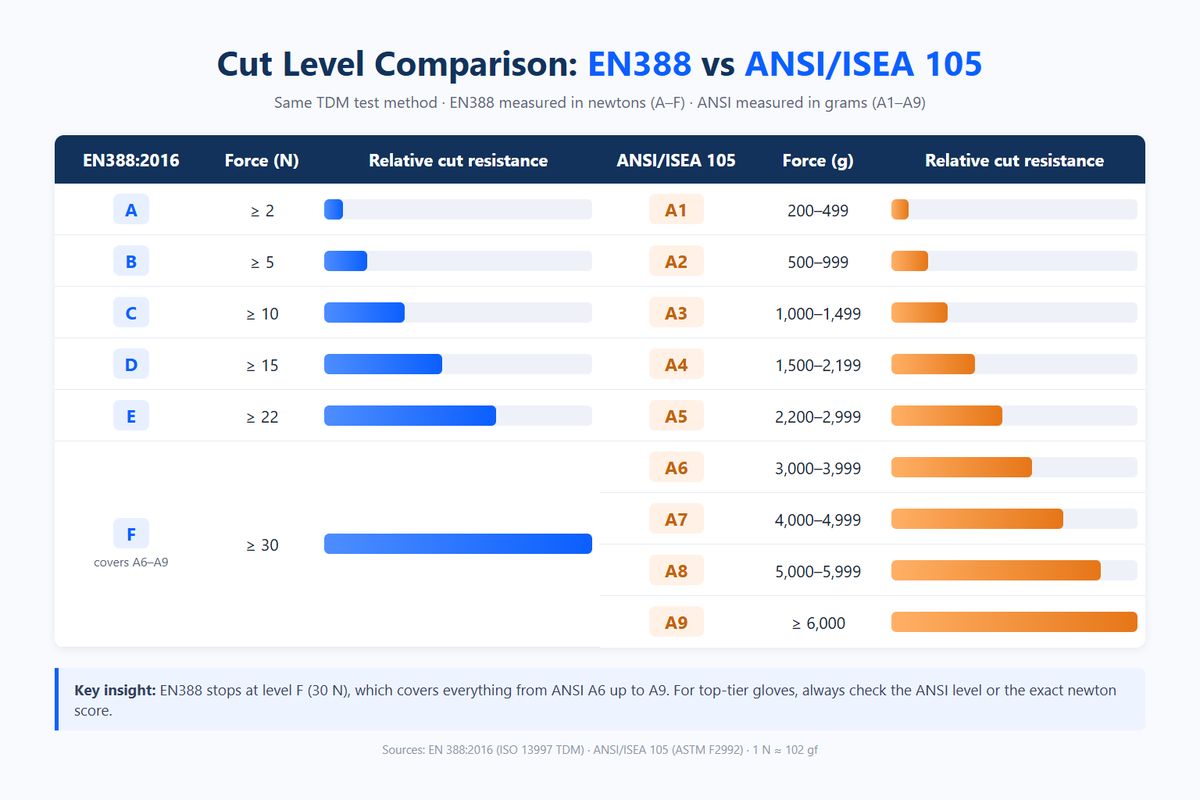
Approximate conversion. Always request the official test report for the exact force value of a specific glove style.
Key Differences Buyers Should Know
1. EN388 tops out at F; ANSI goes to A9. Level F begins at roughly 3,059 g — right where ANSI A6 starts. So an EN388 F-rated glove could be an ANSI A6, A7, A8 or A9 glove. If your North American customer needs top-tier protection, ask the manufacturer for the ANSI rating or the exact gram-force value, because the EN388 letter alone does not distinguish between A6 and A9.
2. The EN388 label carries more information. A full EN388 marking such as 4X43D tells you abrasion (4), cut method (X = Coup test not used, TDM applies), tear (4), puncture (3) and TDM cut level (D). The ANSI label focuses on cut level only, usually printed as a shield with the A-level number.
3. Regulatory context differs. EN388 certification is part of CE marking under the EU PPE Regulation — it is mandatory for gloves sold in Europe. ANSI/ISEA 105 is a voluntary standard in North America, but federal procurement, most safety managers and insurance requirements treat it as the de facto benchmark.
Which Level Should You Specify?
As a rule of thumb used across the industry:
-
A / A1–A2: general handling, warehousing, light assembly
-
B–C / A2–A3: building materials, HVAC, appliance assembly, packaging
-
D / A4: metal stamping, glass handling, sheet metal work — our A5 cut resistant nitrile coated gloves sit in this range and above
-
E–F / A5–A9: metal fabrication, recycling, sharp plastic and blade handling
For a full walkthrough of the ANSI levels themselves, read our companion guide: ANSI Cut Resistance Levels Explained. To browse styles by protection level, see our cut resistant gloves category.
What to Request from Your Glove Supplier
When sourcing globally, a reliable manufacturer should provide:
-
Test reports showing both EN388 and ANSI/ISEA 105 ratings per style
-
The exact TDM force value (N and g), not just the letter or number
-
Consistent ratings across production batches (ask for lot-level QC data)
As a safety gloves factory in China, Raelyn Textile (IAN) supplies cut resistant gloves tested to both standards and supports OEM/ODM customization for global brands. Contact us for samples and test reports.
Frequently Asked Questions
Is EN388 level F the same as ANSI A6?
F starts at about 3,059 g, which is where ANSI A6 begins. But ANSI goes up to A9 (6,000 g+), and all of those are still just "F" under EN388. So F is "A6 or higher", not exactly A6.
Can I put both ratings on one glove label?
Yes — many global brands print both the EN388 pictogram (e.g. 4X43D) and the ANSI cut-level shield on the same back-of-hand label, one per market standard.
Which standard should lead my product listing?
Follow your target market: EN388 for EU customers, ANSI for North America. If you sell worldwide, list both — buyers increasingly search for both sets of terms.