ESD Gloves & Anti-Static Gloves: A Buyer’s Guide for Electronics Manufacturing
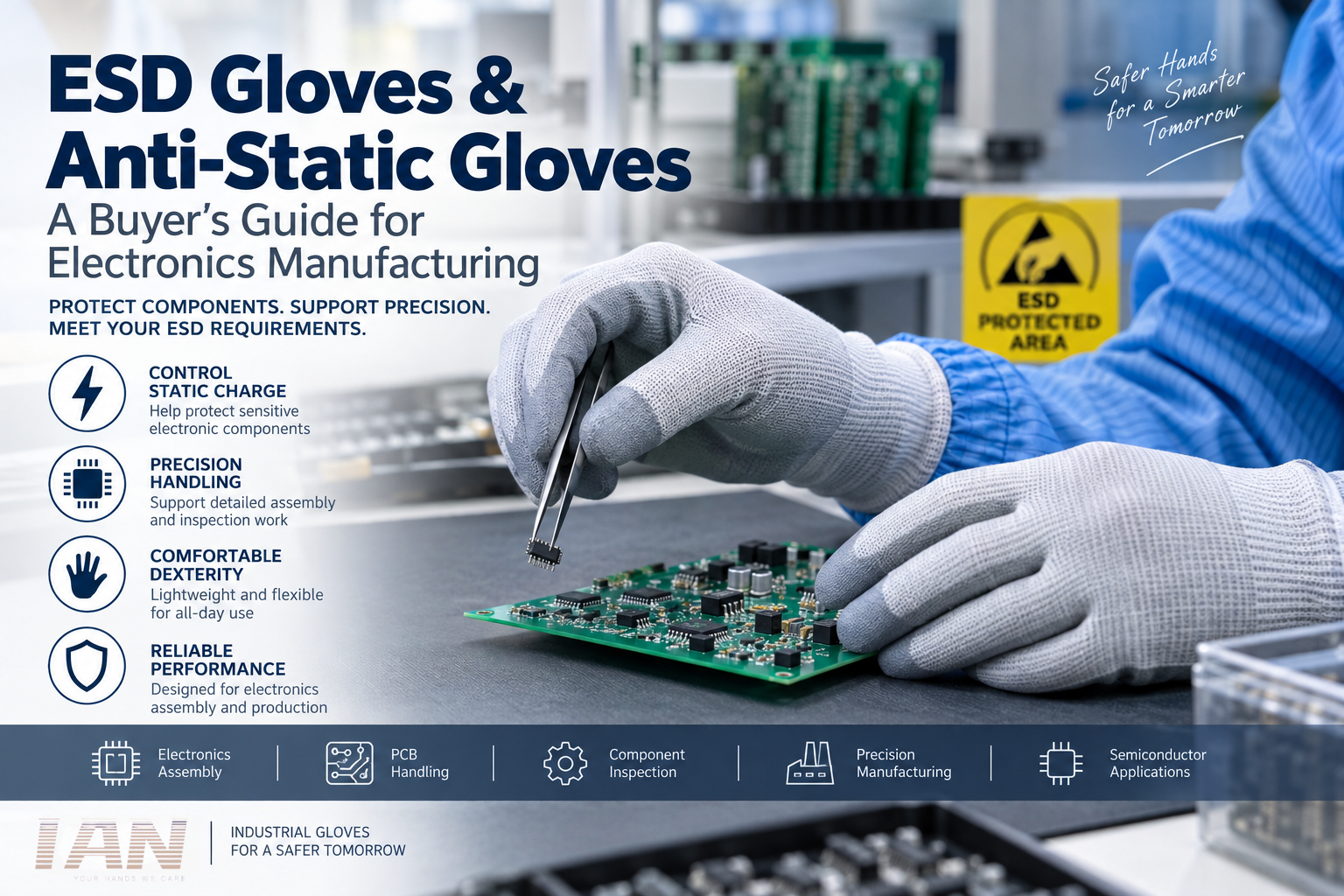
Electronics manufacturing creates a different set of requirements for work gloves than general industrial handling.
In a metal fabrication shop, buyers may focus first on cut protection, abrasion resistance or grip. On an electronics assembly line, however, a glove may also need to support electrostatic discharge (ESD) control while allowing operators to handle small components with accuracy.
That changes the buying decision.
An ESD glove should not be selected simply because it is described as “anti-static.” Buyers need to consider the glove construction, conductive or static-dissipative materials, coating coverage, dexterity, grip and the requirements of the ESD control program in which the glove will be used.
This guide explains the main factors industrial buyers should evaluate when sourcing ESD gloves and anti-static gloves for electronics manufacturing.
What Are ESD Gloves?
ESD gloves are designed for work environments where uncontrolled static charge may present a risk to electrostatic-discharge-sensitive components.
Static electricity can build up on people and materials during ordinary movement and handling. In electronics production, an electrostatic discharge that may not even be noticeable to an operator can potentially affect sensitive components.
For this reason, ESD control is normally approached as a system rather than as a single piece of PPE.
Gloves used when handling ESD-sensitive items therefore need to be compatible with the requirements of the working environment. Depending on the glove design, conductive or static-dissipative materials can be incorporated into the liner, while coatings may be applied to the fingertips or palm to provide the required handling characteristics.
For buyers comparing different constructions, IAN’s range of anti-static gloves provides several examples designed around electronics assembly and precision handling requirements.
ESD Gloves vs. Anti-Static Gloves: Are They the Same?
The terms ESD gloves and anti-static gloves are frequently used together in the industrial glove market, but buyers should not make purchasing decisions based on terminology alone.
“Anti-static” generally describes a product intended to reduce problems associated with static charge. “ESD” is commonly used when products are intended for electrostatic-discharge-control environments.
The more useful questions for a technical buyer are:
What materials are used in the glove? How is conductivity or static dissipation achieved? What parts of the glove are coated? What electrical performance is required for the application? How has that performance been tested?
This becomes especially important when gloves are being sourced for an established ESD control program.
A product name is not a substitute for a technical specification.
Why Glove Construction Matters in Electronics Manufacturing
Two gloves can look almost identical in a product photograph and still behave differently on an assembly line.
The liner influences fit, flexibility and electrostatic properties. Conductive fibers may be incorporated into the knitted construction. The coating changes the contact surface between the operator and the component, while coating coverage affects both grip and finger movement.
For electronics buyers, the important question is therefore not simply:
“Is this an ESD glove?”
A better question is:
“Is this glove construction suitable for the way our operators actually handle components?”
That distinction helps buyers move from a generic product search to application-based selection.
Carbon Fiber and Conductive Materials in ESD Gloves
One approach to ESD glove construction is the incorporation of conductive fibers into the knitted liner.
Carbon fiber is used in some anti-static glove constructions because it can contribute to the electrical characteristics required for static-control applications while maintaining a lightweight knitted structure suitable for detailed handling.
For example, IAN’s 13 Gauge Carbon Fiber Antistatic ESD Gloves combine a carbon-fiber-containing liner with PU-coated fingertips. This type of construction is intended for applications where operators need both controlled handling and access to small components.
However, buyers should avoid assuming that the words carbon fiber automatically define the complete ESD performance of a glove.
Fiber composition is only one part of the specification. When a project requires a particular electrical resistance range or test method, the supplier should be asked to confirm the relevant performance data and supporting documentation.
Why PU Coating Is Common in Precision Handling
PU, or polyurethane, is widely used on gloves intended for precision industrial handling because a relatively thin coating can provide useful grip without creating the bulky feel associated with heavier coating systems.
That matters when an operator is repeatedly picking up components, positioning parts, carrying out inspection or performing assembly work.
In an ESD application, however, coating selection cannot be considered independently from the rest of the glove.
Buyers should evaluate:
-
where the PU is applied;
-
how much of the hand is coated;
-
the liner construction beneath it;
-
the level of grip required;
-
the dexterity needed for the task;
-
and the ESD requirements of the workplace.
IAN’s 13 Gauge Anti-Static PU Coated ESD Gloves illustrate a palm-coated option for buyers who require more coated contact area during handling.
Fingertip Coated or Palm Coated?
Coating coverage can have a noticeable effect on how an ESD glove performs during everyday production.
Fingertip-Coated ESD Gloves
Fingertip coating concentrates the coated surface around the area most frequently used to pick up and manipulate small parts.
This construction can be useful for tasks involving:
PCB handling, electronic component assembly, inspection, sorting and other operations where finger control is important.
A fingertip-coated construction may also leave more of the knitted glove surface uncoated than a palm-coated design.
IAN offers fingertip-coated constructions within its ESD glove range, including its Carbon Fiber Antistatic ESD Gloves.
Palm-Coated ESD Gloves
Palm coating provides a larger coated contact surface.
That can be useful when workers handle components, tools, trays or materials using more of the palm rather than only the fingertips.
For a buyer, neither construction is automatically better.
The decision should be based on how the product is held and manipulated during the actual process.
This is a good example of why samples are valuable. A specification sheet can describe the coating, but an operator trial can show whether that coating coverage works for the production task.
Why 13-Gauge Construction Can Work Well for Detailed Handling
All four products currently represented in IAN’s anti-static glove range use a 13-gauge knitted construction.
Gauge is one factor affecting the feel and structure of a knitted glove. For electronics and precision manufacturing, the objective is generally to provide sufficient hand coverage while maintaining the finger movement required for repetitive handling.
But gauge should not be treated as a standalone performance rating.
Two 13-gauge gloves can differ because of liner yarn, conductive fibers, coating material, coating coverage and overall construction.
For procurement teams, gauge is therefore best used as one comparison point, not as the sole basis for choosing an ESD glove.
Where Are ESD and Anti-Static Gloves Commonly Used?
The need for ESD-compatible hand protection is particularly relevant where workers handle sensitive electronic components or work inside controlled production environments.
Typical applications may include:
Electronics assembly — handling and assembling electronic parts where both finger control and ESD considerations matter.
PCB production and handling — moving, inspecting or assembling printed circuit boards.
Electronic component inspection — repetitive handling where operators need tactile control and a relatively lightweight glove.
Precision manufacturing — operations involving small parts and detailed manual work.
Semiconductor-related operations — selected processes where the glove specification must align with the facility’s ESD control requirements.For application-specific selection, see our guide to ESD gloves for electronics assembly and PCB handling.
The exact glove should still be evaluated against the process. A glove suitable for general electronics assembly should not automatically be described as suitable for every semiconductor or controlled-environment application.
Likewise, an ESD glove should not automatically be considered a cleanroom glove unless the required cleanliness characteristics have been established separately.
Dexterity Is Part of the ESD Glove Specification
A glove can meet an important technical requirement and still be a poor production choice if operators cannot work efficiently while wearing it.
This is particularly relevant in electronics manufacturing.
Workers may need to pick up screws, connectors, circuit boards or small components hundreds of times during a shift. Excessive bulk, poor fit or unsuitable coating coverage can interfere with these movements.
Buyers should therefore evaluate ESD performance alongside:
fit, finger movement, tactile control, grip and operator comfort.
This is one reason lightweight PU-coated constructions are common in precision handling applications.
The best glove is not simply the one with the longest list of specifications. It is the one whose specifications match the actual work.
Grip Requirements Should Reflect the Component
“Good grip” is too broad to be a useful purchasing specification.
An electronics assembler positioning small dry components does not necessarily need the same grip characteristics as an operator moving larger trays or equipment.
Before selecting the coating, buyers should consider:
-
component size;
-
component surface;
-
dry or contaminated handling conditions;
-
fingertip versus palm contact;
-
frequency of handling;
-
and the amount of precision required.
This allows coating coverage to be specified for a reason rather than selected from a catalog without reference to the application.
ESD Gloves Are Only One Part of an ESD Control Program
This distinction is important for industrial buyers.
An ESD glove does not replace the other controls required in an ESD-protected environment.
Depending on the facility and process, an ESD control program can involve personnel grounding, work surfaces, flooring, packaging, equipment, environmental controls, training and other measures.
ANSI/ESD S20.20 provides requirements for establishing an ESD control program for protecting electrical and electronic parts, assemblies and equipment susceptible to electrostatic discharge.
For gloves and finger cots specifically, ANSI/ESD STM15.1 provides methods for measuring electrical resistance.For a closer look at conductive fibers and electrical testing, read our ESD glove resistance and testing guide.
The practical purchasing lesson is straightforward:
Do not evaluate an ESD glove in isolation from the ESD control requirements of the workplace.
Do Buyers Need a Specific Resistance Value?
Not every inquiry arrives with a defined electrical resistance requirement.
A distributor may initially ask for “anti-static PU gloves,” while an electronics manufacturer operating under an established ESD program may provide much more detailed electrical and testing requirements.
These are different purchasing situations.
When a project specifies an electrical resistance range, test method or particular ESD requirement, that information should be communicated to the glove supplier before the product is approved.
Buyers should request relevant test information rather than assuming performance from the product name, liner color or presence of conductive fiber.
This is particularly important for OEM and private-label programs, where packaging and branding should never obscure the underlying technical specification.
What Should Buyers Check Before Ordering ESD Gloves?
A useful RFQ for ESD or anti-static gloves should describe more than quantity and size.
Start with the application.
Tell the supplier what operators are handling, whether fingertip or palm contact dominates the task, what level of dexterity is required and what ESD control requirements apply at the facility.
Then compare the proposed glove construction.
Useful information can include:
Liner material and construction
Confirm whether the liner uses nylon, polyester, carbon fiber or another conductive/static-control construction.
Coating material and coverage
Specify whether PU or another coating is required and whether fingertip or palm coverage better suits the operation.
Gauge and fit
Consider the level of finger movement and tactile control required by workers.
Electrical requirements
Where the ESD program defines electrical performance or a particular test method, provide those requirements to the supplier.
Sizes and packaging
Confirm the required size range, packing method, labeling and carton requirements.
OEM or private-label requirements
For distributors and PPE brands, discuss branding and packaging only after the underlying product specification has been established.
Samples
Test representative samples under the conditions in which the glove will actually be used.
Why Sample Testing Matters
Sample testing is especially useful for ESD gloves because several purchasing requirements interact with one another.
A buyer may find that two constructions both appear suitable on paper, but operators prefer one because of fingertip control. Another application may require more palm contact and therefore favor a different coating configuration.
Sample evaluation can help procurement and production teams assess:
fit, dexterity, component handling, coating coverage, grip and compatibility with the intended working process.
Where specific ESD performance is required, the appropriate technical verification should also form part of the qualification process.
This produces a much stronger purchasing decision than selecting a glove solely from a photograph or generic product description.
Choosing the Right ESD Glove Starts With the Application
There is no single ESD glove construction that is ideal for every electronics manufacturing process.
A precision assembly operation may prioritize fingertip control. Another production line may require greater palm contact. Some buyers may specifically require a carbon-fiber-containing liner, while others begin with a defined electrical performance requirement established by their ESD control program.
The selection process should therefore move in this order:
application → ESD requirement → liner construction → coating and coverage → dexterity and grip → sample verification.
For electronics manufacturers, industrial distributors and PPE buyers evaluating ESD or anti-static gloves, IAN can help compare available constructions according to the intended application, handling requirements and sourcing specifications.
For OEM, private-label or bulk purchasing projects, request a recommendation or sample before finalizing the glove specification.
Related reading: carbon fiber ESD fingertip coated gloves · ESD PU palm coated nylon gloves