Gardening Gloves for Australian Retail Buyers: Spring Timing, AS/NZS 2161 and UV Ageing
Australian garden retail runs on a calendar most glove catalogues never mention. Stock that reaches a Melbourne or Brisbane distribution centre in December has already missed the spring planting peak; stock that lands in August meets the shelf as the nursery trade turns over its range. For importers, wholesalers and private-label retail buyers the practical question is not which glove is best in the abstract, but which glove, tested to which marking, can be on shelf in which month. This guide covers the four things that decide an Australian program: the southern-hemisphere season, the AS/NZS 2161.3:2020 marking, UV ageing (which no glove standard covers), and retail-ready packaging. For product fundamentals, our gardening gloves buyer guide covers materials and coatings.
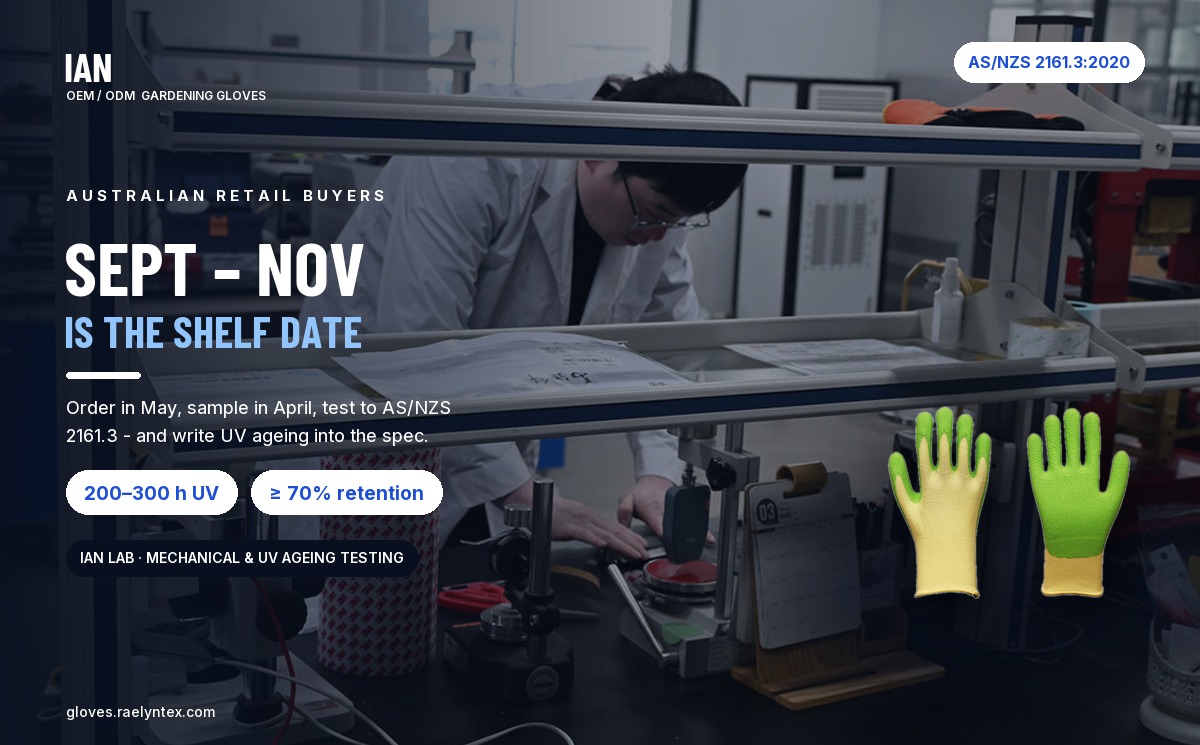
The Australian Season Starts in September, Not in March
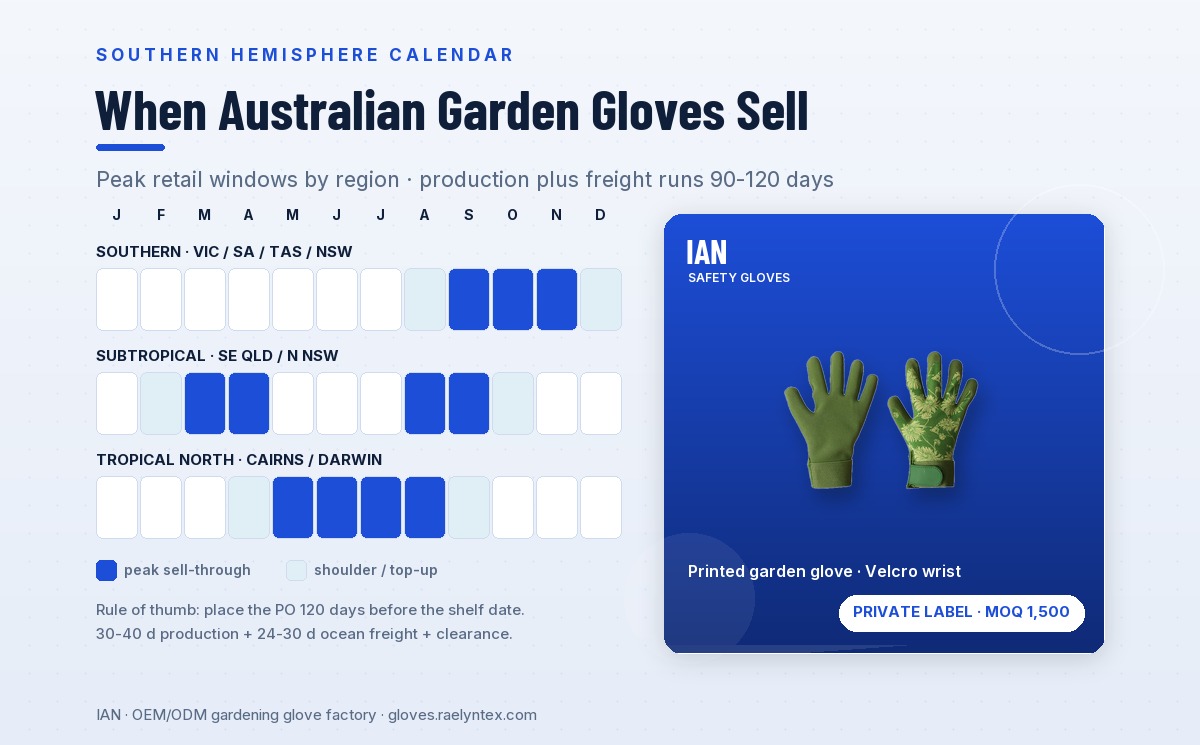
Australia’s gardening year is regional, and treating it as one market is the most common planning error we see. In Victoria, South Australia, Tasmania and inland NSW, soil temperatures lift through August and September; sell-through peaks in October and November, and the gift window (Father’s Day on the first Sunday of September, then Christmas) pulls a second spike through December. Subtropical Queensland and northern NSW have two windows, August–September and February–April. In the tropical north — Cairns, Darwin, northern WA — planting follows the wet season, roughly April to September.
Work backwards from the shelf date and the arithmetic is unforgiving: 30–40 days of production, 22–30 days of ocean freight from Ningbo or Qingdao into Melbourne, Sydney or Brisbane, plus customs clearance and DC booking. A September shelf date means a purchase order in May or June. Buyers who place in August are buying for February, whether they intended to or not. This is why our Australian customers typically split their annual volume into a spring drop and a smaller autumn top-up rather than one large container.
What AS/NZS 2161.3:2020 Actually Puts on the Glove
AS/NZS 2161.3:2020 adopted EN 388:2016 with Amendment 1:2018 in its entirety and took effect in November 2020. The marking is four digits plus a letter: abrasion (1–4), Coupe blade cut (1–5, or X where the blade blunts), tear (1–4), puncture (1–4), then the ISO 13997 / TDM cut letter (A–F, 2 N to 30 N or more). General requirements — sizing, marking, user information — sit in AS/NZS 2161.2.
Two clarifications matter commercially. First, there is no such thing as an “AS/NZS 2161 certificate”: the standard defines test methods and marking, not a certification scheme with an issuing body. “Australian Standard certified” invites trouble under the Australian Consumer Law; the correct wording is “tested to AS/NZS 2161.3:2020, result 4131C”. Second, garden gloves rarely need cut protection. Their enemies are abrasion from soil grit and tear from thorns and wire, so those scores deserve more attention than the cut letter. Pruning saws and brushcutters are the exception, where a cut resistant shell at C or D is the sensible floor.
Puncture is where buyers most often misread the test. The puncture score is generated with a standard steel pin, not a rose thorn; a thorn is a tapered, off-axis point and behaves differently. A high puncture score does not make a glove thorn-proof — dense coating coverage, a reinforced palm and no exposed knit at the fingertips do. Our nitrile coated gardening work gloves and sandy latex gardening gloves are both built to that brief.
UV Ageing: The Test the Standard Does Not Require
Nothing in AS/NZS 2161.2 or 2161.3 requires UV resistance, and AS/NZS 4399 (UPF) applies to garments, not gloves. Yet an Australian garden glove lives in the sun: nursery display rack, wheelbarrow, ute dash. Coated knits fail in a predictable order — the coating embrittles and crazes, colour shifts, then the knit loses tensile and fingertips split. A glove that passes every mechanical test on day one can look tired on shelf in eight weeks.
The practical answer is to write UV into your own specification rather than wait for a standard. A defensible protocol: expose samples to ISO 4892-2 xenon-arc (or ASTM G154 UVA-340) for 200–300 hours, then re-run tensile and tear to the AS/NZS 2161.3 methods and require at least 70–80% retention with a colour shift of ΔE 3–5 or better. Ask for the report and the sample photographs. UV stabilisers and light-fast pigments are what buy the extra months, and darker greens and charcoal hold better than bright yellow or orange. Pigment-printed patterns fade faster than dyed yarn, which is worth knowing before you commit artwork.
Retail-Ready Packaging: What Australian Chains Ask For
Australian retail is unusually specific about the pack, and non-compliance is a chargeback, not a conversation. The recurring requirements:
-
Hang-sell header card with a euro slot or butterfly clip, single pair per card or per polybag, size colour-coded on the header so a shelf can be faced without opening cartons.
-
Barcodes at both levels: EAN-13 on the unit, ITF-14 on the inner and outer carton. Retailer-specific labels are common and normally supplied as artwork by the buyer.
-
Australasian Recycling Label (ARL). Woolworths and Coles increasingly expect the ARL on-pack, assessed through APCO’s PREP tool. Brand owners above AUD 5 million turnover already sit inside the APCO reporting framework, with mandatory EPR fees to follow — a header card printed without an ARL assessment is likely to be reprinted.
-
Carton marks: PO number, style, colour, size ratio, N.W./G.W., dimensions. Distribution centres reject cartons that do not scan or do not match the booking.
-
Pallet configuration: 1165 × 1165 mm (or 1200 × 1000 mm) with ISPM 15 heat-treated timber. Fumigation certificates for the gloves themselves are not required, but the pallet paperwork is checked.
Private Label Programs: Sampling, MOQ and Realistic Timelines
IAN is an OEM/ODM factory, so the work starts from your brand rather than ours. A logo applied to an existing shell — screen print or heat transfer on the back of the hand, printed cuff band — takes 7–10 days for a sample. A new knit, coating colour or full-surface print such as the floral pattern on our printed PU coated gardening gloves needs 15–20 days, because artwork has to be proofed on the dipped surface. Send vector logo files, Pantone references, the header card dieline, size ratio and target FOB; that is enough to quote and sample in one pass.
MOQ is the first question every new buyer asks. For gardening lines we open at roughly 3,000 pairs per style per colour, and can go lower on 1,500 pairs where stock colours and an existing mould are used. Production runs 30–40 days after artwork approval, plus 5 days for dieline and pre-production sign-off. Add both to the freight time before you promise a shelf date to a retailer.
A One-Page Spec Sheet for Your First Australian Order
| Field | What to specify |
|---|---|
| Shell | 13-gauge polyester or cotton knit; 15-gauge for finer dexterity; kids sizes 3–6 where the range includes them |
| Coating | Crinkle latex (wet soil grip, lowest cost), sandy nitrile (puncture and oil), foam nitrile (breathable), PU (precision potting) |
| Cuff | Knit wrist for general garden; Velcro tab where a closer fit is sold as a feature |
| Sizes | 7–10 for adult unisex, with a declared size chart on the header card |
| Marking | AS/NZS 2161.3:2020 performance code, size, manufacturer identification, pictograms |
| Test reports | Mechanical results per lot; UV ageing protocol and retention figures if claimed |
| Packaging | Header card dieline, ARL assessment, EAN-13 / ITF-14, carton ratio and marks |
| Documents | Spec sheet, packing list, BSCI or Sedex audit report — see our factory profile |
Frequently Asked Questions
Do garden gloves sold in Australia need AS/NZS 2161 testing?
If you make a protective performance claim, it must be supportable and the marking must follow AS/NZS 2161.3:2020. Consumer garden gloves sold on comfort alone are not caught by a mandatory standard, but workplace supply is: under model WHS laws the supplier must give adequate information about the glove, and buyers now treat the test report as routine due diligence.
What cut level do Australian garden gloves actually need?
Most do not need a cut rating at all — abrasion and tear are the working scores. Pruning saws, brushcutters and heavy landscaping push into C or D, which our EN 388 cut D and E range covers with factory-side test data.
Which coating should I start with for an Australian retail range?
Crinkle latex remains the volume seller for wet-soil work at the lowest cost per pair — our 3/4 latex coated gardening gloves are the usual opening SKU — with sandy nitrile as the step-up for pruning and puncture resistance. A PU option completes the range for potting and fine handling, and a kids latex coated gardening glove is worth stocking where family gardening is merchandised. Compare the three families in our latex coated, nitrile coated and PU coated ranges.
Plan the Season Before You Plan the Glove
The Australian program that works is sequenced backwards from the shelf: September planting peak, October–December gift window, February–April subtropical and northern top-up. Get the timing, the AS/NZS 2161.3 marking, the UV specification and the header card right, and the glove is the easy part. IAN supplies these lines as OEM/ODM with your brand, packaging and test documentation — send us your target shelf date and we will work back to a sampling and production window. Start at contact us, or browse the full gardening gloves range.