Latex Coated Gloves for US Buyers: Gauge, Coating Weight and Cost per Pair
Ask three US distributors what separates a good rubber coated glove program from a bad one, and you will usually hear the same three words: gauge, coating weight, cost. They are the three specs that decide what lands in the container, how long the glove survives on the jobsite, and what your margin looks like after freight. This guide walks through each of them from a wholesale buyer’s point of view — what the gauge number actually tells you, what extra grams of latex buy you, and how to do the cost-per-pair math that keeps a private-label program profitable.
If you are new to the category, our latex coated gloves line covers the full range referenced below, and the deeper material science lives in the complete latex coated gloves buyer’s guide. Here we stay on the commercial side: the numbers you put on your spec sheet and the math your customers will never see but will always feel.
Fix the Gauge First — Everything Else Follows
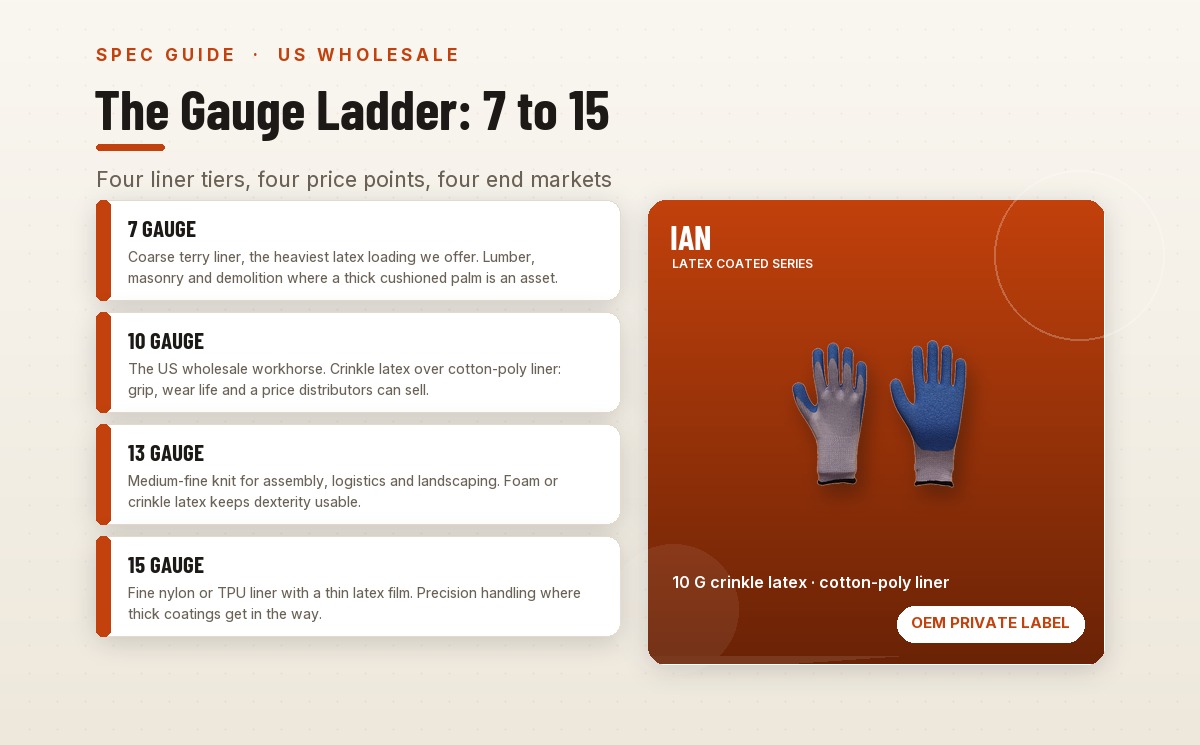
Gauge is the number of needles used to knit the liner, and it is the single spec with the biggest downstream effect on price, dexterity and coating weight. The same latex compound behaves completely differently over a 7 gauge terry liner than over a 15 gauge nylon one, so locking gauge before anything else keeps the whole program consistent. In practice the market sorts into four tiers:
-
7 gauge — coarse terry or loop-pile liners that soak up the heaviest latex loading. Built for lumber, masonry and demolition where a thick cushioned palm is an asset, not a bulk problem.
-
10 gauge — the US wholesale workhorse. Crinkle latex over a cotton-polyester liner hits the balance most general-construction and material-handling customers ask for; our 10 gauge heavy duty latex crinkle work gloves are the reference build.
-
13 gauge — a medium-fine knit for assembly, logistics and landscaping. Dexterity stays usable while the palm still carries real coating; see the 13 gauge latex crinkle coated work gloves for the lighter crinkle build.
-
15 gauge — fine nylon or TPU liners with a thin film of coating, for precision work where a heavy palm gets in the way of small parts.
For distributors, gauge is also a segmentation tool rather than just a spec. A palette that spans 7, 10 and 13 gauge lets one private-label program serve a construction supply house and an MRO counter at the same time, instead of forcing both buyers into the same glove. When a customer asks for "the same glove but lighter," the honest answer is almost always a gauge change, not a coating change.
Coating Weight: What the Extra Grams Actually Buy
Latex coating weight is where cost and performance meet. Every additional gram of latex on the palm is raw material cost, but it also means a thicker, longer-wearing working surface. On a crinkle finish the relationship is slightly counterintuitive: the wrinkle texture adds grip without adding much weight, because it is formed by the way the film cures rather than by piling on compound. That is why crinkle latex keeps showing up in value-tier programs — texture does the work that thickness would otherwise have to do.
Coating coverage is the second variable. Palm-only builds keep weight and cost down; 3/4 and full coverage add compound but turn the glove into a wet-work tool. For buyers serving agriculture, fishing or outdoor trades, a fully coated build such as our waterproof latex coated work gloves sits in its own price and performance class — it should be quoted, sold and warehoused separately from palm-coated models, never blended into the same SKU line.
There is also a fatigue argument for weight discipline. A coating that is heavier than the task requires does not just cost more — it tires the wearer’s hand faster, which shows up as gloves taken off mid-shift. In our own wear trials, distributors who down-spec from an over-built palm to a correctly gauged one consistently report fewer abandoned gloves, even when the per-pair price is similar. The thickened latex coated gloves for construction and heavy duty work exist precisely for the jobs that do justify maximum compound — everything else should be matched, not maxed.
The Cost-per-Pair Math That Matters at Wholesale
Rubber coated work gloves wholesale pricing lives or dies on unit economics inside the case, not on the headline price list. Three numbers do most of the work:
-
Price per pair against wear life. A glove that lasts twice as long at 1.5 times the price is the cheaper product on the jobsite. Frame every quote in cost per working day, not cost per pair — it reframes the conversation away from the lowest bid and toward your better-margin builds.
-
Case and pallet density. Latex coated gloves pack tightly — a dozen-pair polybag inside a master carton is the trade norm — so freight is rarely the deciding cost unless coverage and coating weight push bulk builds like full-dip models into a different carton class.
-
Duty and tariff exposure. Glove classification and tariff treatment are topic-specific enough that they deserve their own review with your customs broker, but build the landed-cost model before you fix retail pricing, not after.
One practical rule from our OEM desk: when a distributor asks us to hit a target price, we adjust the liner first (cotton-poly blends versus all-polyester), the coating weight second, and the finish last. Cutting crinkle texture to save cents is the one lever we push back on, because texture is what the end user actually feels — and the end user is who reorders.
Reading ANSI/ISEA 105-2024 on the Spec Sheet
US buyers increasingly ask for performance ratings rather than marketing adjectives, and the current reference is ANSI/ISEA 105-2024. The 2024 revision kept the test methods and levels unchanged and instead standardized labeling into a single pentagon badge: the cut rating at the top center, abrasion on the left, puncture on the right. On the abrasion scale, levels 1 through 3 correspond to roughly 100, 500 and 1,000 Taber cycles under a 500 g load, while levels 4, 5 and 6 require 3,000, 10,000 and 20,000 cycles under 1,000 g. For a heavy-duty crinkle latex build, the abrasion column is usually the rating that earns the glove its place on a construction site.
Two compliance notes worth passing to your customers. First, OSHA’s hand protection rule at 29 CFR 1910.138 requires employers to select gloves based on the hazards present, so a spec sheet with real ratings is a sales document, not fine print. Second, the standard’s own referencing rules matter: it is "ANSI/ISEA 105," never "ANSI approved" — ANSI does not certify products, and the ISEA mark belongs in the citation. Distributors who quote ratings correctly look better in front of safety managers than ones who guess.
Matching the Spec to the End Market
Putting the three variables together, four US segments map cleanly onto four builds. Construction and building-materials distributors take the 10 gauge crinkle workhorse in volume. Wet and outdoor trades — agriculture, fishing, winter work — move to full-coverage builds, and cold-store programs should be checked against our guidance on gloves that stay flexible below zero before you commit. Assembly, logistics and landscaping buyers sit on 13 gauge, where a foam palm such as the bamboo fiber foam latex work gloves trades a little abrasion life for all-day comfort. And retail programs — hardware chains, farm stores, garden centers — buy on shelf presentation as much as spec; the coatings logic transfers directly from our foam latex palm coated gloves and double dip sandy latex gloves ranges.
Where latex reaches its limits — petroleum oils, solvents, fine-part precision — the program should cross into a different chemistry rather than an thinner latex. The comparison in nitrile versus latex versus PU coated gloves is the cleanest hand-off we publish, and our nitrile coated gloves line carries the oil-side builds.
What an OEM Factory Can Actually Customise
As an OEM/ODM factory, IAN treats gauge, coating weight and finish as adjustable inputs, not fixed catalog rows. Private-label programs typically start from a reference build like the 10 gauge crinkle workhorse, then adjust liner color, knit gauge, coating weight, cuff length, size run and packaging — printed polybags, header cards, display-ready cartons — under your own label. Sampling runs from existing dipping compounds, so lead time on first articles is measured in weeks, and low-MOQ trial orders let you test a market before committing container volume. Sizing charts for the program should follow the fit conventions in our work glove size guide so that retail and industrial SKUs share a common size story.
If you are building a latex program for the US market and want the spec sheet, the case math and the samples in one conversation, send us the target segments and price band through the contact page — our export team replies with a costed OEM proposal and a sampling plan, not a catalog.